




By PIERRE-RICHARD LUXAMA and DÁNICA COTO
PETIT GOÂVE, Haiti (AP) — Amizia Renotte sat on a broken piece of concrete and pointed to a large pile of dirt where her house once stood before the outer bands of Hurricane Melissa crumpled it as the storm lashed Haiti’s southern region.
The Atlantic hurricane season may be over, but thousands of people like Renotte in this Carribean country and beyond are still looking for food and struggling to rebuild their lives nearly two months after the Category 5 storm pummeled the northern Caribbean region as one of the strongest Atlantic storms in recorded history.
“We ran. We had nothing to save,” Renotte said as she recalled waking up in the middle of the night surrounded by floodwaters.
Melissa killed at least 43 people across Haiti, many of them in Petit-Goâve, where residents are still digging out from under the storm that unleased deadly flooding.
Huge piles of dirt and mud now smother this southern coastal town, which once bustled with farmers and street vendors.
The groan of heavy machinery fills the air as crews slowly clear debris scattered by La Digue River, which swept away children, cars and homes in late October.
“People lost everything,” resident Clermont Wood Mandy said. “They lost their homes. They lost their children.”
Hunger persists
Petit-Goâve held a mass funeral in mid-November to say its goodbyes to loved ones, but hunger and frustration remain.
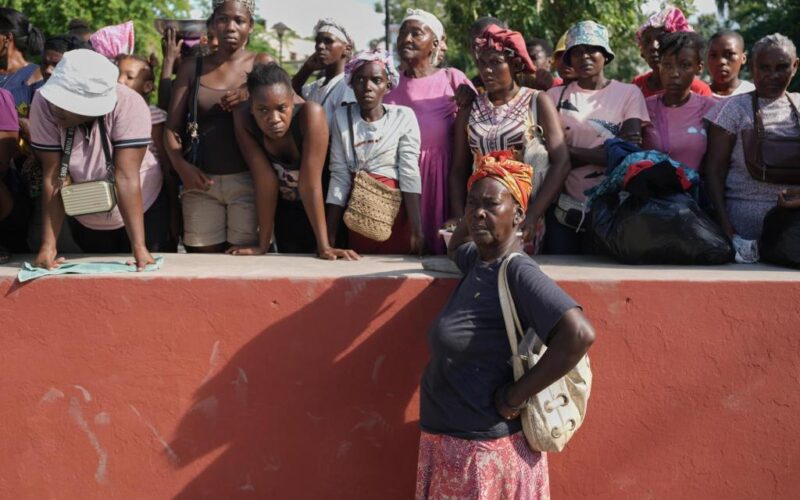
On a recent morning, people crowded around a small convenience store stocked with pasta, butter, rice and other basic items produced locally after receiving cash donations.
In line to buy something was 37-year-old Joceline Antoine, who lost five relatives in the storm.
“My house is destroyed,” she said.
Lola Castro, a regional director with the U.N.’s World Food Program, or WFP, who recently traveled to Petit-Goâve, said in a phone interview Friday that Melissa has deepened Haiti’s crises.
“Around 5.3 million people don’t have enough to eat every day in Haiti,” she said. “That’s a huge challenge.”
Castro noted that Petit-Goâve was an agricultural community that depended heavily on crops, including plantain, corn and beans.
“They have lost their income. They have lost their means of living,” she said.
‘No community will be forgotten’
Jamaica also is struggling to recover from Hurricane Melissa, which made landfall in the western part of the neighboring island in late October, causing an estimated $8.8 billion in damage.
The storm killed at least 45 people, and 13 others remain missing, with an additional 32 deaths under investigation, according to Alvin Gayle, director-general of Jamaica’s emergency management office.
Authorities have reported 30 confirmed cases of leptospirosis — an infection transmitted from animals — and another 84 unconfirmed ones, with 12 related deaths. There were also two cases of tetanus, one of them fatal.
“These figures underscore the scale of the human impact and the seriousness with which the ministries, departments and agencies of government continue to approach the recovery effort,” Gayle said.
More than 100 shelters remain open in seven of Jamaica’s parishes, housing more than 1,000 people.
Meanwhile, some 160 schools remain closed.
“No community will be forgotten,” Gayle said.
Jamaica recently announced that it obtained a $150 million loan to help restore electricity as quickly as possible, with officials saying they expect power to fully be restored by the end of January.
Jamaica also has obtained a $6.7 billion package for reconstruction efforts over three years from the Development Bank of Latin America and the Caribbean; the Caribbean Development Bank; the Inter-American Development Bank Group; the International Monetary Fund; and the World Bank Group.
Call for funding
In Cuba, hundreds of people remain in makeshift shelters nearly two months after the hurricane made landfall in the eastern region of the island hours after it hit Jamaica.
No storm-related deaths were reported in Cuba, where authorities evacuated more than 700,000 people from coastal areas.
Nearly a month after the storm, the U.N. said that about 53,000 people in Cuba had been unable to return to their homes, including 7,500 living in official shelters.
Castro, of the WFP, said that Hurricane Melissa affected 6 million people overall in the Caribbean, including 1.2 million in Haiti.
Around 1.3 million people in the region now need food, security or other type of support, with WFP so far helping 725,000 of them, Castro said.
She said she hopes that number will grow, noting that the agency’s $83 million appeal is only 50% funded.
Dánica Coto reported from San Juan, Puerto Rico.