




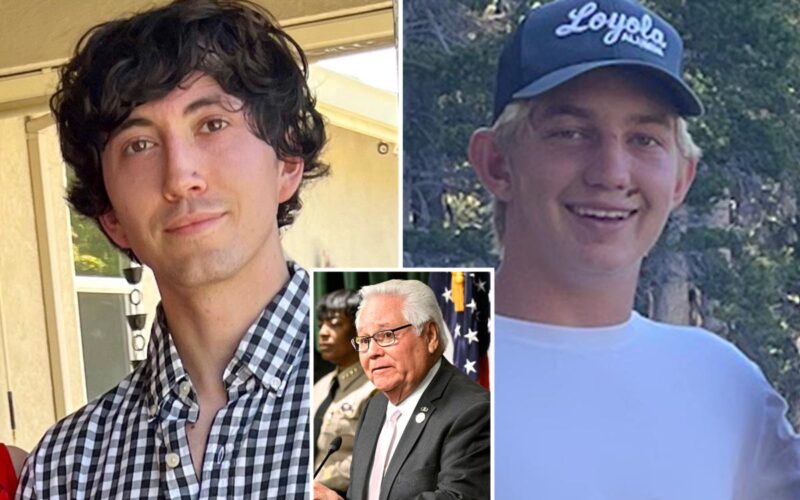
As California’s deadly drunk driving problem has exploded in recent years, with the state being home to six of the country’s 10 worst cities for DUIs, the Los Angeles police union is now placing the blame squarely at the feet of socialist politicians for slashing resources and soft on crime policies.
After three LAPD officers were hospitalized during a suspected DUI pursuit in the San Fernando Valley Saturday night, the police union released a fiery statement to The California Post, condemning lefty lawmakers.
“Driving while intoxicated is not a victimless crime and when Los Angeles politicians such as Councilmember Nithya Raman and Eunisses Hernandez repeatedly vote to cut police officers, stop enforcing DUI laws and end most other traffic enforcement, in the name of criminal justice reform, it only makes our streets less safe for every Angeleno,” the Board of Directors for the Los Angeles Police Protective League said in a statement.
And while the officers were lucky to be released from the hospital without any major injuries, some families aren’t so fortunate.
Jennifer Levi knows the pain of losing a love one all too well. Her 18-year-old son was killed by a suspected repeat drunk driver, and thanks to laws regarding non-violent crimes and good behavior, offenders can serve little jail time and find themselves quickly back behind the wheel — something she is afraid will happen in her case.
“The safety of our roads is deteriorating to a point where everyday it feels like there’s a death from a drunk driver,” said Levi, who lost her son Braun back in May after he was struck and killed while walking home by Jenia Resha Belt, 33, who faces one count of murder.
The California Post has reached out to Raman and Hernandez’s offices for comment but did not hear back.
Now, Levi is one of several victims stepping up to push lawmakers to crack down on California’s lax drunk driving laws, including Democrat State Senator Bob Archuleta, whose eldest granddaughter died from a head-on crash with a drunk driver in 2024.
“You’re intoxicated and you cause great bodily injury to someone, that is considered a violent crime, but the killing of that person would not be a violent crime under current law,” a spokesperson for Archuleta said.
But it’s not just drunk drivers who are are getting let off the hook, Allison Layman is fighting to revoke another soft law that went into effect in 2021. That law, Assembly Bill 3234, expanded the misdemeanor diversion program to include vehicular manslaughter after her 23-year-old son was killed by a drunk driver.
“What’s happened in the last five years, is judges are, I mean, almost handing it out like candy,” Lyman said of the program that allows offenders to receive less punishment than a speeding ticket in some cases.
Drunk driving continues to be a major problem across the state — with a DUI rate of 3.68 per 1,000 drivers, San Jose is second on the list for worst cities in America, followed by Sacramento, according to recent data from LendingTree. Fresno came in at fifth on the list with a DUI rate of 3.31, followed by Long Beach at seven, then Bakersfield, and Oakland.
Levi’s son, Braun, was one of those tragedies that happens too often in California.
“He was gonna go play tennis at the University of Virginia. He loved life, he was a great kid, he worked hard,” Levi said. “It’s completely devastating to us, and I couldn’t believe it happened to us and it’s just so sad that that our state is like this.”
Braun was a nationally recognized tennis player, who was killed just a week before his high school graduation.
Just over 1,300 people were killed in an alcohol-involved crash in 2023, representing a more than 50% increase over the past decade, according to the California Office of Traffic Safety. Thousands more were injured, and more often than not, it’s a result from repeat offenders, according to a report from CalMatters.
“What shocks me the most is how little time they serve in jail for killing somebody,” Levi told The California Post. “Right now, you are drunk and you injure someone, you will most likely spend more time in jail than if you kill somebody, because it’s called an accident. Braun’s death certificate says accident. That was not an accident.”
While Levi’s case is still ongoing, there are even more recent examples of vehicular manslaughter that resulted in early release. Over the weekend, a California woman who killed a 21-year-old cyclist in her fourth distracted-driving crash was set to be released early on Valentine’s Day for good behavior. She began serving a nine-year prison term in 2023.
“Because the way credits work, for good behavior and doing certain things while you’re incarcerated, non-violent felonies you can get up to 50% of your time taken off, while a violent felony you can only have 15% taken off,” a spokesperson for Archuleta told The Post.
Archuleta introduced Senate Bill 907, which aims to strengthen California’s DUI enforcement and sentencing laws.
The bill would target repeat offenders and add gross vehicular manslaughter and vehicular manslaughter while intoxicated to the violent felony list, ensuring those who killed someone while drunk driving serve more time than someone who injures a person.
Another key provision of the bill is “Braun’s Law,” which mandates Watson Warnings in cases where the perpetrator pleas down from a DUI to a hit and run — following the warning, if a person kills someone while drinking and driving they face second degree murder charges.
“The Watson Warning is not read consistently throughout California,” Levi said. “The woman who killed our son, she had a previous DUI but made a misdemeanor plea deal for a hit and run and was never read the Watson Warning.”
While the bill, which has bipartisan support, would be a major enhancement on the state’s drunk driving laws, it doesn’t address 2020’s Assembly Bill 3234, which expanded misdemeanor diversion programs to vehicular manslaughter — something Lyman has urged lawmakers to reform after her son Connor Lopez was killed by a distracted driver.
Lyman, who lost her son last summer, said because of this diversion program, speeding tickets can come with more penalties than vehicular manslaughter.
“We think it’s to empty the jails, that’s been kind of the consensus as we’ve spoken about it — is there was a big soft on crime push, and they didn’t want to pay to put people in jail,” Lyman told The Post.
An investigation by CalMatters found that because of the misdemeanor diversion program, some people charged with vehicular manslaughter were able to keep the case off their driving record.
Lopez, a pianist, was killed in April in Elk Grove when a driver turned into oncoming traffic and hit him while riding his motorcycle.
“He died on the road, that driver never got out of her car,” Lyman said. “She sat there as others ran to cover his body.”
The driver, Harjit Kaur, was charged with misdemeanor vehicular manslaughter. Connor’s family was told to brace themselves for the likely chance a misdemeanor diversion is granted.
“We’re just anticipating at one of the hearings that will be part of her defense,” Lyman said. “It’s like the moment you find out about it, you start living that nightmare. It hasn’t even happened yet and you know, we’ve been told brace for it.”
Lyman is now trying to raise as much awareness as possible to revoke the eligibility of diversion programs for vehicular manslaughter convictions, even starting a petition that has garnered nearly 13,000 signatures to push lawmakers to act.
California has a history of deadly roads, and a criminal justice system that Lyman said “it’s like the compassion goes toward the criminal and not the victim.”
And while no sentence or justice will ever bring their children back, Lyman and Levi are making it their mission to make the state’s roads safer for future generations.
“The woman who killed our son had a suspended license,” Levi said. “Our family will be disappointed and nothing will ever bring our son back and no sentencing or charge will ever feel like enough, but I feel so strongly about changing California for the future.”