




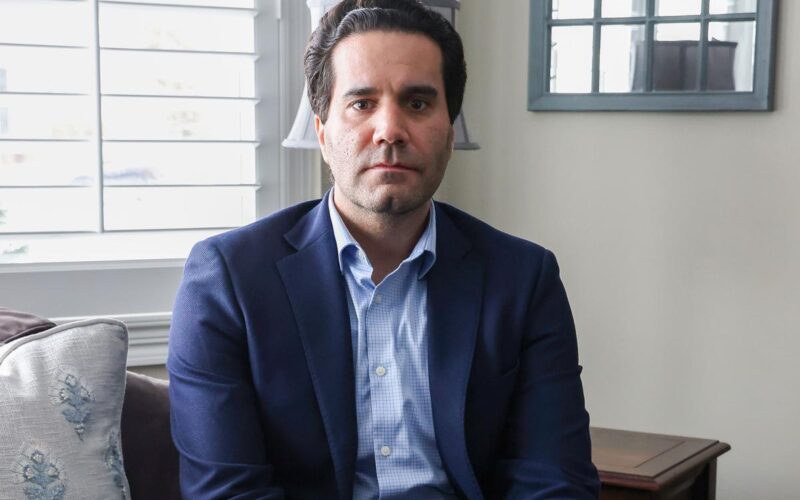
A desperate Long Island dad is begging US lawmakers to restore long-stalled federal money to continue funding the only lab he says is capable of treating his 5-year-old son’s extremely rare genetic disorder.
Andrew Jedlicka, a New York University business professor and father of three from Merrick, has been taking his youngest child to the center in Long Island City, Queens, for the past five months to receive a new experimental treatment he said could fully cure his son.
The boy, whose dad asked that his name be withheld, was diagnosed last year with KBG syndrome, a rarely seen genetic disorder linked to developmental delays, speech issues and seizures.
There are only about 800 known cases worldwide.
After his son’s diagnosis, Jedlicka said he was lucky enough to discover that the only laboratory in the world with the ability to potentially cure his son was right in his backyard.
“I thought the hardest part of this journey would be to find a cure and a treatment for my son,” Jedlicka told The Post.
But without renewed federal funding from the Small Business Innovation Research program, which lapsed in October 2025 after Congress failed to reauthorize it, the lab will have to shut its doors March 1, he said.
The total cost of Jedlicka’s son’s treatment at the center is more than $1.2 million. And the lab would roughly need about a million more dollars on top of that just to stay afloat.
Without the program being renewed from the government, Jedlicka’s family would be responsible for the entire price of treatment while the lab would need to turn to private funding to keep its doors open.
“If the lab closes, everything stops, and we don’t get the cure,” said Jedlicka, who has already spent hundreds of thousands of dollars of his own money on the treatment.
“It says a lot about healthcare in the United States,” Jedlicka told The Post.
The hold-up lies mainly with GOP Sen. Joni Ernst of Iowa, who helms the Senate Small Business and Entrepreneurship Committee and is pushing for sweeping reforms before she is willing to sign off on the funding.
These reforms include lifetime caps for recipients of grants from the fund and stricter safeguards to prevent companies with Chinese ties from accessing the money.
“Too many large companies — not truly small businesses — drain millions of taxpayer dollars by churning out white papers [research submitted by marketers] instead of turning the taxpayer’s investments into reality,” Ernst previously told the Senate.
Jedlicka said he understands the senator’s push for reform but believes families like his are being looked over.
He said he will be personally traveling to Washington in the coming weeks to lobby for the funding.
“I don’t disagree with her concerns,” he said of Ernst. “But here we are almost five months later, and the grant hasn’t been reauthorized.”
New York Rep. Laura Gillen, who represents the Merrick neighborhood where Jedlicka’s family resides, fired off a letter to Ernst urging her and Senate leadership to strike a deal before families such as Jedlicka’s are left without options.
“Without a reauthorization or passing the clean one-year extension, this lab will be forced to close and my constituent will no longer be able to receive the specialized care they need,” Gillen wrote.
Ernst’s camp did not immediately respond to a Post request for comment.