




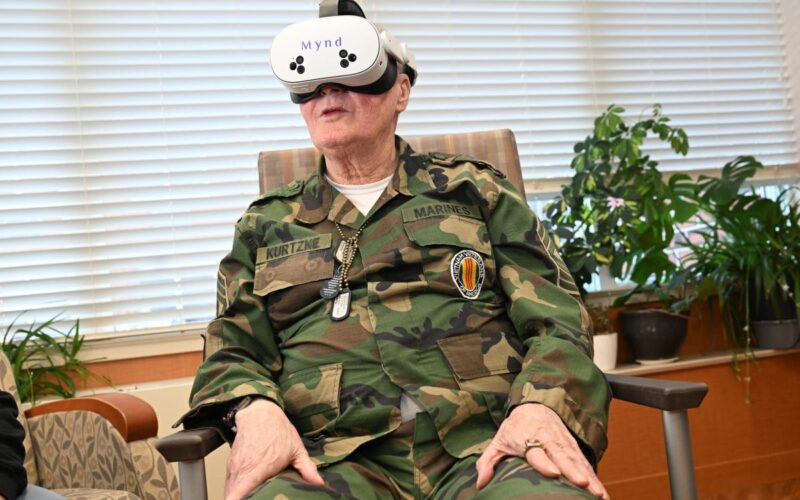
A Long Island veterans home is using state-of-the-art virtual reality to help its residents fight PTSD with amazing simulated tours of outer space, animal sanctuaries and the northern lights.
Residents at the Long Island State Veterans Home at Stony Brook University can have virtual experiences diving with sharks, catching butterflies, shooting archery arrows, racing NASCAR vehicles and watching Broadway shows or an Ole Miss college football game, too.
The veterans also can touchingly even “return” to countries where they fought, such as Vietnam, to see the land now.
“You feel like you’re right there,” 80-year-old Marine veteran Chuck Kurtzke marveled to The Post while exploring the Great Barrier Reef’s depths with one of the latest high-tech headsets.
The Suffolk County facility partnered with tech company Mynd Immersive to bring the groundbreaking visuals and audio headset-based program to its residents.
“We can take these experiences and put you in your happy place,” said the home’s deputy executive director, Jonathan Spier.
Those veterans suffering from PTSD or a related issue have used the headsets to enter calming environments such as watching the northern lights, he said.
“It helps eliminate a lot of pain,” Spier said of the project, which has been rapidly improving over the past few years as the technology only gets better.
Some more senior residents at the home are keeping mobile by using the technology to experience butterfly-catching in a scenic field or shooting arrows at a target by using a handheld device.
“Range of motion in a nursing home is important. If you don’t use it, you lose it,” Spier said.
The software, which pairs with Meta VR headsets, also takes members around the world with guides through cities and other events.
Spier said a resident who fought in Vietnam wanted to see what that country looks like now.
Joseph Marino, 84, said he is curious about virtually returning to Europe.
“I would like to go back to Luxembourg because I’ve been there before. It was nice,” Marino said.
Mynd also offers adventurous programming, such as skydiving, race-car driving, a tour of the International Space Station, horseback riding, animal interactions and an intimate volcano sweep.
Such experiences are especially popular among those who served in Vietnam, whereas the World War II crowd prefers milder scenes, according to Spier.
Kurtzke said his favorite place to be is on the buzzing flight deck of an aircraft carrier, which gladly takes him back to his two decades of service.
“I wasn’t allowed on the aircraft carrier deck, but I did everything else on the inside,” recalled the man who once told President Eisenhower that the Boston Red Sox would never win the World Series again.
“The headset really brought back memories,” he said.
Spier said the devices also pair with one another for guided tours among residents to promote “brain stimulation.”
“They did tours of Europe, walking tours of Washington, DC You can see different museums, Italy, and Paris … the sky is the limit,” he said.
Mynd’s CEO, Chris Brickler, designed the program, which he said was motivated by the condition of his grandfather, who had dementia. The CEO said he saw breakthroughs with the devices in patients similar to his granddad.
Brickler’s father, a Navy veteran, also endured PTSD.
“We’ve never seen a technology that you can put this on and unlock memories to the extent that you can,” the CEO said.
“I’m like, ‘Wow, this is something so cool that could change a lot of lives for older veterans,’ especially for the Vietnam generation,” he said.
“There’s so many locked up emotions, there’s so many locked up feelings about that war.”
The Long Island facility veterans has demonstrated such strong proof of concept over the years that Mynd’s programming has been rolled out in 75 veterans’ homes and counting across the United States.
“Medications don’t always work,” Spier said.
The virtual program is “creating that better interaction and that experience.
“It’s such a great tool for us.”