



Mayor John Lindsay famously faced a massive citywide strike of bus and subway workers as his first challenge in office. The Transport Workers Union Local 100 contract expired at the stroke of midnight on Jan. 1, 1966, just as Lindsay was sworn in. The strike was finally settled 11 days later, with union leaders jailed at Lindsay’s insistence for leading an “illegal” work stoppage.
Legendary TWU president Mike Quill suffered an ultimately fatal heart attack in prison, after wishing the judge who did Lindsay’s bidding “drop dead in his black robes.”
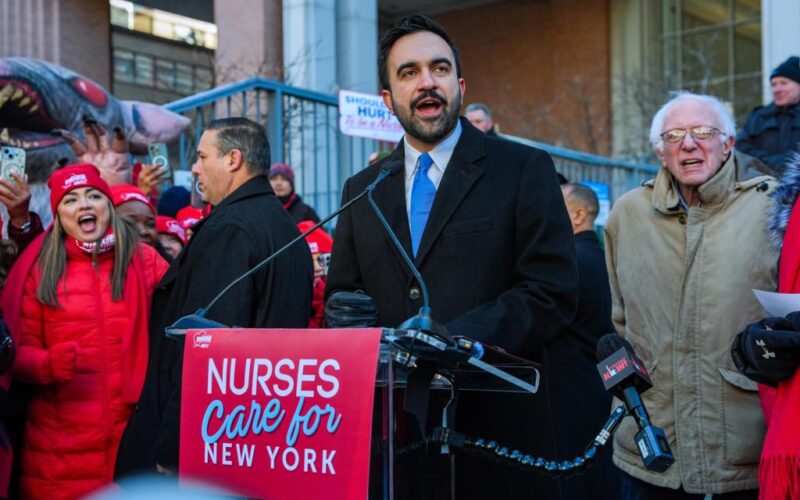
This is what some in the press have suggested towards Mayor Mamdani, who has joined with the 15,000 nurses striking against three big hospitals.
Ironically, when Lindsay joined the 1966 transit strike — very much on the opposite side of the workers — he did so because he cared too much about the opinions of a newspaper columnist. Outgoing Mayor Robert Wagner Jr. was more than capable of settling the TWU contract amicably and on time.
Deep in the archives at New York University is a collection of oral history interviews with union presidents, local politicians (including Wagner) and even legendary mediator Theodore Kheel. They tell that A.H. Raskin, a former labor reporter who was by then on the New York Times editorial board, was in Lindsay’s ear all fall and winter encouraging the mayor-elect to take a hard line with the transit union and seek concessions.
Lindsay’s meddling finally caused Wagner to wash his hands of the matter, which is why Lindsay inherited a massive labor strike within seconds of becoming mayor (an event that signaled how crisis-plagued Lindsay’s tenure would be).
Lindsay didn’t get the concessions he sought by daring the union out on strike. The bus and subway workers held strong. For an encore, Lindsay lobbied the state Legislature for a new law, the Taylor Law, which would more effectively ban public sector strikes by financially punishing the rank-and-file members instead of merely making heroic martyrs of their leaders.
I suppose because Lindsay didn’t simply fire all of the transit workers the way that President Ronald Reagan fired striking air traffic controllers in 1981, maybe the “Fun City” mayor gets a pass on labor relations among those who would pose as friends of labor.
Decades of Reagan, Bush and Trump-style active hostility to unions has lowered the bar for how little a politician can deliver in terms of respecting union efforts to win better pay and protections on the job, as well as efforts to extend the protections of a union contract to more workplaces, and still claim to be pro-union.
Let’s be clear: for most of the city’s history, a mayor getting “both parties in a room” and pressing for a settlement has usually meant weighing in on the bosses’ behalf.
A better model for Mamdani, in whose shoes he seems to be marching, is Fiorello LaGuardia. Like Mamdani, LaGuardia was mayor in a time of deep economic inequality, when union density (even in New York) was quite low, and workers had few rights that federal courts were bound to respect.
Faced with a citywide strike for union recognition by hotel workers as his first test as mayor, LaGuardia sicced city health inspectors on properties whose bosses wouldn’t come to the table. Eventually, LaGuardia got the Hotel Association to sign a neutrality card check agreement with the Hotel Trades Council. The Little Flower also successfully fought for a state law to protect the union rights of workers that federal law left behind, and he vociferously jawboned for a “100% union city.”
Back in April, I wrote in these pages that the then-candidates for mayor should compete for who would best return LaGuardia’s crusading pro-worker agenda to City Hall. Zohran Mamdani was crystal clear in his campaign messaging that, as mayor, he would govern with a bias in favor of the city’s working class, and voters rewarded him with an electoral mandate. I, for one, laud Mayor Mamdani for walking the talk and joining that nurses’ picket line.
Richman teaches labor history at SUNY Empire State University. His new book is “We Always Had a Union: The New York Hotel Workers’ Union, 1912-1953.”