




Mark Zuckerberg’s Meta knows Chinese scammers are bilking users out of billions of dollars – but has allowed them to keep operating rather than risk its profits, according to an explosive report.
In 2024 alone, Meta earned more than $3 billion – or 19% of its total $18 billion advertising haul in China – from scam advertisements, porn, illegal gambling and other shady sources, according to leaked documents obtained by Reuters.
That’s despite the fact that China bans its own citizens from using Facebook and Instagram.
Meta initially took steps to combat scams, creating an anti-fraud team focused on China.
By the second half last year, it had reduced revenue from Chinese scams to 9%.
But the anti-fraud team was disbanded as part of an internal shakeup that included direct feedback from Zuckerberg, the report said.
One late 2024 document said the China anti-fraud team was “asked to pause” its work “as a result of Integrity Strategy pivot and follow-up from Zuck.” Meta also nixed a freeze on allowing new Chinese ad agencies access to its platforms, according to Reuters.
The documents did not specify the nature of the “pivot.” But by midway through 2025, revenue from scam ads had spiked again to constitute about 16% of Meta’s overall haul from China, the report said.
At one point, Meta reportedly determined that about one-quarter of all scam ads on its platforms originated from sources on China – more than any other country. Meta employees described China in internal documents as the company’s top “scam exporting nation.”
In a May 2025 document, Meta staffers noted a spike in fraudulent activity in ads bought by Chinese ad agencies – with violations including deceptive business practices as well as banned marketing for sex content, weapons and even animal abuse.
One staffer noted that 75% of the flagged ad spending in the document came from advertisers who belonged to Meta’s partner program and asked if the company should take action against them.
Another staffer responded they shouldn’t take action because “the revenue impact is too high.”
Meta spokesperson Andy Stone said the anti-fraud team focused on China was always seen as a temporary measure and strenuously denied that Zuckerberg had derailed enforcement efforts.
“Mark’s guidance to the teams responsible for addressing high-risk harms, such as fraud and scams, was to redouble efforts to reduce them all across the globe, including in China,” Stone said in a statement.
Meta has rejected or taken down 245 million ads that violated its fraud policies over the last 18 months, Stone added.
“Scams are spiking across the internet, driven by persistent criminals and sophisticated, organized crime syndicates constantly evolving their schemes to evade detection,” Stone said. “We are focused on rooting them out by using advanced technical measures and new tools, disrupting criminal scam networks, working with industry partners and law enforcement, and raising awareness on our platforms about scam activity.”
Elsewhere, a Meta-commissioned analysis by London consulting firm Propellerfish found that the company’s enforcement of China-based violations was “inconsistent” compared to rivals like TikTok and Google.
Propellerfish concluded that Meta’s “own behavior and policies” were enabling bad actors in China to target users with scams on a massive scale.
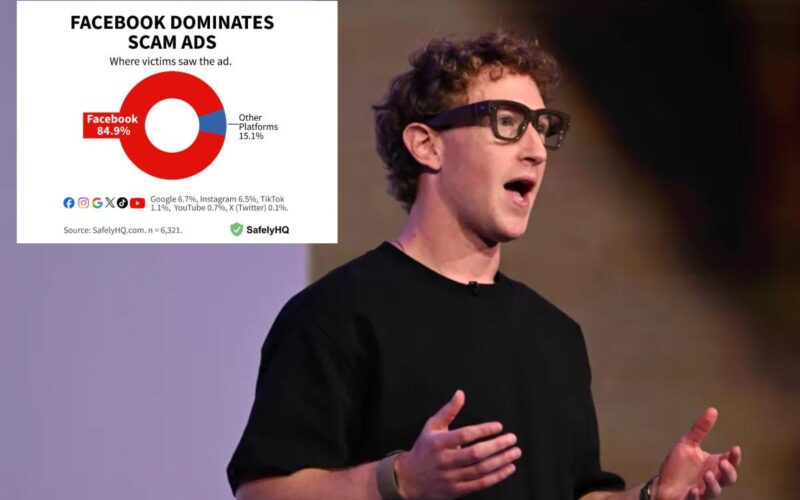
As The Post reported earlier this week, Facebook now accounts for the vast majority of scams on social media, according to data from fraud-reporting platform SafelyHQ.
When the fraud reports mention where the victims got scammed, Facebook is cited a whopping 85% of the time.
Reuters earlier reported that Meta expected to earn $16 billion — or 10% of its revenue — by running scam ads. That report, which is also cited internal documents, revealed Meta bans accounts only if its systems flag an at least 95% chance that they are committing fraud.
Sens. Josh Hawley (R-Mo.) and Richard Blumenthal (D-Conn.) have demanded a federal investigation into Meta’s scam ad problem.
High-risk advertisers are allowed to keep running ads in exchange for higher fees – a system that Meta said was meant to discourage bad behavior, but experts warned as tantamount to “pay to play” for bad actors.