


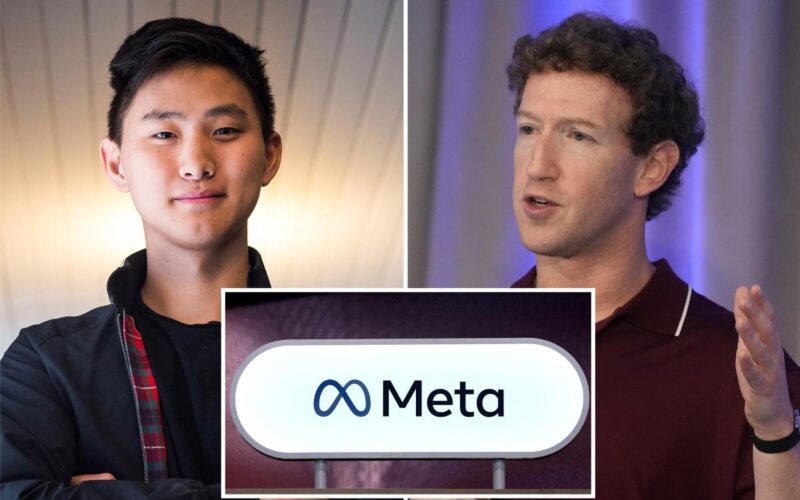
Meta paid billions to bring billionaire AI prodigy Alexandr Wang on board — but the tech wunderkind now privately believes CEO Mark Zuckerberg’s micromanagement of the company’s AI push is “suffocating,” according to a bombshell report.
Wang, the 28-year-old founder of Scale AI who joined Meta earlier this year after the company shelled out more than $14 billion for a 49% stake in his startup, was installed as the public face of Zuckerberg’s AI reboot.
But behind the scenes, Wang has complained to associates that Zuckerberg’s tight grip on the effort is stifling progress, the Financial Times reported, citing multiple people familiar with the situation.
Wang’s unhappiness is just the latest manifestation of the internal upheaval engulfing Meta, which has been beset by repeated layoffs, senior executive exits, rushed AI rollouts and eye-popping spending that has shaken morale and fueled investor anxiety.
One major sign of trouble that reared its head earlier this year was the botched rollout of Meta’s highly anticipated AI model, Llama 4.
Despite ambitious expectations, Llama 4 lagged behind rivals on key benchmarks such as coding and complex reasoning. Meta was also accused of trying to game AI leaderboards by submitting a customized version for rankings.
Inside Meta, the setback was seen as a humiliating blow to Zuckerberg’s pledge to turn the company into an AI powerhouse within a short period of time.
Current and former employees blamed weak training data, insufficient testing and deep organizational dysfunction.
“Our tools and products became fragmented because so many teams were rooting for their own products that no one was really thinking about how they worked together,” one Meta insider told the FT.
Rather than slow down, Zuckerberg doubled down — launching a hiring blitz across Silicon Valley, dangling compensation packages worth up to $100 million and pouring tens of billions of dollars into AI infrastructure.
Wang, who was widely viewed as key to this strategy, also heads the secretive TBD Lab, which is tasked with building a new flagship AI model codenamed “Avocado.”
But some Meta employees have privately questioned whether Wang is out of his depth managing massive research teams at a company of Meta’s scale, according to FT. These employees noted that his background is in AI data services rather than developing frontier AI models.
Tensions have also surfaced between Zuckerberg and Nat Friedman, the former GitHub CEO brought in to integrate AI models into Meta’s products.
Friedman has faced mounting pressure to deliver quickly, frustrating members of his team who felt products were rushed out the door to beat competitors.
One example cited by the FT was the rapid rollout of “Vibes,” Meta’s AI-generated video feed, which insiders said was pushed out at breakneck speed to stay ahead of OpenAI’s Sora.
As leadership strains intensified, top executives began heading for the exits.
Meta’s longtime chief legal officer Jennifer Newstead was recently poached by Apple. John Hegeman, the company’s chief revenue officer, announced he was leaving to launch a startup.
Storied chief AI scientist Yann LeCun, a Turing Award winner, is also departing to start a new AI initiative after reportedly objecting to reporting to Wang and seeing his research priorities slashed.
Other high-profile hires didn’t last either. Clara Shih, recruited from Salesforce to lead business AI, left within a year.
Even as senior talent walked out the door, Meta laid off 600 workers from its AI teams, framing the cuts as a way to speed decision-making.
All of it is unfolding against a backdrop of staggering spending. Meta’s AI capital expenditures are expected to hit at least $70 billion this year, with Zuckerberg signaling costs could top $100 billion annually.
Investors have recoiled. Meta shares plunged sharply in November amid fears that free cash flow could collapse as spending spirals.
Meta disputed aspects of the FT report, saying it routinely experiments with different AI model variants and arguing that public leaderboards can be misleading and “easily gameable.”
The company also pointed to prior statements disputing characterizations of internal upheaval and said recent chatbot policy concerns were based on examples that were “erroneous and inconsistent” with its rules.