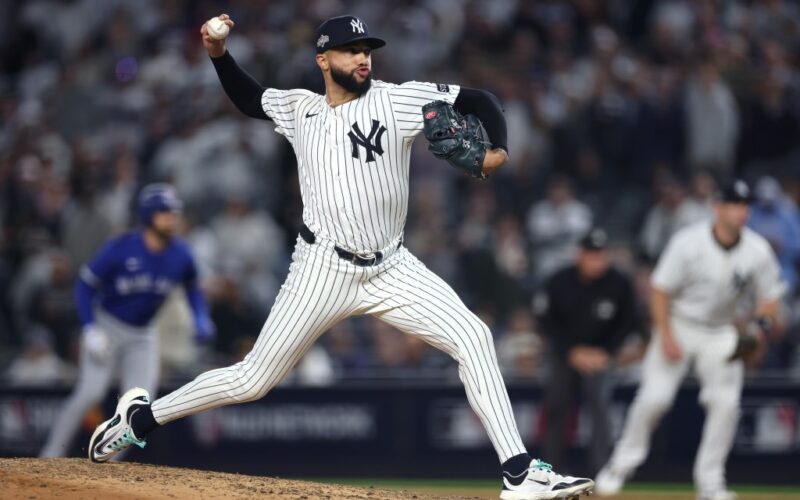
During last week’s introductory press conference, new Mets reliever Devin Williams expressed a willingness to set up Edwin Diaz, whom many expected to return.
But Williams also dropped a line that flew a bit more under the radar.
“Every team I talked to was for the closer role,” Williams said.
Williams is now set to be the Mets’ closer, as Diaz agreed to a three-year, $69 million contract with the Los Angeles Dodgers on Tuesday following seven seasons in Queens.
On paper, Williams — a two-time National League Reliever of the Year with 86 career saves — is as strong of a Diaz replacement that a team could find.
Williams boasts a 2.45 ERA and a historically elite strikeout rate of 14.1 per nine innings over seven MLB seasons, the first six of which he spent with the Milwaukee Brewers.
But Williams enters the 2026 season with uncertainty after a roller-coaster one-year stint with the Yankees in which he pitched to a career-worst 4.79 ERA and was twice removed from the closer role.
By comparison, Diaz — a three-time Reliever of the Year — posted a 1.63 ERA and 28 saves in 31 opportunities last season.
Williams, 31, acknowledged moving from small-market Milwaukee to New York required an adjustment, and he ended the season on a high note with 13 consecutive scoreless appearances, including the playoffs, as the set-up man to David Bednar.
Now acclimated to New York, Williams could be primed for a return to form with the Mets, who signed him to a three-year, $51 million contract.
“It’s familiar now,” Williams said. “I know what I’m going to need to do in order to get to the field, things like that, you know? Like getting home — just life stuff. So I’ve got all that figured out already and I’m comfortable there.”
While Williams’ overall 2025 numbers were well below his standard output, the right-hander’s underlying metrics provide hope for a rebound.
Williams’ chase percentage, swing-and-miss percentage and strikeout rate all ranked within MLB’s 97th percentile, while his expected ERA of 3.09 was nearly two runs lower than his actual one.
“He had a handful of games that destroyed the overall numbers,” Yankees general manager Brian Cashman said recently. “I thought he pitched pretty close to what he’d always pitched in the years gone by.”
Williams’ problem was that the bad outings came in bunches. He pitched to a 9.00 ERA in March/April, then endured a stretch over the summer in which he either blew a save or suffered a loss in four consecutive games.
After his initial struggles in pinstripes, Williams began calling his own pitches via PitchCom.
“I feel like there were a lot of factors, really,” Williams said last week of his 2025 season. “Some mechanical, pitch-selection-type stuff, looking back on it. [I am] just kind of reflecting on that and using that to help me prepare for this next season.”
The vision for the Mets’ bullpen changed Tuesday when Diaz left in free agency.
Instead of deploying a super-pen with Williams in the eighth inning and Diaz in the ninth, the Mets now turn their focus to building a bridge to their new closer.
Other than left-hander A.J. Minter, who is expected to return from the lat surgery that cost him most of 2025, and fellow lefty Brooks Raley, that bridge remains a work in progress.
But if Williams can regain his consistent dominance, ninth innings won’t look too different for the Mets — even with Timmy Trumpet’s “Narco” presumably following Diaz to Los Angeles.
“You’re talking about one of the best relievers for the past few years, a guy that’s used to pitching in high-leverage and [with] closing experience,” Mets manager Carlos Mendoza said of Williams. “We’re looking for help down there, and the fact that we got one here, I was excited.”