




When Zee Rosado joined the newspaper club at the High School of Art and Design in ninth grade, the A&D Observer‘s first online edition got a great response in June 2025. A total of 1,082 visitors logged in to read articles about student entrepreneurs, the fencing team and President Trump’s education cuts.
But when Zee returned last fall as a sophomore, far fewer students were reading the Observer. The paper’s advisor said it logged only 315 visitors through November — just a third of its prior audience. Zee blames the state policy banning cell phones in schools. “Nobody can actually go and check it out,” she said.
Her solution? Raise money to print a special edition so students can see what they’re missing.
The cell phone ban is a golden opportunity for public schools to invest in student journalism. My nonprofit, Press Pass NYC, helps city public schools start or strengthen student news publications. Our student reporters have been writing about the ban since September. While many don’t like it, we’ve heard from students and teachers who say it’s creating more space to talk and to read.
“I see far more students engaged with each other and with printed text now that they can’t spend all their time staring at their phones,” said Helen Leshinsky, school librarian at the Urban Assembly School for Applied Math and Science in the Bronx. She advises its online newspaper and just fundraised for a printed edition.
Many student publications already do both. The Survey at Brooklyn Tech has a website and publishes at least three print editions a year. Teacher Tom Wentworth said more students are picking up printed copies in the halls and credits the cell phone ban. “Before that, we’d have to convince teachers to distribute them in class.”
Akim Fridman, a Survey writer, said the trend helps students connect to their community. “It allows students who aren’t in journalism to relate to it more than just random headlines.”
That’s the superpower of student journalism. We’re living in a time of massive disinformation, some driven by AI. Too many teens have little interest in mainstream news and get information from social media influencers with no journalism connections. Last year, the News Literacy Project found 84% of teens don’t trust the news, with many thinking reporters make up quotes.
Student journalism bridges that gap. It gives teens an opportunity to write about important issues facing their school communities. Reporting teaches students to verify sources and think critically — skills that serve them in college, careers and life. Student newspapers also model how reliable news is produced, because teens can see firsthand where information comes from and whether it’s accurate.
Yet too few students have access to this learning opportunity. While New York is the nation’s media capital, a 2022 Baruch College survey found only 27% of its 400-plus public high schools had student newspapers. Schools without them disproportionately serve low-income Black and Brown students. In the Bronx, less than 15% of high schools had student newspapers.
Press Pass NYC is part of the NYC Youth Journalism Coalition, which has been lobbying for more journalism opportunities in city schools. A new journalism curriculum, which we contributed to, is being piloted at 30 high schools, and those schools will produce news content over the next two years.
But there’s no need to wait. The city should invest now in helping more schools produce high quality student news publications. Since 2021, Press Pass NYC has started or strengthened 38 student publications, expecting to reach 44 by June. We do this through a fellowship providing free teacher training, mentors and stipends — critical support since most teachers have no journalism background. Our model is flexible for schools that can’t offer a journalism course but can run a journalism club.
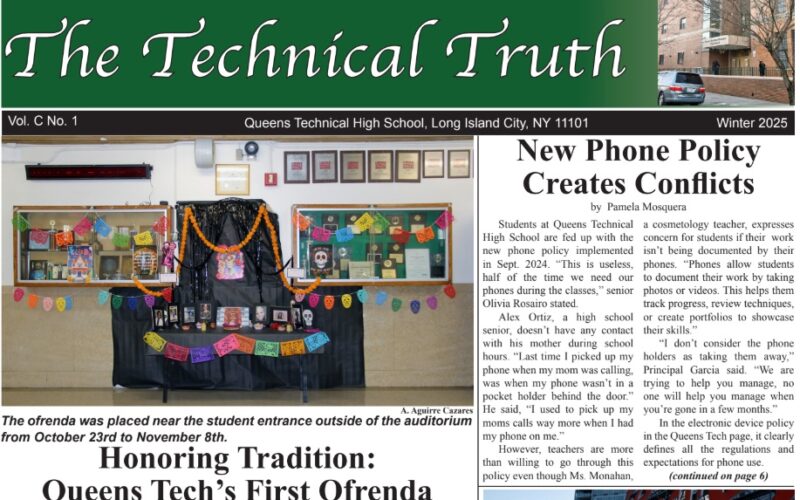
The city should also help schools with online news sites pay for printed editions. Queens Technical High School spends about $1,000 each semester on 1,600 color copies of The Technical Truth. This is a fun novelty for teens who don’t see newspapers the way many adults did at their age. A student at a Bronx school with a printed paper told me, “It’s very old school but it’s cool.”
Student journalists face the same challenge as the rest of the news industry: finding an audience. For NYC students, that means classrooms, lunchrooms, halls and libraries where phones are now off limits. Investing in student newspapers — both online and in print — can help reach a new generation still discovering the power of journalism.
Fertig is executive director of Press Pass NYC, and was previously an award-winning reporter at WNYC Public Radio and NPR.