




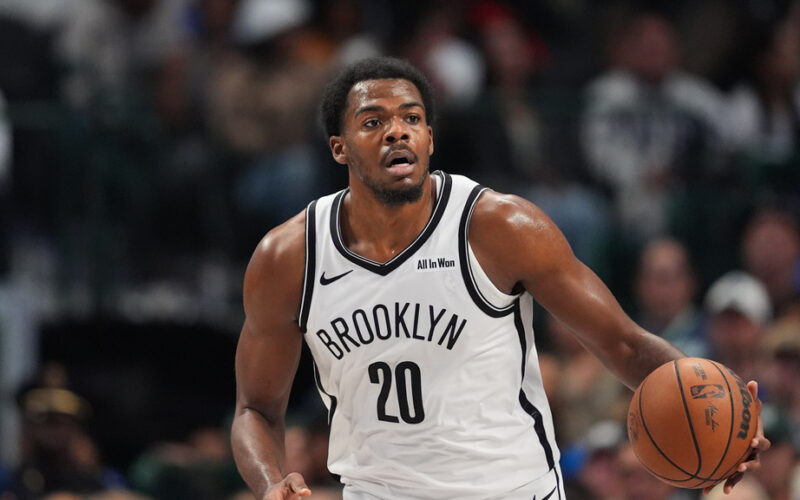
Day’Ron Sharpe doesn’t grade himself kindly. He knows he’s finishing better than he used to this season, but he also knows that improvement alone isn’t the finish line. He sees room for more. More force. More intent. More moments where the defense knows exactly what’s coming and still can’t stop it. For the fourth-year center, growth has become a simple idea: every touch in the paint should end violently.
“That’s what I’m really trying to work on,” Sharpe said. “When I get the ball in the paint, demolition, so that’s about it.”
The efficiency is already there. Sharpe is shooting 63.3% on two-point attempts and owns a 62% effective field goal percentage this season, both personal highs. He’s converting more of the chances he gets around the rim and wasting fewer possessions when the ball finds him in traffic. But Sharpe is also realistic. Turning every paint touch into a dunk isn’t possible, especially with defenses collapsing early and bodies meeting him at the rim.
What is realistic, he said, is putting himself in better positions to finish with authority by slowing the game down and trusting his work.
“Being patient,” Sharpe said. “When I get the mismatch in the post, or when I get a post up in general, just being patient, taking my time and just trying to go right into my move. Scan the floor, make the right play every time.”
That balance between violence and control has come to define Sharpe’s progress this season. His game still runs on energy, physicality and offensive rebounding, but there’s more nuance now. He’s finishing cleaner around the rim, reading defenders earlier and making quicker decisions when the ball finds him in traffic. That growth shows up in the passing numbers as well, with Sharpe averaging a career-high 2.0 assists per game. Instead of forcing shots through crowds, he’s more willing to kick the ball out, hit cutters or reset the offense.
The result is fewer wasted possessions and a more dependable presence in the middle during his 16.1 minutes a night off the bench.
That evolution has mattered for more than just Sharpe’s individual development. With Brooklyn leaning heavily on high-energy lineups and young contributors, his ability to stabilize the middle in short bursts has become a real asset. When Sharpe is on the floor, the Nets consistently gain extra possessions through offensive rebounds, get a physical screen-setter who frees shooters, and have a defensive presence willing to absorb contact and clean up mistakes.
The challenge, as head coach Jordi Fernández sees it, is finding a way to extend that impact without dulling the edge that makes Sharpe effective.
“Very positive. Got him better,” Fernández said. “I think his effective field goal percentage is the best it’s ever been. He has to take care of those turnovers, and at some point, I want him to play in a little longer stretches. But the reality is he plays so hard that I’m very happy with where he’s at right now.”
That intensity remains Sharpe’s calling card, even as it limits how long he can stay on the floor. He plays fast, physical and relentlessly, often flipping the energy of a game in short stints. He crashes the glass, battles bigger bodies inside and anchors the defense when lineups skew smaller. The next step, Fernández has said, is learning how to sustain that level of impact for longer stretches without crossing the line into fouls or rushed decisions.
Teammates have noticed the change.
“Last year he was great, he’s building off that,” starting center Nic Claxton said. “He’s been really solid for us in his minutes, anchoring the defense. Of course, his offensive rebounding is great. His feel for the game, playmaking, and he’s getting better. He’s still super young, so he still has a long way to go.”
Sharpe would agree with that assessment. The production is up, the efficiency is real, and the confidence is growing. But in his mind, the work isn’t finished. Every possession is another chance to sharpen the balance he’s chasing.