



Maybe you could have scripted a better start to this Knicks season—but it wouldn’t have been easy.
The Knicks have been that good in their first year under head coach Mike Brown. They’re near the top of the Eastern Conference for a second straight season, only this time the championship talk doesn’t feel aspirational. It feels earned. This roster looks like the version it envisioned back in the offseason, and only now is it beginning to tap into what its ceiling might actually be.
Which makes this the perfect time for a winter report card.
The Knicks enter the holiday break with standout grades across the board—from the stars to the margins of the rotation to the coach himself. If this is a midterm exam, New York is passing with room to grow.
Mohamed Diawara: B
The tools are undeniable. The 51st overall pick in the 2025 NBA Draft is still raw, but his defensive upside jumps off the screen. Diawara already looks the part of a disruptive, switchable forward, and at 6-foot-9 with a 7-foot-4 wingspan and a 9-foot-2 standing reach, he’s built to bother anyone in his zip code.
The swing skill will be the jumper. Diawara is hitting 33.3 percent of his threes in Year 1—good enough to keep defenses honest, not yet good enough to demand respect. If that shot stabilizes, the minutes will follow. Defensive versatility has a way of finding the floor.
Ariel Hukporti: A
Buried behind Karl-Anthony Towns, Mitchell Robinson and Guerschon Yabusele, Hukporti isn’t guaranteed minutes on a team with title ambitions. But when he plays, he looks ready.
The second-year center has brought toughness and physicality this team occasionally lacked a season ago, flashing the same edge he showed before a meniscus injury cut his rookie campaign short. He’s back, stronger, and more confident. With Robinson operating under a tight load-management protocol, Hukporti’s role could quietly grow—and he’s done nothing to suggest he isn’t ready for it.
Tyler Kolek: B+
Malcolm Brogdon’s abrupt retirement left a real hole at backup point guard. Kolek has helped plug it.
He’s sharper defensively than he was as a rookie—an important development given that defense was the main reason his minutes were limited last season. Like Hukporti, Kolek isn’t expected to play big minutes behind the captain. His job is simple: keep the offense organized, avoid mistakes, and compete defensively. He’s done that.
The swing skill here is also shooting. Kolek is still below 30 percent from three in Year 2, and that has to improve. But the progress elsewhere is real.
Guerschon Yabusele: C+
Context matters here.
The Knicks didn’t sign Yabusele to a minimum deal. They used most of their mid-level exception—two years, just over $11 million—to bring him in. And yet his role hasn’t matched the investment.
Yabusele is averaging fewer than 10 minutes per game and is shooting a career-worst percentage from three in a limited role. The versatility is appealing, but the impact hasn’t matched the opportunity. There’s time for that to change—but so far, the return has been modest.
Jordan Clarkson: B+
The shot selection took some getting used to. At times it echoed Cameron Payne’s 2024-25 stint. But Clarkson is clearly an upgrade—and a savvy one at the minimum.
The former Sixth Man of the Year brings size, experience, and just enough defensive versatility to survive. More importantly, he’s addressed the Knicks’ most glaring weakness from a year ago: bench scoring.
New York is still bottom-five in second-unit production, but it’s averaging 10 more points per game off the bench. Coincidentally, Clarkson is averaging nearly that number himself.
Mitchell Robinson: B+
Free throws. Free throws. And more free throws.
Robinson remains a game-changer. He’s an elite rebounder and a rim presence that alters possessions the moment he steps on the floor. But his inability to convert at the line—career 51 percent, career-worst 40 percent this season—creates a real late-game dilemma.
Teams will foul him intentionally. It disrupts rhythm. It limits his minutes in high-leverage moments. That’s a problem for a player this impactful, especially with his contract status looming as he approaches unrestricted free agency next summer.
Miles McBride: A+
No player has benefitted more from Brown’s system than McBride.
He’s posting career highs across the board: scoring, three-point volume, efficiency. The confidence was always there. Now the production matches it. And crucially, the offensive leap hasn’t come at the expense of his point-of-attack defense.
McBride owns the Knicks’ second-best net rating this season behind OG Anunoby. That’s not noise. That’s impact.
Josh Hart: A+
The season turned when Hart entered the starting lineup.
Brown’s decision restored the Knicks’ connective tissue to a high-usage role, and the effect was immediate. Hart is the team’s engine—a nightly triple-double threat who rebounds like a big and defends like a pest.
The revived three-point shot is gravy. If it holds through the postseason, it changes everything about this offense.
Mikal Bridges: A
What an offseason can do for a player in this league.
This version of Bridges looks freer—on both ends. He’s still defending elite scorers, but he’s sharing that burden. He’s touching the ball more as a secondary playmaker, easing pressure off Brunson. And he’s grown into a vocal leader, holding teammates accountable in real time.
The scoring is down. The impact is up. That’s a trade every contender makes.
OG Anunoby: A
The contract says it all—and the numbers back it up.
Anunoby remains the Knicks’ most impactful player by net rating, just as he’s been since arriving in December 2023. He looks comfortable in Brown’s offense and is enjoying the first 40-percent three-point shooting season of his career.
If he stays healthy and the Knicks stay near the top of the East, his first All-Star case won’t be hard to make.
Karl-Anthony Towns: B+
The shooting numbers are down. The three-point percentage is the worst of his career. And yet, Towns is still the second-best player on a team tightening its grip on the East.
His defense has improved—he’s closer to a block per game than he’s been in years. And when he chooses to be aggressive, he remains one of the most unguardable centers in basketball, stretching defenses beyond their breaking point.
Towns has faced the steepest learning curve in Brown’s system. He’s climbing it. When it clicks fully, this offense levels up.
Jalen Brunson: A
One second less per touch doesn’t sound like much—until you realize Brunson averages more than 90 touches per game.
That’s energy redistributed. Rhythm created. Confidence shared.
Brunson’s scoring is up despite fewer minutes and fewer dribbles. The shot quality is better. The reads are quicker. And when the moment demands it, he can still bend the game to his will.
He got 27 mayoral votes for a reason. And he’s closer to delivering on a promise than most politicians ever get.
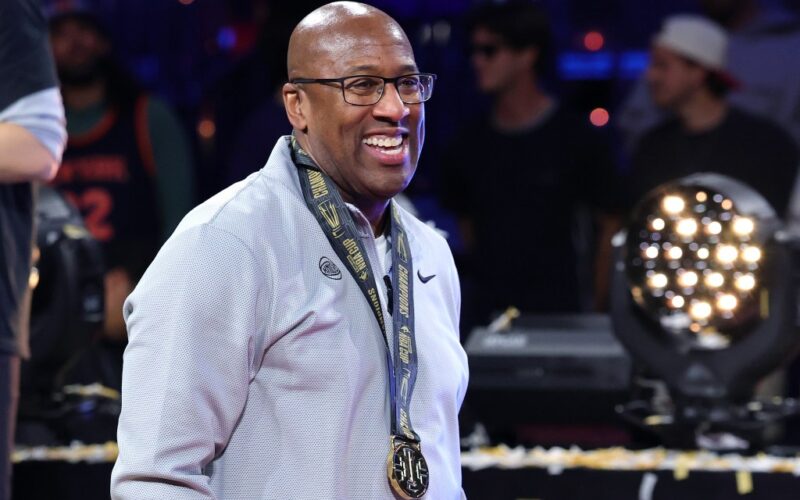
Mike Brown: A
If there’s one nit to pick, Brown would pick it himself: Josh Hart probably should’ve started sooner.
But injuries complicated that decision early. When Brown finally made the switch, the Knicks took off. More importantly, the moment captured why the organization trusted him in the first place—he listened.
The philosophical shifts on both ends have worked. The culture feels different. The ceiling feels higher.
If the Knicks keep this pace, end-of-season awards won’t be limited to the locker room.