




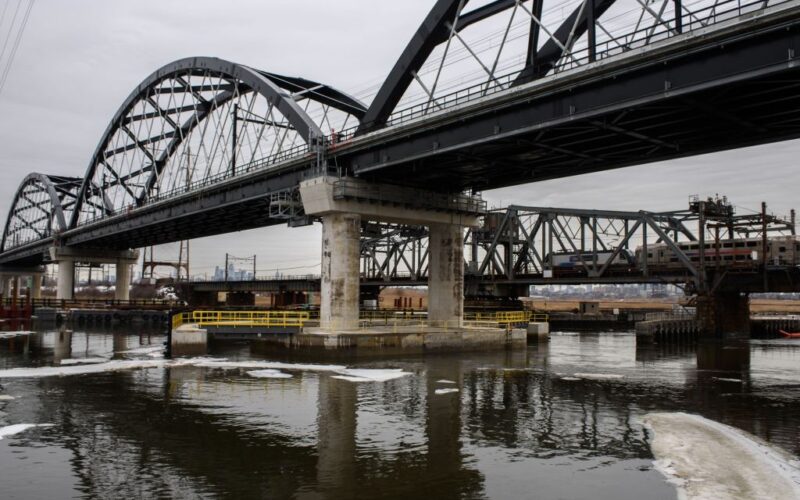
Commutes between Gotham and the Garden State have been in disarray this week as NJ Transit and Amtrak crews work to transfer a track from the old Portal Bridge in the New Jersey Meadowlands to the newly built Portal North Bridge.
But officials from both railroads said Thursday that their work remained on schedule, and that the second track over the Hackensack River would return by the evening of March 15.
“In a few short weeks, customers are going to experience a ride on one track over the new Portal North Bridge,” said Bill Brooks, NJ Transit’s senior vice president of capital delivery. “That’s going to be more reliable [and] convenient.”
The Portal Bridge, which carries the Northeast Corridor line over the Hackensack River, is the busiest rail span in the Western Hemisphere, with 150,000 passengers crossing it each day, according to NJ Transit.
The 116-year-old span, constructed by the Pennsylvania Railroad in its heyday, is now a known choke point for rail traffic across the New Jersey swamp.
A low swing bridge that must open for passing ships, it’s also home to aging power and signal infrastructure, like much of the Northeast Corridor across the North Jersey swamp.
The Portal North Bridge, by contrast, stands tall enough for ships to pass underneath without interrupting train traffic. On Thursday, a Daily News reporter could see work crews on the new bridge adjusting brand-new overhead catenary wires for traction power.
Railroad officials say the new bridge will also allow for an increase in top speeds across the swamp. While the outgoing bridge had a 60-mph limit — slower than the average car on the adjacent New Jersey Turnpike — the new bridge, and the nearly 2.5 miles of new track around it, is expected to allow trains to get up to 90 mph.

But swapping the nation’s busiest rail corridor from one bridge to another has proven to be a tricky business.
Last weekend, NJ Transit and Amtrak shut down the westbound track of the Portal Bridge — Track 3 — in order to connect the new Portal North Track 3 into the existing Northeast Corridor.
The new tracks themselves have since been spliced into the Northeast Corridor, railroad officials said Thursday. But crews now have to reroute the catenary lines that power the trains, plus plug the new bridge’s signal and communications system into the broader network.
That task is expected to take until the end of the month, and will be followed by two weeks of adjustments and runs by test trains.
“This is all in preparation for resuming full revenue service on the evening of March 15,” said Chrissa Roessner, NJ Transit’s acting chief of construction.
In the meantime, though, train traffic in both directions must run on the one lone track of the old bridge left unaffected by the construction work.
That’s meant a drastic reduction of trains to New York Penn Station, with many Gotham-bound passengers forced to disembark at Hoboken and cross the Hudson River by PATH train.
The whole sequence will be repeated again in the fall in order to bring the second, city-bound track from the old Portal Bridge onto the new bridge.
The demolition and replacement of the Portal Bridge is a component of the broader Gateway project meant to double the capacity of the Northeast Corridor across Northern New Jersey and into New York Penn Station. After both Portal Bridge tracks are transferred to the Portal North span this year, the older bridge will be demolished — a task expected to be completed by the end of 2027.
Then a second new bridge — appropriately named Portal South — will be built in the same right-of-way as the old bridge. The two new tracks will then feed into the Hudson River Tunnel, work on which is expected to resume next week after a funding spat with the Trump administration.
All told, the Gateway improvements aim to double the number of tracks from New Jersey into New York Penn Station, which is also in the early stages of a planned overhaul.