



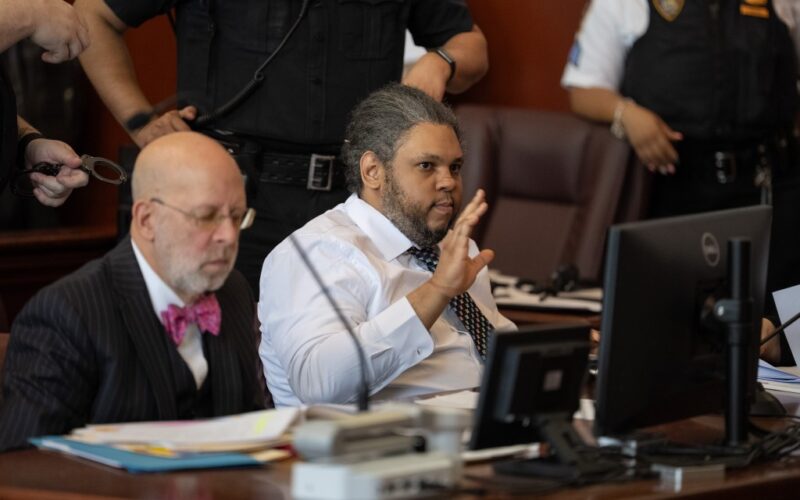
It was not a broken moral compass but severe mental illness that led to the 2019 killings of four men sleeping on the streets of Chinatown, a Manhattan jury heard at closing arguments Wednesday in the quadruple murder case against Randy Santos.
Urging the Manhattan Supreme Court panel to find his client not guilty by reason of mental disease or defect, Marnie Zien from the Legal Aid Society said there would be no justice in holding the 31-year-old Santos criminally liable for actions he took in a state of psychosis.
Zien said Santos, who has diagnosed schizophrenia, was acting on the orders of menacing voices in his head when he fatally bludgeoned Chuen Kok, Nazario Vásquez Villegas, Anthony Manson, and Florencio Moran.
“The voices told him to go to Chinatown, and they told him to kill people, and that’s what he did,” Zien said.
death
Clarissa Sosin/for New York Daily News NYPD and FDNY clean up the crime scenes at 2 Bowery Street and Catherine and East Broadway in Chinatown where Randy Santos, 24, allegedly bludgeoned five homeless men as they slept on Saturday, October 5, 2019. (Clarissa Sosin for New York Daily News)
“The only explanation is Randy’s psychosis. It’s the only thing that explains what happened,” the attorney later added. “There’s no motive for what he did to those men.”
Santos, who is originally from the Dominican Republic and has lived in the city since his childhood, listened to Wednesday’s proceedings through a Spanish interpreter, at times seen dabbing his eyes with a tissue. He has pleaded not guilty to four counts of first-degree murder, one count of attempted murder, and related offenses stemming from the Oct. 5, 2019 attacks. If convicted, he faces the possibility of life in prison without parole.
If found not guilty by reason of insanity, Santos will not be released, state Supreme Court Justice Laura Ward told the jury during her instruction. The case would proceed to hearings to determine whether he should be involuntarily committed to a secured, state-run facility for long-term psychiatric treatment.
In the prosecution’s closing argument, Assistant District Attorney Alfred Peterson said there was no dispute as to whether Santos was mentally ill, but argued his symptoms of schizophrenia were not severe enough to equate with insanity.

“He heard voices, he clearly had disillusions — disorganized thinking … There’s no doubt he’s schizophrenic,” Peterson said.
The prosecutor contended surveillance footage showing Santos waiting until the coast was clear before targeting some of the victims in the group — and lies he initially told police — proved “his capacity to discern wrongfulness was clearly intact.” He also pointed to an incident in Chelsea a week beforehand, when Santos beat with a stick a man sleeping outside before passersby stepped in to stop him.
Peterson said if Santos had been truly out of his mind, he would have told police about what the voices in his head ordered him to do.
“Why didn’t he say that to the police, if he was so psychotic and his delusion was so overwhelming?” Paterson said. “The fact that he doesn’t say that is powerful evidence.”
Santos himself was homeless and had racked up a number of arrests in the years prior to the killings, with his mental illness, like that of so many defendants who cycle through the revolving doors at 100 Centre St., going largely untreated, The News previously reported.
When deliberations begin Thursday, jurors will be tasked with discerning whether Santos lacked substantial capacity to appreciate the nature or circumstances of his actions were legally or morally wrong. Ward said they needed to determine a true understanding — not a surface-level one, like when a child recites information they don’t fully understand — and that they could factor in Santos’ extensive medical records when reaching their conclusion.
Zien said Santos may have had some grasp that what he was doing was legally wrong, but on a moral level, his illness instilled in him the warped belief that others in his shoes would have done the same.
The attorney took repeated aim at Jason Hershberger, a psychiatrist who testified for the prosecution, for spending less than two hours interviewing Santos before determining he knew his actions were illegal and against generally acceptable moral principles.
A clinical psychologist who testified for the defense, Virginia Barber-Rioja, countered that Santos’s psychosis had replaced ordinary moral judgment with the delusional belief that he had to obey the voices in his head to save his own life.
Jurors heard that Rioja spoke at length with Santos and his relatives, learning of delusions he experienced in the weeks and months prior to the Chinatown killings.
The jury has heard Santos targeted the first victim near the corner of East Broadway and Catherine St., fatally battering him in the head at least seven times. He next targeted three men — killing two — huddled together under scaffolding on East Broadway near Chatham Square, according to trial evidence.
Santos targeted a fifth victim up the block by Doyers St., fatally beating him with the metal bar, jurors have heard.
The innocent men’s horrific killings sent shockwaves through the city and shone a light on the high rates of violence people without housing are likely to encounter, whether sleeping outside or in a shelter.
The jury is expected to return to court Thursday to begin deliberations.