




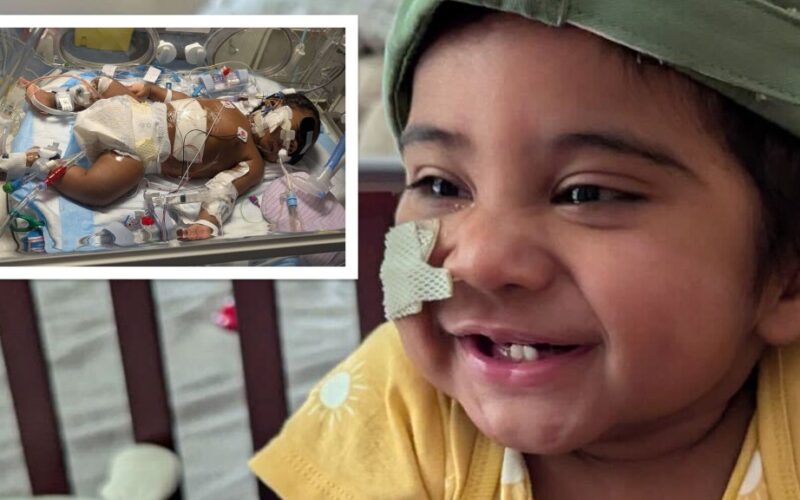
When little Dhruvan Gopi was taken by his parents to a New Jersey urgent care center, they never imagined he was suffering acute liver failure at just 7 weeks old. The shocking discovery set off a race to keep him alive long enough to receive a seldom-performed risky organ transplant at Manhattan’s Mount Sinai Hospital.
Over the next few days, he was rushed between hospitals in New Jersey and New York, his blood stopped clotting, his parents were warned he might not survive the night, and a large team of specialists converged around his crib. The doctors didn’t yet even understand why a baby who had seemed perfectly healthy just a week earlier was suddenly fighting for his life.
He would later be discovered to be suffering from an incredibly rare newly discovered genetic disease.
First signs of trouble
Dhruvan was born on Oct. 15, 2024, to Gopi and Prabha Subramanian, who live in Edison, N.J. “He was fine for six weeks,” recalled Gopi, a software engineer from Chennai in Southern India.
Then one Tuesday in late November, things changed. His urine was dark in color and he began throwing up. His parents brought him to their local urgent care clinic, expecting to be back home in a few hours.
But staffers there sent them to a local emergency room, where doctors found the infant’s liver numbers to be way off. He was transferred to St. Peter’s University Hospital, where he had been born less than two months earlier. There he was treated for a urinary tract infection, but his liver tests kept looking worse. His blood stopped clotting properly. His platelets and red blood cells were dropping, forcing doctors to transfuse him just to keep him stable.
That’s when the parents got him to Mount Sinai hospital on the Upper East Side, recommended to them by a friend. Doctors there told them something unimaginable: their son very well might not survive the night.
‘A day or so to live’
When Dhruvan arrived at Mount Sinai’s neonatal intensive care unit (NICU) on Dec. 2, he was in rapidly progressive liver failure.
“He literally had only a day or so to live,” said Dr. Sander Florman, director of the Recanati/Miller Transplantation Institute, the transplant surgeon who would go on to perform a harrowing 11-hour surgery on the infant.

The medical team raced to run every test they could: blood work, imaging, specialist consults. On Dec. 4, 2024, as they prepared to place him on a transplant waiting list, Florman’s phone rang. It was a colleague at another New York transplant center.
“Would you ever use a 2-year-old liver for a ‘domino?’” she asked him, Florman recalled
“I said, ‘Are you kidding me, what blood type?’ And it was the same blood type [as Dhruvan].”
Most people have never heard of a domino liver transplant, in which one patient both gives up a liver, which goes to somebody else, and receives a liver from a third person. It’s one of the rarest scenarios in medicine. Mount Sinai’s team estimates they’ve done just a dozen in 40 years.
“We’re going to take it out in 15 minutes,” Florman’s colleague told him about the 2-year-old’s liver.
When Florman got that call, he had still never met Dhruvan’s parents. He walked straight to the NICU to meet the Subramanians for the first time.
“The kid is absolutely going to die within 24 hours or so,” he said of little Dhruvan. He had to explain, quickly but clearly, what a domino transplant was to the infant’s shocked parents.

A liver that is a problem for one child can in rare circumstances save the life of another. The 2-year-old was suffering from a rare metabolic disease called Maple Syrup Urine Disease (MSUD), named for the sweet smell it can give a child’s urine. A missing enzyme was letting certain substances build up to dangerous levels in that child’s body.
The 2-year-old’s liver, one of the body’s main producers of the missing enzyme, was not making the enzyme the way it should. But the liver was otherwise normal and doing its usual jobs of filtering blood, making bile and supporting metabolism.
“You can take their liver and give it to somebody else who doesn’t have that problem, because they make the enzyme somewhere else in their body,” the surgeon explained.
A 10-minute decision
The parents were stunned. “We were very hesitant,” Gopi said. “You’re not mentally prepared for something like this.”
But the surgeon was blunt: For a baby this small getting a liver of this size is very rare, Gopi remembered him saying.
“That’s perfect size,” Florman said. “We can split it, and we can still fit it under his belly.’”
The Subramanians said yes.

The 2-year-old’s liver was removed and rushed to Mount Sinai. While anesthesiologists put Dhruvan to sleep, the surgeon split the donor liver, trimming it down to a piece small enough to fit inside a 10-pound baby.
“It’s one of the most unbelievable, remarkable, serendipitous cases,” Florman said. “These are very high-risk transplants and very few places in the country will take on children under 10 pounds.”
Dhruvan received the liver from the 2-year-old patient while that baby received a new liver from another patient and went on to do very well. But little Dhruvan still had a rocky road ahead.
The surgery was only the beginning
Even after the transplant, no one knew why a seemingly healthy newborn had plunged into liver failure after a simple infection. Mount Sinai’s genetics team kept digging. Eventually, they found the answer in a scientific paper first published in 2023.

It was a mutation in a gene called DOCK11, an incredibly rare genetic glitch affecting how immune cells form and move.
“These are rarest of the cases. In fact, there’s no case of anybody being transplanted for this,” Florman said. “These kids generally die … It’s a brand-new class of genetic mutations that people are only just starting to understand.”
The DOCK11 mutation causes immune dysregulation, leaving patients vulnerable to overwhelming infections and runaway inflammation. In Dhruvan’s case, the urinary tract infection was the spark that set off his immune system and destroyed his liver.
The diagnosis also complicated his recovery. Transplant patients must take drugs that suppress the immune system to prevent rejection. The very system that, in his case, was already miswired.
Still, there was no alternative. “This was the kid’s only chance to be alive,” Florman said.
Months of setbacks and small victories
After surgery, Dhruvan returned to the NICU, his abdomen initially left open because the new liver was still too big. Tubes and lines snaked from his tiny body.

He went on to face complications including blood clots, an infection in his belly requiring repeat surgeries, massive swelling that made him appear almost double his size.
“He was very weak,” said Dr. Courtney Juliano, the system chief of the division of newborn medicine at Mount Sinai Kravis Children’s Hospital. “He required a breathing tube and a ventilator for a very prolonged period of time.”
Every morning, a large multidisciplinary team would crowd around his incubator.
“The hospital staff and nurse took care of him like their own baby,” Gopi said.
Adjusting to post-hospital life
After more than three months in the hospital, Dhruvan finally came home.
“When he was getting released, we were happy,” his father said. “OK, he is back home. But then it hits you hard. He’ll be on a lot of medicines, a lot of care is required every single day. And then the lifelong immune suppression.”

“We started with 11 medicines,” he added. “Morning and evening.”
Twice Dhruvan’s parents rushed him to the emergency room for FPIES, a severe gut reaction where his body violently rejects certain foods. But each time, he bounced back, tolerating foods that once made him desperately ill.
Stay in the present
“I’m not a person who used to pray to God every single day. But now I do,” Gopi said. “It changed his Mommy and definitely it changed us. We start having a lot of appreciation for what we already have.”
“Stay in the present — that’s what I started doing more,” he added. “Live in the moment.”
Their older son, who is 8, dotes on his little brother. The house is noisy again.
Dhruvan is already showing a stubborn streak. “

If I go by his crib, I have to lift him,” Gopi laughed. “Otherwise, he’ll shout, he’ll do silly things, like try to bump his head into the railing to say, ‘Hey, I’m here.’ He has his ways of getting things done.”
Back at Mount Sinai, the team that once fought to keep him alive now gets to enjoy the payoff.
“What we hope for is more than just survival. I want babies who are thriving, and he’s a great example of that,” said Juliano. “Each time his parents bring him back, he’s looking better, bigger, stronger, healthier, with less signs of what he went through.”
Eariler this month, Dhruvan, now 15 months old, was busy doing what toddlers do best when he made a return visit to Mount Sinai Hospital. Squirming, grabbing at his mother’s shoulders and protesting whenever anyone tried to put him down.
You wouldn’t know that beneath his T-shirt a long scar runs down his tiny belly, a reminder of the night last year when doctors weren’t sure he would live to see morning.
“Could there be anything more gratifying than seeing them a year later, running around like a normal kid?” said Florman, a year after operating on him. “Today, he looks like any normal 1-year-old kid.”