




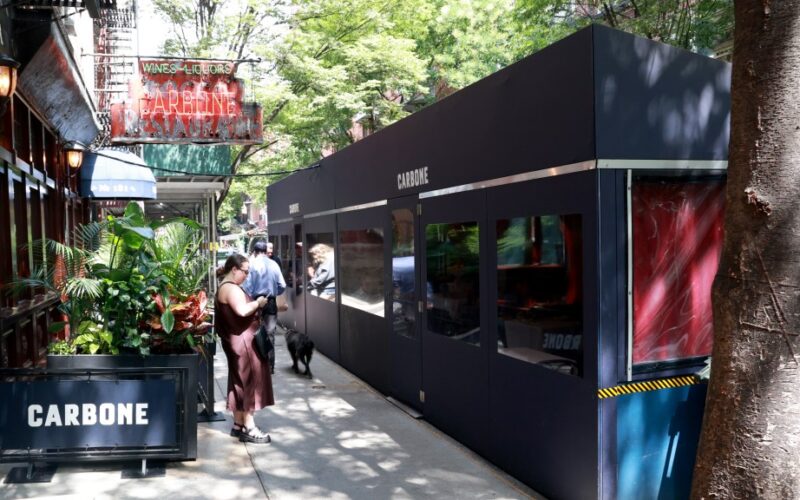
Last month, City Council Speaker Julie Menin announced that the Council would revive and fix year-round outdoor dining on sidewalks and at curbs. This is great and long overdue news, but to make sure that it works sustainably for restaurants, residents, and communities alike, the devil is in the details.
As I explain in my forthcoming book, “Sidewalk Nation: The Life and Law of America’s Most Overlooked Resource,” public rights of way like sidewalks and curbsides are hotly contested spaces. They’re where we engage in commerce — from outdoor dining to advertising, food trucks, vendors, and more. They’re where we socialize, speak, and protest. They’re where we put the infrastructure that keeps the city running — from lampposts and fire hydrants to bus stops, subway entrances, trash, and more. And they’re where we walk, bike, park, and navigate with walkers, strollers, and wheelchairs.
Each of these uses competes for limited space, and the space each one takes up leaves less for the others. But none of these uses is necessarily “better” than the others. In a city as big as ours and with as many neighborhoods, densities, and preferences as our city has, the goal must be to harmonize them as best as we can.
Too often, we don’t do a great job. First, too many scattered parts of city government regulate these uses, and they don’t always coordinate well enough. Departments of transportation, sanitation, buildings, consumer affairs, health, parks, and more all overlap on the sidewalk and curb.
Second, nearby property owners are in the mix too: they are responsible for repairing and shoveling the sidewalk, and they sometimes even have the power to dictate what happens there.
Finally, despite all of this overlap, gaps remain. The last few weeks highlighted a major one: nobody is responsible for clearing the snow from the curb. Property owners move the snow from the sidewalk to the curb, snow plows move the snow from the street to the curb, and the result is a wall of snow and ice.
There’s a lot we can do better when it comes to these public spaces across the board, and curbside and sidewalk dining is a great place to start. In order for the program to be a success, it is essential that the City Council writes rules that are geared toward making the curbs and sidewalks work for everyone.
That means requiring sufficient space be left for pedestrians, including people with mobility limitations, and for bikes. It means ensuring that dining structures leave enough room on each block for trash, utilities, bus stops and subway entrances, and so on. It means requiring restaurants to keep the space clean, safe, and clear of obstructions or trip hazards. It likely means limiting the number of structures per block, especially near intersections.
And it absolutely means consolidating oversight in one city agency, which would make it easier for business owners to apply, for residents to lodge complaints, and for the city to enforce its requirements. In the long run, we might even consolidate all of the city’s numerous sidewalk responsibilities into one Department of Sidewalks, but starting with a one-stop shop for outdoor dining is an obvious first step.
New York City’s sidewalks and curbs are a big part of what make the city the vibrant, fun, and exciting place it is. But too much of any one good thing is never good. Expanded and permanent outdoor dining will make these spaces even better, but only if we remember that our sidewalks and curbs belong to all of us. Let’s ensure that they serve all of us too.
Pollack is a professor of law and the associate dean for faculty development at Cardozo School of Law. His forthcoming book, “Sidewalk Nation: The Life and Law of America’s Most Overlooked Resource,” will be published on June 2.