



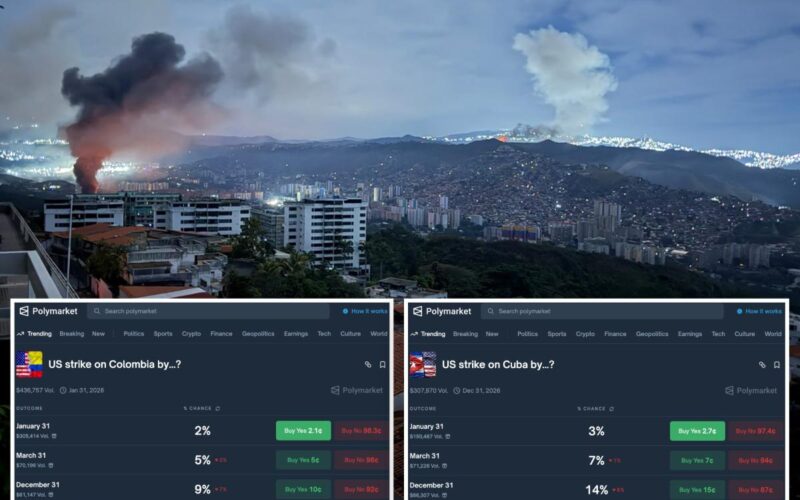
After mysterious Polymarket traders raked in over half a million dollars on contracts related to the capture of Venezuelan dictator Nicolás Maduro, the prediction market added several new contracts betting on President Trump’s next target – like Colombia or Cuba.
Traders placed wagers on whether the US will invade Cuba in 2026 – giving it a 10% chance – as well as when a possible strike might take place.
By Thursday afternoon, Polymarket users saw just 9% odds that the US would launch a strike on Colombia by the end of the year.
Three newly-created accounts on Polymarket won more than $620,000 on betting that Maduro would be forced out as leader by the end of the month – just hours before the US raid on the nation last Friday.
The largest wager came Friday — a $34,000 bet answering “yes” to the question, “Will Nicolás Maduro be forced out of power by January 31, 2026?”
That quickly fueled suspicions of insider trading, as prediction markets remain a bit of a legal gray area – with the status of betting on wars and conflict unclear.
Polymarket did not immediately respond to The Post’s request for comment Thursday. The company has a data partnership with Dow Jones, which shares common ownership with The Post.
Platform users now see a 36% chance that Ali Khamenei will be out as supreme leader of Iran by the end of June – up from less than 20% before the US raid on Venezuela.
There were also 34% odds that Israel strikes Iran by the end of the month, and a 15% chance that the US will acquire part of Greenland by the end of 2026.
Bettors saw just a 15% chance of a Russia-Ukraine ceasefire by March 31.
Polymarket came under criticism for refusing to pay out bets on a US invasion of Venezuela after the US strike over the weekend – arguing that the action wasn’t technically an invasion.
The bet refers to “US military operations intended to establish control,” Polymarket said on its website. “President Trump’s statement that they will ‘run’ Venezuela while referencing ongoing talks with the Venezuelan government does not alone qualify the snatch-and-extract mission to capture Maduro as an invasion.”
That sent the value of the “yes” contracts on a nosedive and left some gamblers outraged.
Prediction markets like Polymarket had an explosive rise after they correctly predicted Trump’s victory in the 2024 election – growing large enough to rival sports betting giants like FanDuel and DraftKings.
In 2024, the FBI raided the home of Polymarket founder Shayne Coplan, then 26, as part of a probe into whether the startup was accepting illegal bets from US users.
The US Commodity Futures Trading Commission gave Polymarket the green light to operate in the US in September.
Prediction markets that are regulated by the body face more stringent restrictions, including bans on contracts related to terrorism, assassination, war and illegal activities.
Kalshi, an American prediction market that launched in 2021, avoids topics related to wars – but its contracts often toe the line, like one questioning whether all or part of Greenland might join the US.
Critics have questioned the ethics around prediction markets that allow bets on violence and geopolitics – warning that could potentially create harmful incentives for military insiders to try to reap major windfalls.
Polymarket, for example, offers several contracts related to Middle East conflict.
“The promise of prediction markets is to harness the wisdom of the crowd to create accurate, unbiased forecasts for the most important events to society,” a website disclaimer linked to Middle East contracts said.
“That ability is particularly invaluable in gut-wrenching times like today.”