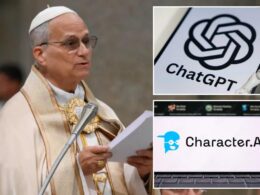
Pope Leo XIV on Monday issued a dire warning about the threat of “anti-human” AI in the first major theological document of his papacy — saying humanity is constructing a disastrous prideful Tower of Babel.
The first American pontiff used his encyclical — an official open letter from the pope to the Catholic Church — to call for the use of artificial intelligence in warfare to be subject to “the most rigorous ethical restraints,” warning that technology is fueling global conflicts.
The 70-year-old Chicago-born head of the Catholic Church compared the threat posed by AI to the biblical Tower of Babel.
Pope Leo, who previously described AI as the biggest challenge facing humanity, noted that the Tower of Babel was a doomed attempt by people to “make a name” for themselves by trying to build a single power and one language as they sought to erect a structure to Heaven.
He said the biblical story is a warning against a plan that “dominates and ultimately dehumanizes,” adding that instead, AI’s development should be shaped by diverse opinions and groups.
His letter appeared to put the Vatican in direct conflict with Silicon Valley executives — and at further odds with the Trump administration.
“The primary choice is not between a ‘yes’ or ‘no’ to technology, but rather between constructing Babel or rebuilding Jerusalem,” the pope wrote.
Unfettered technological development risks reducing humans “to mere cogs in a system driven toward ever greater efficiency.”
Titled “Magnifica Humanitas,” or “Magnificent Humanity,” Pope Leo’s encyclical, which is expected to define his papacy, demanded protection for what he called the distinctive “grandeur of humanity.”
AI “threatens to normalize an anti-human vision,” and so it cannot remain in the control “of a few” private actors, Leo said in his nearly 43,000-word encyclical, one of the highest forms of teaching from a pontiff to the Church’s 1.4 billion members.
“What is needed is a more active political involvement that is capable of slowing things down when everything is accelerating,” the pontiff said.
The pope called for “robust legal frameworks, independent oversight, informed users and a political system that does not abdicate its responsibility.”
Pope Leo presented Monday’s 235-page booklet alongside Chris Olah, a co-founder of the AI company Anthropic, which has been in a legal dispute with President Trump’s administration over the use of its technology in military and defense operations.
Echoing the pope’s call for greater accountability of AI bosses, Olah said decisions “should not be left to people in the industry” but instead requires a collective resolution.
Olah said three key principles involve a “duty to the global poor,” “moral imagination and ambition” and the “need for discernment.”
“Every frontier AI lab, including Anthropic, operates inside a set of incentives and constraints that can sometimes conflict with doing the right thing,” Olah told the audience at the Vatican.
The pope also issued a critique of “transhumanism,” the idea that technology can help a person overcome physical and biological limitations such as aging, as well as “posthumanism,” which blurs the boundaries between humans and machines.
“We cannot consider AI to be morally neutral. Every technical tool embodies choice and priorities through what it measures, ignores, and optimizes, and how it classifies people and situations,” Leo wrote.
Trump has been critical of the pope over his stance on the Iran war and has also taken a hands-off approach to AI regulation.
While his document focused primarily on AI, Leo also appeared to deliver a barb toward Vice President JD Vance, too, after the Catholic pol previously called on the pope to “be careful when he talks about matters of theology,” following his criticism of joint US-Israeli strikes on Iran.
The pope called the “just war” theory of Christian doctrine “now outdated,” adding that military force can only be used for “self-defense in the strictest sense.”
With Post wires