


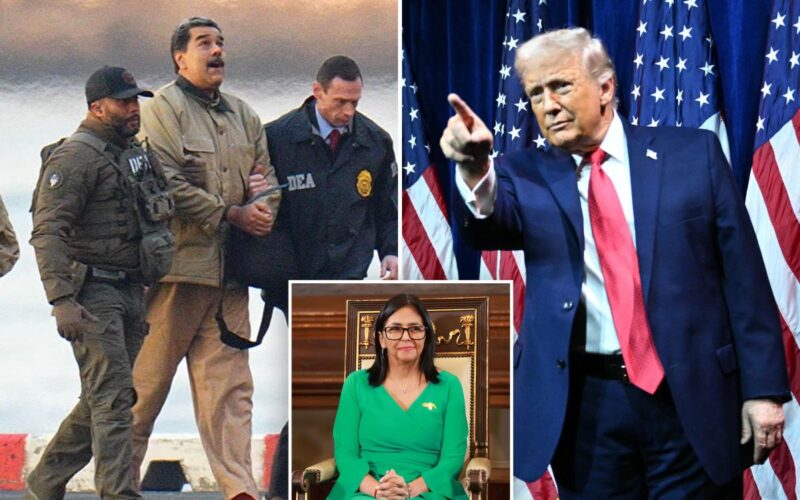
President Trump suggested Wednesday that the US will oversee Venezuela for at least a year following the Jan. 3 arrest of the South American country’s president, Nicolas Maduro, on federal drug and weapons charges.
“We will rebuild it in a very profitable way,” Trump told the New York Times in a lengthy interview. “We’re going to be using oil, and we’re going to be taking oil. We’re getting oil prices down, and we’re going to be giving money to Venezuela, which they desperately need.”
The president initially said “only time will tell” when asked how long the US will have a direct say in Venezuela’s affairs, but when reporters suggested various periods of time up to a year, Trump admitted: “I would say much longer.”
Trump also did not say when new elections in Venezuela might take place after he endorsed Maduro’s vice president, Delcy Rodríguez, as the head of the Caracas government rather than opposition leader María Corina Machado.
Secretary of State Marco Rubio has insisted that new elections take place as the final step to transitioning Venezuela out of 25 years of left-wing authoritarian domination that has sapped the country’s wealth.
Trump did not say Wednesday whether he has spoken to Rodriguez since Maduro’s arrest, but “Marco speaks to her all the time.”
“I will tell you that we are in constant communication with her and the administration.”
Earlier Wednesday, Energy Secretary Chris Wright said the US would “indefinitely” control sales of Venezuelan crude oil, explaining: “Instead of the oil being blockaded, as it is right now, we’re gonna let the oil flow … to United States refineries and around the world to bring better oil supplies, but have those sales done by the US government.”
A day earlier, Trump had vowed that Venezuela’s authorities would hand over between 30 million and 50 million barrels of sanctioned oil to the US and that he had directed Wright to execute the sale.
Here’s the latest on Nicolás Maduro’s capture:
Trump added the crude would be shipped to the US, sold at market prices and placed under American control to be used for what he described as the benefit of both countries.