




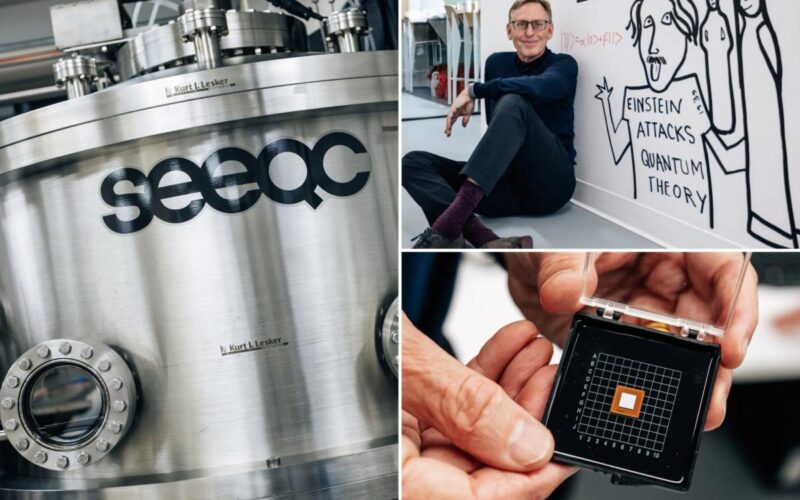
Tucked between a gymnasium and an inflatable amusement park, twenty-five miles north of midtown Manhattan, engineers are building some of the smallest quantum computers the world has ever seen.
Based in Elmsford, NY, SEEQC is collapsing the rooms worth of equipment that traditionally constitute a quantum computer — giant cylinders cooled to near absolute zero, racks of cabling, amplifiers and control equipment — onto a single chip.
Those chips, merely the size of a fingernail, are finally making quantum technology scalable. And, perhaps more importantly, they could give the U.S. its best shot at catching China in the race for quantum dominance.
“We’re talking about this brand new idea of computing,” John Levy, CEO and co-founder of SEEQC, told NYNext. “From an economic development perspective, a national defense perspective, there’s a serious opportunity up for grabs.”
Quantum computing technology harnesses the immense power of quantum mechanics — rather than the binary bits of traditional computing — to perform calculations. It can perform tasks that would take today’s most powerful supercomputers years and has the potential to reshape nearly every industry, from pharmaceuticals to finance to national defense.
Recognizing such immense potential, governments around the world have poured nearly $55 billion into the technology. China, which has pledged more than $12 billion in state funding to date, leads the pack.
Developments there are already so advanced that they drew warnings from the U.S. Defense Intelligence Agency in its 2025 Worldwide Threat Assessment.
Meanwhile, the U.S. has committed just $1.2 billion (about 2 percent of the worldwide total), leaving much of America’s progress in the hands of private innovators like SEEQC (pronounced ‘seek,’ short for Scalable Energy Efficient Quantum Computing).
The company, which has 35 employees, is a spin out of a company that spun out of IBM — and retains a handful of employees from those days. SEEQC’s chip technology is being integrated into partner systems with its forebear in Poughkeepsie, NY, along with Nvidia, Google, Amazon and Microsoft; it has also raised $30 million in private funding to advance what it calls the world’s first full-stack quantum processor.
But SEEQC isn’t just fueling Big Tech’s ambitions; their quantum-on-a-chip approach represents an entirely new computing architecture, one that merges quantum and classical computing into a single plane — harnessing the power of both, side by side.
“The typical way of controlling and operating a quantum computer takes up a lot of energy, requires a lot of bandwidth and is computationally slow,” Levy explains. “By putting it all on a chip, we’ve made it a lot faster and a lot more energy efficient — about a billion times more than your traditional, classical computing chip.”
Quantum on a chip isn’t the only route to making the technology scalable. Other companies are pursuing approaches based on trapped ions, neutral atoms, photonics, and superconducting systems that rely on external control hardware.
It’s still too early to know which model will ultimately dominate, but SEEQC’s advantage is that its chip-based approach architecture can interface with all of them. Because its technology isn’t tied to a single quantum model, it can plug into whichever approach ultimately scales.
That flexibility matters because the payoff is enormous. Quantum computing has the potential to help design life-saving drugs, unlock new forms of clean energy and simulate materials we’ve never been able to create; at the same time, its power could crack the encryption systems that secure everything from global banking to Bitcoin.
“That’s what keeps me up at night,” Levy said. “There are going to be implications on a global scale.”
As the race towards quantum dominance enters a critical stretch, with demand ever increasing, SEEQC is preparing to open a second facility in nearby Hawthorne, NY.
This story is part of NYNext, an indispensable insider insight into the innovations, moonshots and political chess moves that matter most to NYC’s power players (and those who aspire to be).
And yet, Levy knows his firm — and America — can’t win alone.
“We’ll need real collaborative efforts between private industry, government and academia to maintain the quality of life and the economic supremacy that our country enjoys,” he said.
Send NYNext a tip at nynextlydia@nypost.com.