




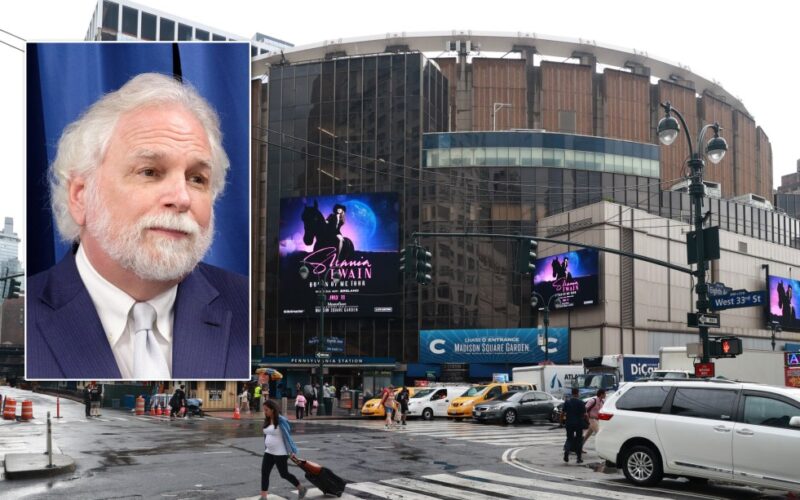
Two days before resigning as first deputy mayor, Randy Mastro took a parting shot at the city Department of Investigation, charging in a court filing that the watchdog agency was “fundamentally flawed” in raising concern about the legal work he did for the Madison Square Garden business empire while in public service.
Mastro submitted the Dec. 29 filing in response to ex-NBA player Charles Oakley’s attorney having called on a Manhattan Federal Court judge to disqualify Mastro from working as an attorney for Madison Square Garden due to the Department of Investigation’s findings.
Oakley has for years been bogged down in a legal battle with MSG over his ejection from a Knicks game in 2017 that he alleges was retaliation for his criticism of the team’s owner, James Dolan. Mastro has since 2017 been an attorney for Dolan’s corporate empire in the case and, as first reported by the Daily News, kept doing so on the side after Mayor Adams made him his first deputy in spring 2025.
Because MSG holds various city government business interests, the Department of Investigation concluded in a report last month that Mastro’s representation of MSG while first deputy mayor “technically violated” the law and that he could have legally engaged in it only if he received a public waiver from the Conflicts of Interest Board. The DOI report stressed Mastro wasn’t himself under investigation and faulted the board for clearing him for the work without a waiver.
Still, in last month’s court filing urging a judge to reject the Oakley lawyer’s disqualification request, Mastro went out of his way to lambaste the DOI for its reasoning.
“While not relevant to the disposition of this application, I note that DOI’s analysis is fundamentally flawed,” Mastro wrote in a footnote to the previously unreported filing.
The flaw, Mastro continued, lay in the fact that the DOI’s conclusion relied on local ethics law barring city officials from engaging in many forms of “moonlighting” while in public service.
“‘Moonlighting’ is commonly understood to mean ‘hav[ing] a second job in addition to one’s regular employment,’” Mastro wrote, citing the Oxford English Dictionary. “But I did not have a second ‘job.’ Indeed, spending a few hours pro bono for the limited purpose of fulfilling my ethical obligation to appear at an imminent court hearing relating to MSG’s motion for summary judgment — an effort I led prior to my appointment as First Deputy Mayor — is not ‘moonlighting’ at all.”
In a separate footnote, Mastro even claimed Oakley’s attorney may have instigated the DOI’s review of his MSG work. “It seems possible, if not probable, that Oakley’s counsel generated this DOI inquiry in an attempt to have yet another bite at the apple on an issue they litigated and lost,” he wrote.

Mastro, who has returned to his private law practice since leaving City Hall on Dec. 31 ahead of Mayor Mamdani’s inauguration, didn’t return a request for comment Thursday.
In response to Mastro’s rebuke, DOI spokeswoman Dianne Struzzi said her agency “stands by the findings in our report.” She also dismissed Mastro’s claim about any involvement of Oakley’s attorney, saying the DOI’s “inquiry began with media reports,” specifically The News’ coverage.
The judge overseeing the Oakley matter has set a hearing for Tuesday to consider Oakley’s request to disqualify Mastro from the proceeding.