




By MAE ANDERSON
NEW YORK (AP) — At Fleece & Harmony, a woolen mill and yarn shop in bucolic Belfast, Prince Edward Island, in Canada, owner Kim Doherty used to be able to send yarn skeins to U.S. customers across the border with little fanfare.
The yarn orders usually met an import tax exemption for packages valued at under $800, meaning it could be imported tariff-free and avoid the customs process.
But ever since the Trump administration eliminated the exemption as of Aug. 29, the cost to send yarn to U.S. customers has skyrocketed. The bill for a $21 ball of yarn now includes $12 to $15 in brokerage fees that her shipper UPS charges, plus state taxes and a 6.5% tariff, all of which almost doubles her costs.
“We had orders that have reached the customers and they’re in shock about the fact that they have to pay,” she said. “And it’s amazing how many people really didn’t know what the impact was going to be.”
Getting rid of the so-called de minimis exemption was meant to curb drug trafficking and stop low-quality goods from discount sellers like Temu and Shein flooding the U.S. market.
But as the all-important annual holiday shopping season kicks off, it is putting a crimp on small businesses and shoppers now facing higher costs.
Chad Lundquist in Fort Lauderdale, Florida, ordered fragrance oil from a site called Oil Perfumery in October, but he didn’t realize the business was based in Toronto, Canada. His total was $35.75, which included an $8 standard shipping fee. But when his package arrived, he was hit with a $10.80 tariff bill from FedEx.
“It wasn’t worth the $10 tariff for a $27 purchase,” Lundquist said. Oil Perfumery did not respond to a request for comment.
He’s not the only skittish shopper. Three months after the exemption ended, sellers abroad are reporting drastic declines in U.S. sales. Some are paying the duties themselves instead of passing them to consumers. They are also trying to focus on domestic customers to replace U.S. ones and adjusting product lineups to feature best selling items to try to goose sales.
Martha Keith, founder of British stationery brand Martha Brook, which is based in London with a small office in Melbourne, Australia, said U.S. sales from her Etsy store — her main e-commerce channel in addition to her own website — were up 50% for the year before the exemption ended. But sales fell dramatically when the tariffs hit, and continue to drop even though she’s paying the import taxes and customs fees herself so customers aren’t impacted. Sales are down about 30% year-over-year.
“The issue seems to be in customer confidence hitting the desire to order from businesses outside of the U.S., because of confusion about how the tariffs will affect them,” Keith said.
She’s also in a bind because she sold a £109 ($144) stationery advent calendar to about 344 U.S. customers ahead of the tariffs, and had to ship them under the tariffs. Shipping and tariffs cost her an additional £5750 ($7590) to cover shipping the advent calendars already sold.
“The whole thing has been a bit of a nightmare for businesses like ours, and such a huge shame, as the U.S. market was such a valuable growth area for us, particularly through Etsy,” she said.
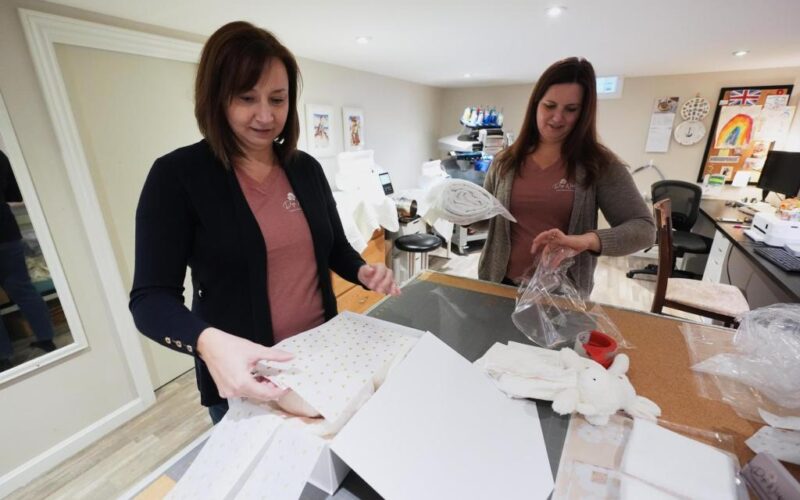
The timing was particularly bad for Sue Bacarro, who along with her sister co-owns Digi Wildflowers, an Etsy shop that sells embroidered baby blankets, gifts and custom quilts for wedding and anniversaries, located across the border from Detroit in Windsor, Ontario.
-
Fran Poirier, right, and her sister, Sue Bacarro, left, fill orders at their Etsy shop, Digi Wildflowers, Thursday, Oct. 30, 2025, in Windsor, Ontario, Canada. (AP Photo/Paul Sancya)


1 of 4
Fran Poirier, right, and her sister, Sue Bacarro, left, fill orders at their Etsy shop, Digi Wildflowers, Thursday, Oct. 30, 2025, in Windsor, Ontario, Canada. (AP Photo/Paul Sancya)
Before the announcement of the removal of the de minimis exemption, they placed a large inventory order to prepare for the holiday season and early 2026 demand. But when the de minimis exemption ended, “inventory wasn’t moving as expected, and we suspected customers were hesitant to purchase due to potential duty charges,” Bacarro said.
Sales — 70% of which come from Americans — finally started to rebound when Digi Wildflowers prominently added a banner on its site that said, “U.S. Import Duties On Us.”
“Heading into this holiday season, we’re keeping that message front and center through banners, social media, and direct communication,” said Bacarro, who is also expanding their product line.
But not all businesses can — or want to — pick up the tariff tab.
Kim Doherty, who runs the woolen mill on Prince Edward Island, doesn’t plan to pay the tariff and fees for her customers.
“I’m not in a position as a small business owner to do that. The profit margins are already rather thin,” said Doherty, adding that “on principle,” she shouldn’t have to do it.
Right now, her shipments to U.S. customers are about 10% of what they were. Instead, she’s working on expanding her fiber offerings to Canadian customers at her brick-and-mortar store and fiber festivals.
“We’ll see what happens,” she said. “I’m pretty sure that my U.S. customers were shopping and not even thinking about it, but now they’ll be evaluating the purchases that they’re making, knowing that they are going to have the extra fees on top of whatever they see.”
Some Etsy businesses have been stymied by international postal services temporarily halting deliveries to the U.S. because of the confusion around the ending of de minimis.
Selene Pierangelini’s business, Apricot Rain Creations, based in Brisbane, Australia, which sells crystals, candles, and spiritual wellness products on Etsy, depended on the Australia Post to get deliveries to U.S. customers. More than three-fourths of her customer base comes from the U.S. Australia Post suspended service to the U.S. for about a month, resuming on Sept. 22.
She temporarily switched to FedEx and UPS — private shippers that are more expensive than Australia Post. Since it resumed, Australia Post is working with Zonos, a provider of cross-border shipping technology, to offer a shipping calculator that lets her prepay duties and fees. They themselves charge a fee of $1.69 plus 10% of the total duty fee.
So far, the items she ships from Australia have been tariffed at a 10% rate, the baseline tariff for the country. She increased her shipping costs to help cover the expense. It is manageable, but tricky, she said.
“You don’t really know how much (the cost) is going to be until the package clears custom in the U.S., and you get an invoice which is automatically paid out of your account,” she said.
And her sales have not recovered. Before the tariffs, her U.S. sales were about 85% of her total sales, and now they’re around 35%. She’s hopeful people are just holding off until Black Friday and Cyber Monday holiday sales.
In the meantime, she has restarted sales to Europe, which she had paused in 2024 due to increased regulations. And she’s launched a Facebook marketing campaign and is exploring print-on-demand services from U.S.-based providers for production and fulfillment.
“This situation highlights how fragile small businesses can be when dependent on one market,” Pierangelini said. “While it has been a shock, it’s also pushed me to diversify — something that will hopefully make my business stronger and more resilient in the long run.”