


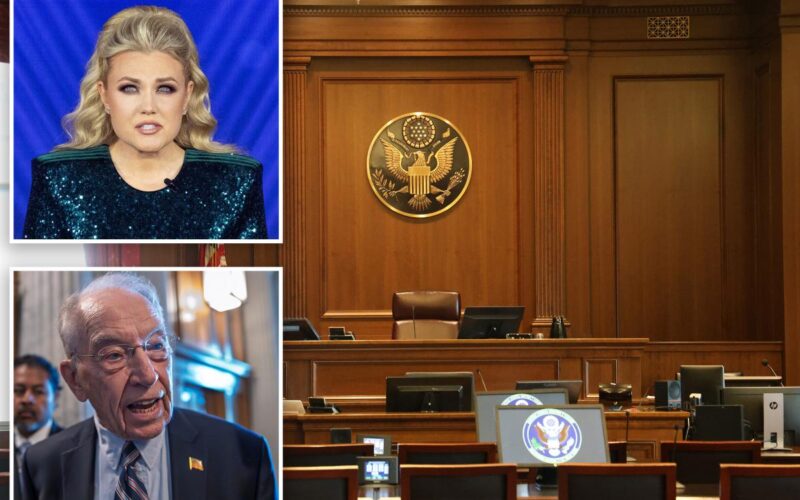
Sen. Chuck Grassley (R-Iowa) Thursday pushed legislation through the Senate Judiciary Committee to allow cameras in federal courtrooms, arguing that greater public access would strengthen confidence in the judicial system.
The most highly anticipated court hearings have been televised for millions to watch. From Ted Bundy, OJ Simpson to Johnny Depp, trials have captivated audiences worldwide.
As more national cases come to the forefront — from Charlie Kirk’s accused murderer Tyler Robinson to Luigi Mangione, on trial for the killing of UnitedHealthcare CEO Brian Thompson — audiences are becoming more eager to be in the know about what’s happening inside the courtroom.
The “Sunshine in the Courtroom” act, introduced by Grassley and Sen. Amy Klobuchar (D-Minn.), would give federal judges discretion to permit cameras in the court proceedings while preserving the right for a fair trial.
Grassley’s separate bipartisan legislation, the “Cameras in the Courtroom” Act, co-led by Sen. Dick Durbin (D-Ill.), would allow television coverage of open Supreme Court sessions, unless a majority of justices determines that it would violate the due process rights of a party in the case.
Both measures are part of a decades-long effort by Grassley to open federal courts to greater public scrutiny. Versions of the Sunshine in the Courtroom Act have been introduced repeatedly since 2015, while the Cameras in the Courtroom Act has received bipartisan support in multiple Congresses since 2021.
Grassley said the legislation will “boost transparency” and help “Americans grow in confidence and understanding of the judiciary.”
While most state courts already permit some sort of camera access, federal courts have remained largely resistant. In the federal appellate courts, only the Second and Ninth Circuits allow cameras in proceedings. The U.S. Supreme Court continues to prohibit video coverage, but allows for live audio of oral arguments.
Grassley said that the legislation will contain “provisions to protect the identity of witnesses, lawyers and prohibits coverage of private conversation.”
“The public has a right to observe the cases before the highest court, and these Supreme Court decisions have national importance, and they affect the lives of every American,” Grassley said. “This legislation ensures access to all Americans, even those who may not have resources to travel to Washington D.C. and observe the court in person.”
In April, Robinson pushed to not allow on-camera press coverage of his court proceedings on charges in the killing of Kirk on Sept. 10. He argued coverage of the case was “filled with opinion and misinformation,” believing that media coverage is harming his ability to receive a fair jury.
Aristide Economopoulos
Fourth District Judge Tony Graf Jr., however, said he wouldn’t prohibit media in the courtroom, but has taken steps such as placing a camera in the back of the courtroom to address concerns about capturing private conversations or documents.
Kirk’s widow, Erika Kirk, argued in a Fox News appearance last fall that cameras should be allowed because transparency is the best way to guard against conspiracy theories that have circulated.
“Why not be transparent?” Kirk said. “There’s nothing to hide. I know there’s not, because I’ve seen what the case is built on.”
Grassley said this bill will grant the “transparency Erika Kirk seeks” and that the “public has a right to see justice prevail.”
Klobuchar echoed Grassley, saying that “people should have the right to see what’s going on when senators are debating” and should be granted the same in the Supreme Court.
A former federal prosecutor, Paul Butler — who now teaches law at Georgetown University — told The Post that “there is zero evidence that cameras sensationalize cases” and believes that cameras in courtroom “enhance civic engagement and the public’s right to know.”
“A hallmark of the US judicial system is that it is open; any person can walk into a courtroom to watch how the system works,” Butler said. “Cameras in the courtroom are just a modern-day, technological application of the value of an open and transparent legal system.”
Opponents of cameras in court, including U.S. Supreme Court Justices Elana Kagan and Samuel Alito, argue that recording arguments would compel lawyers to perform for the cameras more than the courts. Arturo Corso, a criminal defense lawyer based in Georgia, told The Post that when “cameras come in, discretion goes out.”
“No one has the same level of courage to exercise discretion and judgment when they worry they will be edited, cast in a false light, or put into a supercut that gets played on loop,” Corso said. “Bottom line, cameras bring out fears that squash courage to make the tough calls.”
Both bills were easily passed out of the Senate Judiciary Committee by voice vote and will move forward to the full US Senate for consideration. It’s unclear when the legislation would receive a floor vote.