



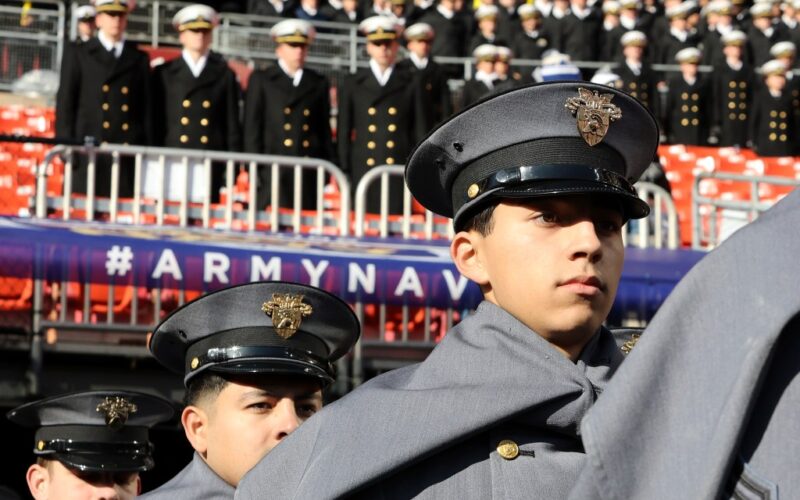
Today, about seven million people will watch what is known as “America’s game” — the Army-Navy football contest. It has been played since 1890, and, since 1898 has never been cancelled.
Seven million people is a lot of viewers, but it is a fraction of the number of Americans who should watch it. Not for the quality of play on the field — which is pretty good — but for the quality of character off it.
Fewer and fewer people are familiar with West Point, Annapolis, or the Air Force Academy in Colorado Springs. That is not surprising: the number of living Americans who have served in the military is about 7.8 million, about 6% of the U.S. population, down from 18% in 1980.
Interestingly, as colleges, the Military, Naval, and Air Force Academies are more popular than ever. They attract a large number of applicants each year — between 13,000 and 15,000 each for about 1,300 spots at each school. Yet, many high school seniors considering an academy apply to more than one.
So, while 1.7 million students will graduate from high school this year, and about 250,000 will apply to the 300 more selective colleges, only about 10% of them will consider an academy. In contrast, Brown University will probably receive more than 50,000 applicants, Notre Dame about 28,000, and Berkeley more than 125,000.
Despite the academies having free tuition and room and board — certainly an incentive for some — the required five years of military service after graduation is not seen as a guaranteed job. Rather, it is an obligation and honor, a shared experience by generations who see themselves as part of the Long Gray Line at West Point or an Annapolis grad.
To anyone who has gone through Beast Barracks or Plebe Summer (as I did in the summer of 1969) — the two-month boot camp that precedes the first academic year at an Academy — it is absolutely evident that money has almost nothing to do with a young person’s decision to endure four years of Academy life or service after commissioning.
Unlike their college-bound friends, cadets and mids know their professional path will have one big difference: inherent danger.
Naval Academy midshipmen are reminded of those dangers nearly every day as they past Memorial Hall, which honors the many Academy graduates who have given their lives in service to the nation. West Point and Colorado Springs have similar tributes, and all are reminded by regular headlines about international military special operations where recent grads are at risk.
I was reminded of these risks — and the general public’s general unawareness of them — recently when I visited my other alma mater, Brown, for a Veterans Day celebration.
After speeches by dignitaries and a very impressive Brown sophomore Kloey Albertson, an Army staff sergeant, 12 ROTC cadets were sworn in.
About 250 people were in attendance, but that included most of the 75 undergraduates, and 38 graduate students who are veterans, and the 49 undergraduates who participate in ROTC programs. In short, it was clear to me that there were few, if any, non-military-affiliated students in attendance.
I didn’t sense any hostility towards this very light military presence on campus, but I certainly saw little connection between undergraduate civilians and the military contingent.
The gap — social, experiential, and probably political — between most Brown — and other Ivy — undergraduates and those who have served in the military is significant. And it is unfortunate and detrimental to the country. In all likelihood, Ivy League graduates will be among the next generation’s leaders in law, business, and government — but not the military.
On the flip side, many of tomorrow’s military leaders will come from the service academies. It would benefit both groups and the nation to have more interaction, and exposure to the other’s experiences and perspectives.
To that end, I would love to see regular Ivy-Academy football contests, and a semester-long exchange program between the Ivy League schools and the Academies. They would learn from each other, and more importantly, we as a nation would be better for it.
Cohen is an attorney at Pollock Cohen in New York, and member of the class of 1973 at the Naval Academy and the Brown University class of 1975.