




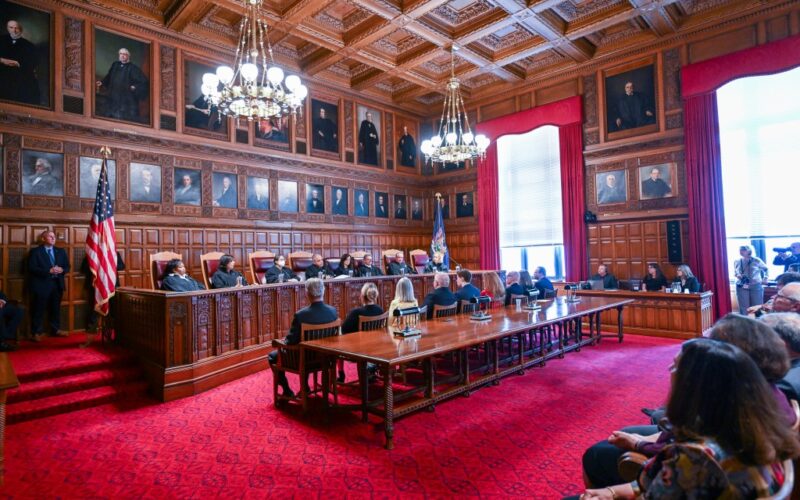
Former Court of Appeals Judge Susan P. Read has written on the substitution policy of the Court of Appeals under Chief Judge Rowan T. Wilson in these pages and in the New York Law Journal. As Read states, under that policy the chief judge “designate[s] a substitute judge in every appeal as soon as a Court of Appeals judge recuses.”
Read is critical of that policy from a public policy perspective, and I agree. But my focus is on the authority of the chief judge under the New York Constitution: Does the chief judge have the authority to determine whether to designate a substitute judge and, if so, who should be designated? I conclude that only the court itself has that authority.
Two provisions of Article 6, Section 2 authorize the designation of what may be called temporary judges of the Court of Appeals. Under both provisions, only a justice of the Supreme Court may be so designated.
The provision at issue when a Court of Appeals judge recuses is the fifth sentence of subdivision (a) (the “subdivision (a) provision”). It reads as follows: “In case of the temporary absence or inability to act of any judge of the Court of Appeals, the court may designate any justice of the Supreme Court to serve as associate judge of the Court of Appeals during such absence or inability to act.”
AP
Judge Rowan Wilson (Office of Governor of New York/Darren McGee via AP)
The second provision is the opening sentence of subdivision (b) (the “subdivision (b) provision”). It reads as follows: “Whenever and as often as the Court of Appeals shall certify to the governor that the court is unable, by reason of the accumulation of causes pending therein, to hear and dispose of the same with reasonable speed, the governor shall designate such number of justices of the Supreme Court as may be so certified to be necessary, but not more than four, to serve as associate judges of the Court of Appeals.”
Can the word “court” in the second clause of the subdivision (a) provision reasonably be construed to mean “chief judge”? Surely not.
The opening sentences of Article 6 are: “The Court of Appeals is continued. It shall consist of the chief judge and the six … associate judges … and their successors, and such justices of the Supreme Court who may be designated for service in said court as hereinafter provided.” The text thus distinguishes between the court and the chief judge.
So, too, does the next sentence: “The official terms of the chief judge and the six associate judges shall be 14 years.” The next paragraph of subdivision (a) makes all the more clear that the “court” is not to be identified with a single judge of the court. It begins as follows: “Five members of the court shall constitute a quorum ….”
The syntax of the subdivision (a) provision confirms the point. The provision’s first clause ends with “the Court of Appeals” and, immediately after a comma, the second clause begins with “the court.” If the second clause began with “the Court of Appeals,” any argument that the provision conferred designation authority on the chief judge would be foreclosed. The want of textual verbosity — i.e., the omission in the clause of the words “of appeals” — cannot transform the words “court” and “chief judge” into synonyms. Notably, subdivisions (b) and (c) of Section 2 also use the words “the court” only after first referring to the “Court of Appeals.”
Moreover, the designation authority conferred by the subdivision (b) provision is contingent on a certification by the “Court of Appeals,” not the “chief judge.” And subdivision (d)(1) of Section 2 confers authority to appoint members of the Commission on Judicial Nomination: “[F]our shall be appointed by the governor, four by the chief judge of the Court of Appeals, and one each by the [four legislative leaders].” Similarly, Section 22(b)(1) of Article 6 specifies that three members of the Commission on Judicial Conduct “shall be appointed by … the chief judge of the Court of Appeals.”
And Section 28, among other things, empowers “[t]he chief judge” to establish certain standards and administrative policies, “after consultation with the administrative board …, which shall be submitted by the chief judge to the Court of Appeals.” Obviously, this appointment and other authority could have been conferred on the Court of Appeals rather than the chief judge. When the framers of Article 6 wanted to differentiate between the court and the chief judge, they knew how to do it.
A final textual point: If the word “court” in the subdivision (a) provision somehow means “chief judge,” wouldn’t that mean no Supreme Court justice could be designated if the chief judge either had to recuse in a particular case or became suddenly but temporarily incapacitated? That cannot be correct. And indeed, the provision authorizes the designation of a Supreme Court justice “[i]n case of the temporary absence or inability to act of any judge of the Court of Appeals” (emphasis added) — including the chief judge. This is yet another reason why it cannot be right that the subdivision (a) provision confers designation authority on the chief judge only.
An overarching point is that both sources of designation authority reflect the Constitution’s preeminent precept of checks and balances. After all, the subdivision (b) designation authority is conferred on the head of the executive branch, but is checked by the judicial branch because it is exercisable only if “the Court of Appeals” makes the requisite certification. Read correctly, the subdivision (a) designation authority, while it is not conferred on the head (or heads) of a different branch, is nevertheless both diffused among the members of the court and checked by the need to obtain a majority to determine whether and how it should be exercised.
Consider, too, the enormous breadth of the authority the chief judge would have if he or she, rather than the court itself, had the authority to designate Supreme Court justices under the subdivision (a) provision. No temporal limitation is placed on the length of the service on the court by a Supreme Court justice. What if a judge of the court is temporarily absent or unable to act for, say, two weeks, two months or more?
No numerical limitation is placed on the number of Supreme Court justices who can be designated. What if, during a particular stretch of time, two or more judges are temporarily absent or unable to act? If the chief judge is authorized to designate one Supreme Court justice under the subdivision (a) provision who can serve for two weeks or two months, he or she must be authorized to designate two or more Supreme Court justices who can so serve.
If there were a substantive reason to concentrate so much power in the chief judge, that reason would be obvious. None, however, is apparent.
Another structural point is that the proposition that the word “court” in the subdivision (a) provision means the “chief judge”, cannot be squared with the 1977 amendment to Section 2. The amendment put the judges at a remove from the political fray. It abolished the election of the judges in favor of what is commonly referred to (with at least some legitimacy) as “merit selection.”
Under the amendment, vacancies are filled through a process in which no branch of government — let alone the leader, or one of the leaders, of a branch — has unilateral authority to determine who will fill a vacancy. Rather than concentrate appointment power in one branch, the amendment diffuses it. When a vacancy occurs, the Commission on Judicial Nomination must convene and it, as noted, consists of 12 members, with four members appointed by each branch. This multi-branch body must “recommend to the governor those persons who by their character, temperament, professional aptitude and experience are well qualified to hold such judicial office.”
The governor’s authority is cabined in two respects: the governor can appoint only a person recommended by the commission and the appointment is subject to the advice and consent of the Senate. The governor has the authority to make interim appointments, but only when the Senate is not in session to give its advice and consent. Thus, if the Senate is in session, no one — not the governor, the chief judge, or any governmental actor or body — can fill the vacancy on an interim basis. If the Senate is not in session, the governor is commanded to make an interim appointment, and the interim appointee must be the person the governor nominates to fill the vacancy.
In sum, Section 2 is a comprehensive constitutional scheme that imposes checks on the power of governmental actors to determine who shall serve, be it temporarily or for the constitutionally prescribed term, on the Court of Appeals.
The subdivision (a) provision is not an anomalous provision that confers unchecked power on the chief judge to determine either whether the designation authority should be exercised or who, from the ranks of the elected Supreme Court justices, should be designated to serve on the court to hear and potentially provide the decisive vote in one, ten, or scores of appeals. The only reasonable reading of the word “court” in the subdivision (a) provision that is consistent with the constitutional scheme and the repeated uses of the word in Section 2, is the one that gives the term its plain meaning: the “court” is the “Court of Appeals.”
McGuire, a partner at Holwell Shuster & Goldberg, is a former associate justice of the Manhattan Appellate Court.