




Last week the Supreme Court gave the country one notable gift in blocking the Trump administration’s efforts to deploy the National Guard to Chicago, part of a campaign of intimidation that has seen troops deploy now to various (invariably heavily Democratic) areas.
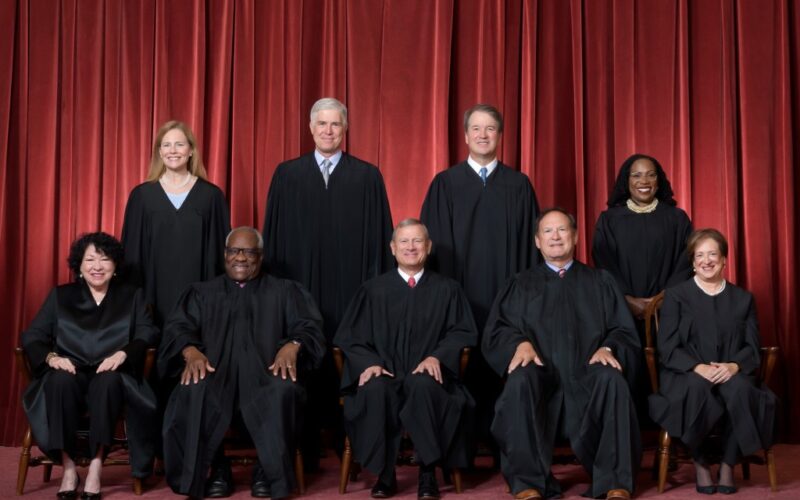
Six justices said no to Trump, Chief John Roberts, Sonia Sotomayor, Elena Kagan, Brett Kavanaugh, Amy Coney Barrett and Ketanji Brown Jackson, while only three stood with him: Clarence Thomas, Sam Alito and Neil Gorsuch.
That doesn’t take the high court off the naughty list; this shadow docket decision is all the more notable for how comically these decisions have so far tilted in favor of Trump. Prior to this ruling, the Supreme Court had issued 24 decisions on its emergency docket, of which 20 had gone in favor of the Trump administration, often overturning district and circuit court decisions that had sided against, on what were sometimes relatively obvious points of law.
For the justices to slap down Trump’s attempts to use it as a get-out-of-legal-compliance-free card, something seems to have to be both extremely unlawful, as were the efforts to invoke the Alien Enemies Act under insane pretenses and to disregard a federal court order requiring the return of Kilmar Abrego García.
We’re in sort of a weird posture these days when our federal court system has to take at face value and evaluate legal arguments that are obviously pretextual. In this case, seeing that there was no plausible way to argue that there was rebellion or invasion in Illinois, the administration hung its hat on the notion that it could not uphold the law in the state without the deployment of the military. The court stopped short of addressing the point of whether order really has broken down in Illinois (it has not) but rested its order on the president’s ability to deploy the National Guard.
Beyond the absurd premise — that Trump’s already-legally-questionable efforts to use overwhelming force to round up immigrants and native-born citizen protesters alike could not be carried out by the combined force of every federal law enforcement agency — the court pointed out that this legal authority just doesn’t exist.
This extraordinary power can only be invoked when the regular military is not enough to enforce domestic laws, and the military is already barred from enforcing laws on U.S. territory except in extreme circumstances, for pretty good reasons (countries where armed military is conducting operations on the streets are not often those where things are going well or particularly democratically).
Chalk up at least one victory here for the rule of law, among the biggest stress test in at least 150 years. Unfortunately, the lesson Trump has learned from his decades of lying and cheating in business and then lying and cheating in politics is to always keep punching and prodding regardless of the law, norms, ethics or basic decency, so don’t expect this to stop here. There’ve already been rumblings for a while that some White House factions have been salivating over the prospect of invoking the Insurrection Act in an attempt to actually get regular military out on American streets with the possibility of actually employing force.
The courts, one of the few remaining institutional checks on his authoritarian power grabs, must continue to quickly and forcefully slap down the administration’s efforts to politically weaponize our military — often seen as a final, conclusive step in consolidating autocratic power — whether it’s a district judge or the highest court in the land.