


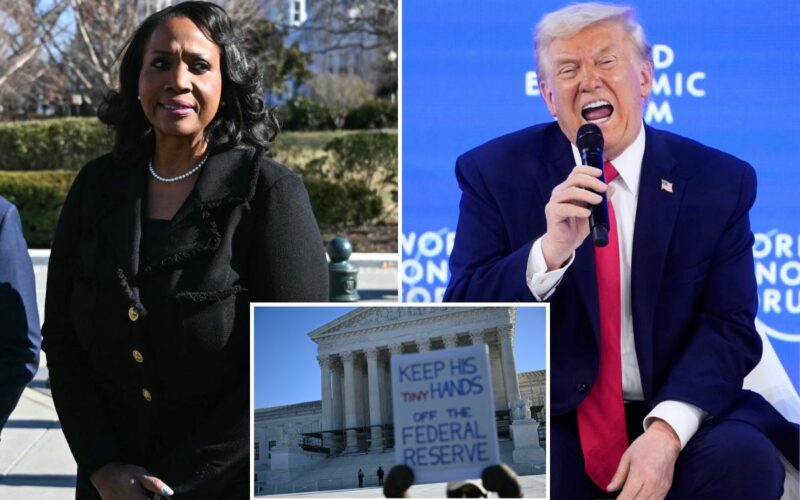
WASHINGTON — The Supreme Court appeared likely Wednesday to rebuff President Trump’s bid to dismiss Federal Reserve Governor Lisa Cook, with the justices devoting much of oral arguments to agonizing over limits on the executive’s power to remove officials from nominally independent agencies.
The high court raised concerns about the potential erosion of the central bank’s independence and its effect on the economy if it granted the White House request, but also fretted about setting a precedent that could be abused by future Fed officials.
Trump attempted to fire Cook on Aug. 25, 2025, via a Truth Social post — citing accusations by Federal Housing Finance Agency Director Bill Pulte that she had committed mortgage fraud.
Cook sued to stop the firing, and a district court issued a preliminary injunction barring her immediate removal, which both an appeals court and the Supreme Court declined to lift.
“We have amicus briefs from economists who tell us that … if we grant you your stay, that it could trigger a recession,” conservative Justice Amy Coney Barrett told Solicitor General John Sauer, arguing for the Trump White House.
“Your position that there’s no judicial review, no process required, no remedy available, very low bar for cause — that the president alone determines [cause] — that would weaken if not shatter the independence of the Federal Reserve,” added conservative Justice Brett Kavanaugh.
“It incentivizes the president to come up with what, as the Federal Reserve’s former governors say, ‘trivial’ or ‘inconsequential’ or old allegations that are very difficult to disprove,” he later added. “It incentivizes kind of the search and destroy.”
Under the Federal Reserve Act, the president is allowed to remove a member of the Board of Governors, but only “for cause” — and not over policy differences.
Trump is the first president in the history of the Fed, which was founded in 1913, to attempt such a removal.
“Just thinking big picture, what goes around comes around,” Kavanaugh mused. “All the current president’s appointees would likely be removed for cause on January 20, 2029, if there’s a Democratic president, or January 20, 2033, and then we’re really at at-will removal. So what are we doing here?”
Sauer repeatedly contended that Trump had cause to fire Cook because of the mortgage fraud accusations, despite her lawyer disputing them.
Attorney Paul Clement, who argued on Cook’s behalf, argued that to satisfy the “for clause” requirement, the president needed to provide notice, evidence of wrongdoing, and not prejudge the case.
Clement conceded that any president should get “flexibility” in terms of the process for how he or she determines whether or not a Fed governor needs to be removed, but rejected Sauer’s suggestion that the firing shouldn’t be subject to a court review.
Some of the justices were also leery of hamstringing a president from firing a Fed governor even if it was over actions, such as those alleged in Cook’s case, that took place before their tenure.
“Suppose that the office holder was permitted to resign from a previous job under a nondisclosure agreement based on a long and egregious pattern of sexual conduct. That would not be for cause removal?” conservative Justice Samuel Alito asked.
“How about if, after a person assumes office, videos are disclosed in which the officeholder is expressing deep admiration for [Adolf] Hitler or for the [Klu Klux] Klan?”
Clement responded that impeachment would be the proper remedy rather than dismissal “for cause.”
Several times during oral arguments, justices such as conservative Neil Gorsuch floated the idea of remanding parts of the case to the lower courts for further deliberation.
Cook, who was tapped by former President Joe Biden in 2022, was defiant after the arguments, saying in a statement that “as long as I serve at the Federal Reserve, I will uphold the principle of political independence in service to the American people.”
Trump’s attempt to fire Cook came amid his pressure campaign for the Fed to lower interest rates and loosen up monetary policy, something that economists warn would risk inflation.
Fed Chair Jerome Powell and one of his predecessors, Ben Bernanke, were among the spectators at oral arguments.
A decision in Trump v. Cook is expected by the end of June.