




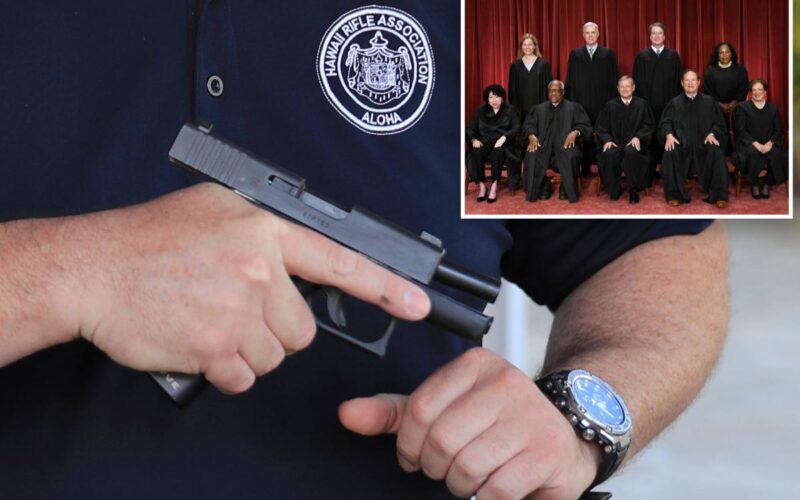
Supreme Court justices were stunned Tuesday when lawyers defending Hawaii’s so-called “vampire rule” — which restricts carrying guns on privately owned spaces without consent — pointed to racist laws in their defense of gun control.
During their arguments, the lawyers had cited the Black Codes, post-Civil War segregationist laws that limited the rights of African Americans, as evidence of a tradition of similarly restrictive gun control in US history.
“I want to understand how you think Black Codes should inform this court’s decision-making. It’s quite astonishing,” conservative Justice Neil Gorsuch pressed attorney Neal Katyal.
Lawyers were before the Supreme Court Tuesday for arguments over whether Hawaii can ban people from carrying a handgun onto private property open to the public, like laws and hotels, without the owner’s permission.
Katyal argued that while the Black Codes were a “shameful period” in US history, there were parts of those laws that were “race neutral.”
The attorney, who defended Hawaii’s “vampire rule,” further contended that the debate around the Black Codes in the 1800s also proved that it was understood at the time “you have no right to carry a firearm onto someone’s property absent their consent.”
But conservative Justice Samuel Alito asked, “Wasn’t the purpose of the laws in the post-reconstruction South that disarmed black people precisely to prevent them from doing what the Second Amendment is designed to protect?”
“They wanted to disarm the black population in order to help the [Klu Klux] Klan terrorize them,” he went on. “They wanted to put them at the mercy of racist law enforcement officers. So is it not the height of irony to cite [that]?”
Conservative Justice Clarence Thomas later chimed in and highlighted the fact that the 14th Amendment was later enacted to counter racist laws like the Black Codes, which could complicate the case for Hawaii.
The requirement is dubbed the “vampire rule” for its consent requirement.
The Supreme Court is expected to hand down a decision by late June, marking one of its most significant Second Amendment cases in the past three years.
The 9th U.S. Circuit Court of Appeals, which is based in San Francisco, upheld Hawaii’s law in 2024. Several states, such as New York, New Jersey, and California, have adopted similar gun control measures to Hawaii.
Liberal Justice Ketanji Brown Jackson defended the references to the Black Codes, arguing they were being referenced to satisfy a legal test required in the New York State Rifle & Pistol Association v. Bruen case, which nixed the Empire State’s old “special cause” requirements for people to get a license to carry a handgun.
“It’s because we have a test that asks us to look at the history and tradition,” Jackson argued. “The fact that the Black Codes were at some later point determined themselves to be unconstitutional doesn’t seem to be relevant to the assessment that Bruen is asking us to make.”
Overall, during the nearly two hours of oral arguments, a majority of the justices appeared uneasy with Hawaii’s law, while the liberal justices grilled the attorneys trying to overturn it.
“You are just regulating the Second Amendment to second-class status,” Alito argued to Katyal.
Conservative Brett Kavanaugh mused at one point that the case was “pretty simple” in light of the high court’s recent precedents requiring proof of history and tradition of similar gun restrictions.
Chief Justice John Roberts pointed to examples of how people have an assumed right to walk up to a gas station on the side of the highway or go up to people’s homes to hand out leaflets.
They broadly seemed unconvinced by Katyal’s arguments in defense of Hawaii’s gun control law based on precedents.
“Every private property owner has the right to affirmatively put up a sign or otherwise not give permission for people to enter the property with firearms,” Alan Beck, attorney for gun rights advocates, contended.
“The crux of our argument is why flip that historical default from them having to affirmatively say guns are not allowed here to the current law.”