



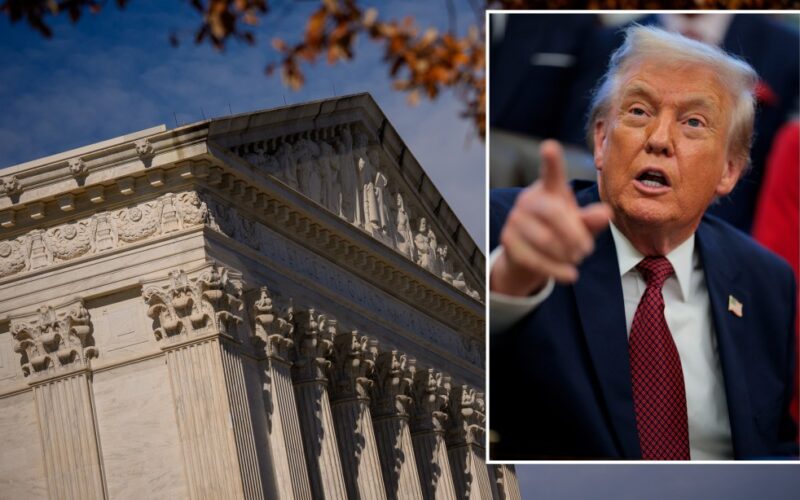
The conservative Supreme Court Friday agreed to hear full arguments over President Trump’s push to end birthright citizenship, the longstanding edict rooted in the 14th Amendment, which says that anyone born or naturalized on American soil is a U.S. citizen.
The top court, led by a six-judge right-wing majority, said it will take up Trump’s appeal of a lower-court ruling that struck down his effort to bar children of undocumented immigrants from automatically being granted citizenship.
The case, which would upend a bedrock policy that has stood virtually unchallenged for more than 125 years, will be argued in the spring. A ruling would be expected by early July 2026.
The Supremes could have simply refused to take up the case and upheld the lower court rulings, suggesting the justices believe Trump’s claims have at least some legal weight.
Trump calls birthright citizenship a “scam” that lures undocumented immigrants to the U.S. so they can give birth to children who will obtain American citizenship and a pathway to a better life.
The administration asserts that children of undocumented immigrants are not “subject to the jurisdiction” of the United States and therefore not entitled to citizenship. It says the 14th Amendment was narrowly aimed at granting citizenship to freed slaves.
“The Fourteenth Amendment’s Citizenship Clause was adopted to grant citizenship to newly freed slaves and their children — not … to the children of aliens illegally or temporarily in the United States,” Solicitor General D. John Sauer wrote in legal papers.
Critics say the Trump policy violates the clear language of the Constitution’s 14th Amendment and also deals a huge blow to the promise of America as a nation of immigrants and stable laws.
If the court were to rule the Trump order is legal, some fear the government could also seek to revoke citizenship from millions of descendants of immigrants.
The 14th Amendment says “all persons born or naturalized in the United States, and subject to the jurisdiction thereof, are citizens of the United States.” The Supreme Court has repeatedly ruled that clause only permits narrow exceptions for the children of foreign diplomats and those born to a foreign occupying force.
The birthright citizenship order, which Trump signed on the first day of his second term, is part of his broader immigration crackdown, including deploying troops on the streets of American cities and invoking the 18th-century Alien Enemies Act to deport alleged gang members without due process.
Supreme Court-watchers say it’s tough to predict how the justices might approach the landmark case.
Although the court has mostly given the green light to Trump’s aggressive executive actions, some justices might be loath to overturn a 125-year-old constitutional precedent.