



Breaking Rust is breaking hearts — but he’s totally fake.
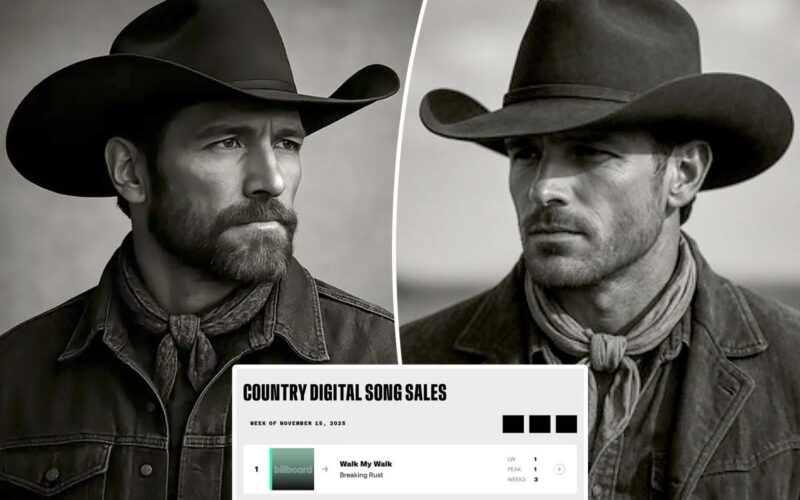
“Walk My Walk,” an AI-generated track from the AI artist Breaking Rust, has topped the Billboard Country Digital Song Sales chart since the week of Nov. 8.
Featuring a raspy vocal performance akin to Chris Stapleton with generic lines about being “beat down” but not “staying low” with “mud on my jeans,” the uninspiring tune is credited to the unknown songwriter Aubierre Rivaldo Taylor.
“Every scar’s a story that I survived / I’ve been through hell, but I’m still alive,” the formulaic lyrics go as a stomp-clap rhythm plays in the background. “They say slow down, boy, don’t go too fast / But I ain’t never been one to live in the past.”
“You can hate my style, you can roll your eyes / But I ain’t slowing down, I was born to rise,” the unremarkable chorus continues. “So kick them rocks if you don’t like how I talk / I’m gonna keep on talking and walk my walk.”
Breaking Rust is depicted in several AI images as an outlaw blues-country singer: a manly cowboy with a chiseled jawline and stubble wearing a 10-gallon hat and a bandana around his neck.
A link in the artist’s Instagram bio says that Breaking Rust makes “music for the fighters and the dreamers.”
Besides landing at No. 1 on the Billboard Country Digital Song Sales chart, which is measured by downloads and digital purchases, “Walk My Walk” has also garnered nearly 3.7 million listens on Spotify since being added to the streaming service on Oct. 17.
“Livin’ on Borrowed Time,” another song from the AI artist’s “Resilient” EP, has amassed more than 4.7 million listens since its release less than a month ago.
Breaking Rust has gained more than 2.3 million monthly listeners since joining Spotify as a verified artist with the single “Whisky don’t talk back” on Oct. 11.
Taylor, who is listed on the platform as the composer and lyricist behind Breaking Rust’s songs, has released additional tracks under another AI country act called Defbeatsai.
Unlike Breaking Rust, Defbeatsai’s output consists mostly of raunchy tracks with titles like “Morning Wood,” “Her Blessed Juice,” and “Kreme Queen.”
Despite declining to explain how an AI singer like Breaking Rust was able to become a verified artist on the platform, Spotify said that it is committed to “providing listeners with more transparency.”
“We support artists’ freedom to use AI creatively while actively combating its misuse by content farms and bad actors,” a Spotify spokesperson told The Post. “Spotify does not create or own music; this is a platform for licensed music where royalties are paid based on listener engagement, and all music is treated equally, regardless of the tools used to make it.”
The Post has also reached out to both Taylor and Billboard for comment.
Billboard, however, has acknowledged that Breaking Rust is an AI act – and admitted that Breaking Rust isn’t the only computer-generated artist chart in recent months.
“AI music is no longer a fantasy or niche curiosity among internet sleuths. It’s here, and it’s already beginning to have an impact on Billboard’s charts,” Billboard announced on Nov. 4. “In just the past few months, at least six AI or AI-assisted artists have debuted on various Billboard rankings. That figure could be higher, as it’s become increasingly difficult to tell who or what is powered by AI – and to what extent.”
“Walk My Walk” has received mixed reactions from fans and music industry experts.
“This is absolutely a bad sign for the future of music,” rapper Breland told The Post. “We are reaching a pivotal point in history where we can no longer discern the difference between what’s real and what isn’t.”
The multiplatinum rapper and record producer has collaborated with country stars like Keith Urban and Shania Twain.
“This technology has only existed in this capacity for about a year, and we are already seeing multiple instances of this happening,” the “My Truck” singer continued. “I’m inclined to believe it’s the tip of the iceberg, and five years from now, the entire Billboard chart could be filled with well-funded AI slop.”
Breland warned that the success of AI-generated artists and songs like “Walk My Walk” could drastically change how the music industry operates.
“This should be a concern for everyone in the music industry, as well as everyone outside of the music industry,” the “Cowboy Don’t” artist cautioned. “When you take the humanity out of music, it affects more than just the people making it. Music is one of those threads that holds society together, helps people find common ground, and processes complicated emotions.”
“If you’re an artist out there, you have to be aware of these trends, because at some point soon, we will all be impacted,” Breland added. “The more oversaturated the market becomes with passable AI music, the harder it is for real artists’ music to be heard and discovered. This affects all creatives in the industry.”
Jason Palamara, an expert who specializes in the development of AI-related music software, agrees.
“[It’s] definitely going to influence the future of the music industry in a lot of ways,” he told The Post. “At some point, when AI is good enough at making compelling music, these companies are going to start growing their own AI artists and promoting them over human artists.”
“Once one of them starts to have real success with this, the arms race will begin, and it will be hard for any human artist to gain traction,” Palamara added. “This will have a corrosive effect on the whole industry.”
Breaking Rust isn’t the first AI-generated artist to make waves.
Xania Monet, an AI singer created by Telisha Nikki Jones, made history over the summer when the song “How Was I Supposed to Know?” debuted at No. 1 on the R&B Digital Song Sales chart.
“Xania is an extension of me, so I look at her as a real person,” Jones, who has landed a multimillion-dollar recording contract for Monet, explained during an interview with Gayle King earlier this month.
Although it is currently unclear how Taylor went about creating the songs released as Breaking Rust, Jones revealed that she utilized an AI music generator app called Suno to construct Xania Monet.
“I wouldn’t call it a shortcut, because I still put in the work,” Jones argued following pushback from the “CBS Mornings” host. “I just feel that AI is the new era that we’re in.”