



When New York’s newly elected governor, Hugh Carey, delivered his first State of the State address in January 1975, he famously said, “Now the times of plenty, the days of wine and roses are over.” Gov. Hochul could have begun her FY 27 Executive Budget address by saying, “the days of wine and roses are back.”
Hochul has been blessed since she took office with the powerful tailwinds of strong revenue growth. Her budget briefing book noted that tax receipts through the current fiscal year have grown on average by roughly $11 billion annually, representing 11% compound annual growth, from 2021 levels. Even Microsoft only grew revenue at a rate of 13.8% between 2021 and 2025, which increased its stock price and market capitalization by more than 120% over that time.
The estimated tax revenue growth in FY 26 (i.e., the fiscal year ending March 31, 2026) of 10.4% and the conservative estimate of tax revenue growth of 4.2% in the FY 27 Executive Budget will provide the state with nearly $17 billion more in revenue to spend in FY 27 than it spent in FY 25 and $9.5 billion in increased revenue to spend in FY 27 than was forecasted at the time of the FY 26 mid-year update.
The state’s surplus available for spending on programs would be at least $3 billion higher than reflected in the FY 27 Executive Budget had the state chosen to reflect that the federal government will approve its request to end the Section 1332 waiver, revive the original Essential Plan statutory authority, and then utilize the reserves in the Basic Health Program Trust Fund to fund this $3 billion potential liability in increased state-only Medicaid spending. Although the conservatism in this presentation is understandable, most observers believe the federal government will grant the state’s request.
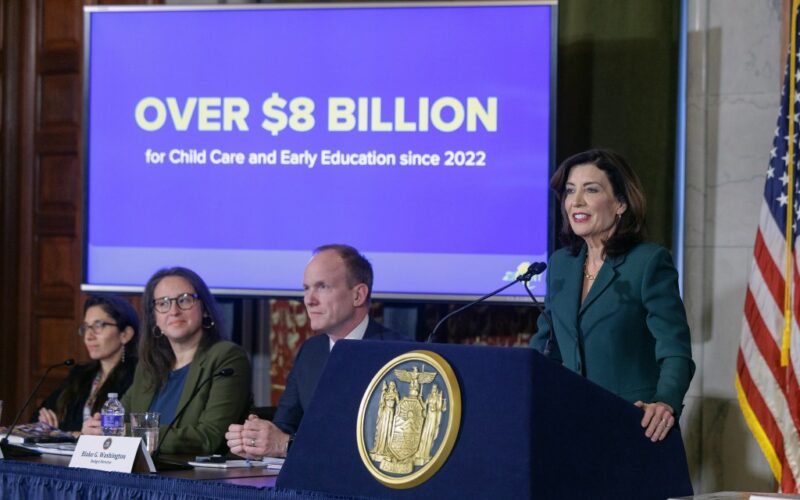
Hochul emphasized in her budget address that the state was supporting these increases in State Operating Funds spending, including a total increase of $1.7 billion in increased funding for new and existing child care programs (of which about $73 million supports Mayor Mamdani’s universal child care initiative) without increasing personal income or corporate income tax rates.
The budget presentation pointedly notes that personal income tax rates and corporate income tax rates in New York City are the highest in the nation: “In the City of New York (NYC), the highest combined [Personal Income Tax] top rate of 14.776% surpasses all other states. Likewise, NYC-based businesses face the highest state and local combined top corporate tax rate in the nation at nearly 17.5%.”
Arguably, the biggest news about the state budget was not the release of the Executive Budget on Jan. 20, but city Comptroller Mark Levine’s announcement on Jan. 16 that New York City faces a $2.2 billion budget shortfall for FY 2026 and a projected $10.4 billion gap for FY 2027. This divergence in the financial condition of New York City from that of New York State is something that I addressed in my post “The Mamdani Mayoralty” and its excerpt “Tax Revenue is Destiny” in Vital City.
If Levine’s estimate is close to being accurate — and we will know more when the mayor releases his Preliminary Budget in February — the real battle of the state budget will not be about the need for additional tax revenue to support increases in state spending or to support Mamdani’s signature campaign initiatives. It will be about the need for increased tax revenues to bail out New York City from its core budget deficit, rather than significant spending on new signature programs.
It’s in the eye of the beholder whether New York State’s use of its growth in tax revenue over the last five years — its State Operating Funds spending in FY 27 will be $45 billion, or 40% more, than spending in FY 22 — has made New York more than twice as valuable, in the same way that Microsoft’s revenue growth over those years more than doubled the value of that company.
As the governor said in her budget address, budgets are “a statement of priorities, [and] a test of discipline.” New York State’s bounty this fiscal year will set up a debate about priorities and discipline — more specifically, the priorities of the newly ascendant progressive wing of the Democratic Party led by Mamdani and the at least relative discipline of the moderate wing of the party now led by Hochul.
Francis, a former state budget director, is the chairman of the Step Two Policy Project.