




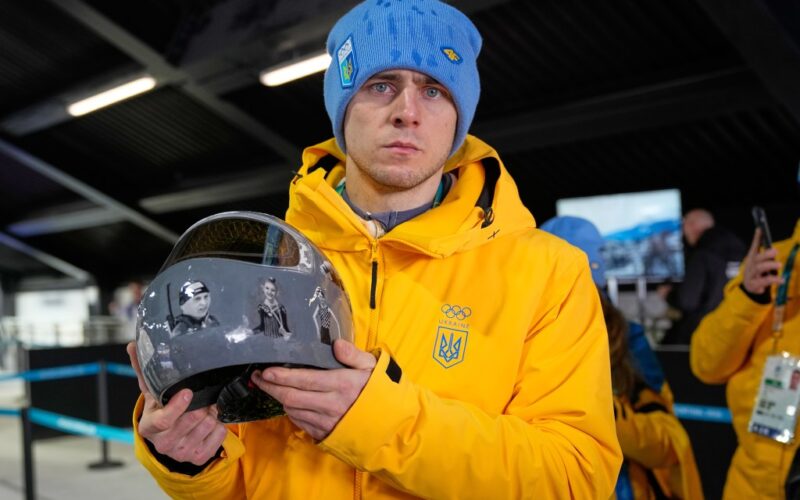
One of the most profound moments of the Milan Olympics has been the principled stance of Ukrainian Vladyslav Heraskevych, who was disqualified for honoring slain Ukrainian athletes on his skeleton helmet.
On it are elegant images of defenders and civilians, some of whom Vladyslav knew. It includes those who excelled in boxing, weight-lifting, figure skating, hockey, diving, dancing, skiing, shooting and coaching. If you want to view a few of the hundreds of athletes who have perished for the way of life that allows the Olympics to exist, the website Angels of Sport, profiles their stories.
There was no text on Vladyslav’s helmet so the International Olympic Committee had the option of being more flexible in their interpretation of their rules, which states “no kind of demonstration or political, religious or racial propaganda is permitted.” The IOC also could have taken into consideration that Vladyslav was one of the few Ukrainians with a chance at a medal and comes from a land whose sports infrastructure has been decimated.
He was offered the chance to compete if he replaced the headgear with a black armband. Vladyslav balked, describing, “I see the faces on this helmet and I will not betray them.” The repudiation was a moral imperative for Ukraine’s flag-bearer at the Opening Ceremony.
Further, his stance was in line with his unheeded plea at the Beijing 2022 Winter Olympics, where days before Russia’s invasion, he held up a sign that read “No War in Ukraine.” He then maintained this naïve view, “I didn’t really believe in these times a war could actually start.”
His views and actions are more in the spirit of the explicit Olympic mission of “promoting peace through sport,” than anything any other athlete will do in Milan. Rather than ban him, the IOC should recognize they found an ambassador for peace in the now 27-year-old from Zhytomyr.
Moreover, if the IOC is so intent on applying their standards, there is a much more significant subject to address. Kirsty Coventry, the current IOC president, recently spoke of the importance of “keeping sports a neutral ground.” Back in March of 2025, she also described having an aversion to banning countries (hint, hint…Russia) over international conflicts and suggested the idea of a task force to establish “policies and some guiding frameworks that we as the movement can use to make decisions when we are brought into conflicts.”
Last December, the IOC took a step in that direction, recommending that Russians be allowed to participate in the upcoming Youth Games.
This trend ignores the IOC’s initial reaction to Putin’s invasion, which, it should be acknowledged, was actually scheduled around the Beijing Winter Olympics, as Putin did not wish to offend the Chinese. Former IOC President Thomas Bach then stated: “The horrifying images and reports of the invasion… shocked the world. Every day we are more devastated by seeing so much human suffering.”
Russia was considered to have violated the Olympic truce by invading between the main games and the Paralympics and was therefore banned, with a later allowance permitting some athletes to compete under a neutral flag. There has been exponentially more suffering since Bach made his proclamation. It follows that the rationale for keeping the injunction is now stronger than before.
Let it not be lost that IOC is a Western institution that has an interest in upholding the way of life Russia threatens. Keeping them out for as long as their genocidal war persists conveys the message that the Olympics are a beacon of Western culture and field of honor it is a privilege to play on.
Strockyj is an Ukrainian-American attorney from Queens and avid sports fan.