




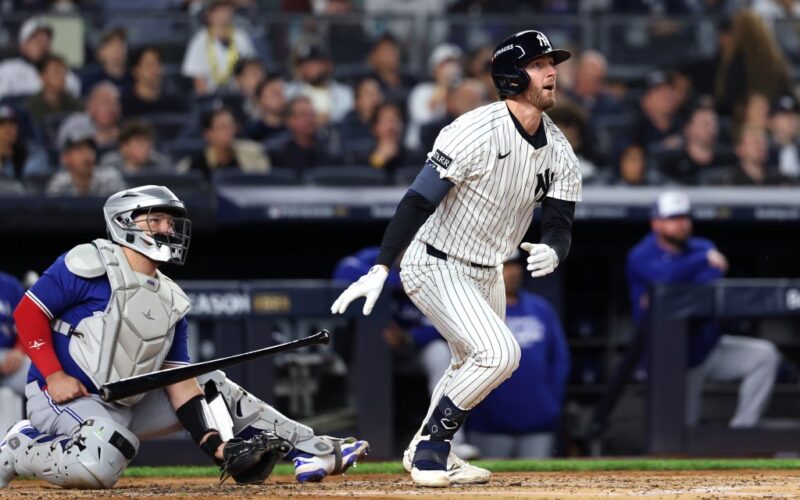
As the 2025 regular season came to a close, Ryan McMahon lamented his production at the plate.
“It’s been tough,” the Yankees’ defensively stellar third baseman said in late September. “I’ve been really honest with you guys. It’s no secret I’ve been struggling.”
McMahon, acquired from the Rockies in July, hit just .208 with a .641 OPS, four home runs, 18 RBI and an 84 wRC+ over 54 games for the Yankees. He hit .214 with a .693 OPS, 20 home runs, 53 RBI and an 86 wRC+ overall. He also had a 32.3 K%.
Now the Yankees are hoping to get more out of McMahon’s bat, which has produced an 89 wRC+ and a .738 OPS for his nine-year career.
“Yes, there are strikeouts in his bat,” Brian Cashman said during the Winter Meetings. “Yes, he has power. Yes, he has plate discipline. I think now with us getting a full spring training with him, a winter working with him, maybe we can unlock some things.”
Aaron Boone was on the same page as Cashman, insisting “there’s a lot more in there offensively than we saw.”
“I feel like there’s a real two-way player in there, and hopefully we can help him make little adjustments here that unlock all that,” the manager continued. “Because he’s a tremendous athlete, real power, feel like knows the strike zone pretty well.”
The Yankees shared similar sentiments when McMahon first arrived in the Bronx, and that didn’t pan out. But as Cashman noted, the 31-year-old does bring some positive attributes to the plate.
Last year, McMahon’s 93.3-mph average exit velocity ranked in the 95th percentile, while his 50.5 Hard-Hit% was in the 89th percentile. McMahon’s 11.9 BB% was in the 87th percentile, and he also had an above-average 25.0 Chase%.
McMahon’s problem is that his 35.2 Whiff% and 32.3 K% ranked in the second percentile, and his 21% squared-up rate ranked in the 10th percentile. He also had a 74.8 in-zone contact percentage, the second-worst mark in baseball.
“There’s some things he does in his swings that get him in trouble a little bit,” Boone acknowledged, “but it would not surprise me at all to see him go to a different level offensively.”
One source of inspiration could be teammate and fellow lefty Jazz Chisholm Jr., who had the third-worst in-zone contact percentage and ranked lower than the 10th percentile in squared-up percentage, whiff rate and strikeout rate in 2025. Yet he just authored a 30-30 season with an .813 OPS and a 126 wRC+.
That’s not to say that McMahon can produce like the speedier Chisholm at the plate. However, the latter was able to make more of an impact despite some commonalities in their offensive profiles.
Pulling the ball in the air more helped Chisholm accomplish that, as he did so at a 24.5% clip. McMahon only did so at a 17% clip.
While that was a career-high, pulling the ball in the air even more would benefit McMahon as a left-handed swinger who plays half of his games at Yankee Stadium.
The Yankees got a little more out of McMahon’s bat in the postseason, as he hit .286 with a home run and an .833 OPS. That was only a six-game sample, though.
If the Yankees could get a fraction of that production over the course of an entire season, McMahon — who will be spelled by the right-handed, recently re-signed Amed Rosario — would become an incredibly valuable player on both sides of the ball. He’s already a terrific defender, which offsets some of his shortcomings at the plate.
“I was excited he was one of the productive players in our postseason run this year on both sides of the ball, and he certainly makes our pitching staff better, especially when you have groundball guys like [Max] Fried and [Carlos] Rodón and all those groundballs going to that side of the field,” Cashman said. “I think he was a good get.
“But are there areas to improve upon? Sure. We look forward to seeing if we can.”