



Three American service members were killed in Iranian counterattacks after U.S. and Israeli air strikes pounded Tehran and killed Supreme Leader Ali Khamenei, the U.S. military said Sunday.
Five more troops were seriously wounded and “several others sustained minor shrapnel injuries and concussions — and are in the process of being returned to duty,” U.S. Central Command said on social media.
The Trump administration says the next step was for the Iranian people to rise up and choose their own new leadership path — but there was little sign of that on the ground Sunday in Tehran, according to witnesses.
“I don’t think anyone can give you a simple answer,” Sen. Tom Cotton (R-Ark.) said on CBS’ “Face the Nation” on the subject of who will now lead Iran. “As President Trump promised last month when the Iranian people were rising up against their own regime, help is on the way. Help has arrived.”
Thousands of Iranians were killed in protests throughout January against the ruling regime, which has held power since the 1979 revolution that overthrew the last shah. Khamenei’s government violently cracked down and killed demonstrators multiple times throughout his three-decade reign.
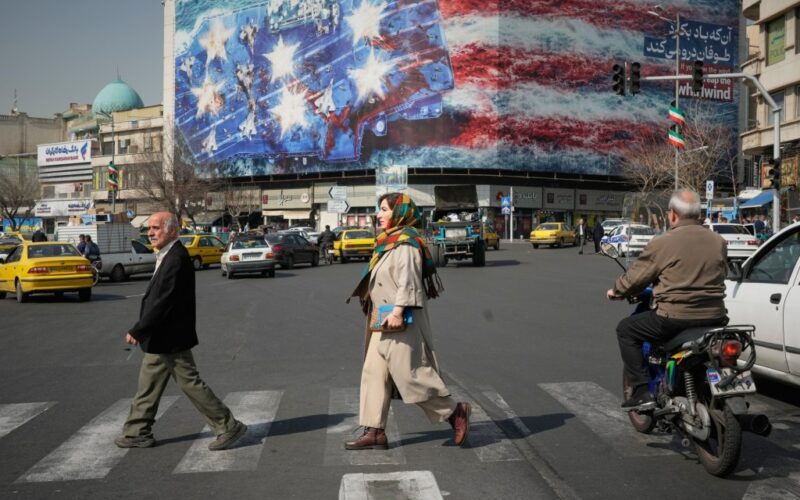
But there were no signs of protests on Sunday in Tehran, with security forces patrolling mostly empty streets while people sheltered inside, witnesses told The Associated Press. Iran said it had established a ruling council to choose a new supreme leader and would continue its military operations.
“Nothing has changed in our military capability,” Iranian Foreign Minister Abbas Araghchi said on ABC’s “This Week.” “Our military is in place. They are capable enough to defend our country. They are more prepared and capable than [the] previous war [in June].”

Multiple U.S. politicians, including Sen. Lindsey Graham, said there were no plans for a ground war in Iran. Graham instead told NBC’s “Meet the Press” the Iranian people would choose their next leader.
Meanwhile, Cotton suggested Iranian politicians were jockeying for the role of “Iran’s Delcy Rodriguez,” referencing the Venezuelan vice president who took over the nation following a U.S. military operation that captured President Nicolas Maduro in January.
“We would all celebrate if the Iranian people were able to rise up and reclaim their freedom and reclaim their destiny,” Cotton said on “Face the Nation.”
While Democrats largely praised the killing of Khamenei, they criticized Trump for bypassing Congress before the attack and apparently lacking a long-term vision for Iran. Sen. Mark Kelly (D-Ariz.) said simply wishing for the Iranian people to rise up and overthrow the government was not enough.
“Hope is not a strategy,” Kelly told “Meet the Press.” “We’ve got to have a plan here. I mean, what is the strategic goal, and how do we achieve it?”

One man who threw his hat into the leadership ring was Reza Pahlavi, the son of the last Iranian shah, who lives outside Washington, D.C.
“This is time now for a very strong, stable transition,” Pahlavi told Fox News’ “Sunday Morning Futures.” “I am leading this transition. I have the support of millions of Iranian people. I have the people inside the country that are joining…the military will side with us.”
However, no evidence of Pahlavi’s stated transition was seen on Sunday. Elsewhere, international leaders criticized the U.S. attack, and everyday citizens responded with violence at the U.S. Consulate in Karachi, Pakistan. Ten people were killed in clashes between security forces at the consulate and protesters angered by the killing of Khamenei.
With News Wire Services