




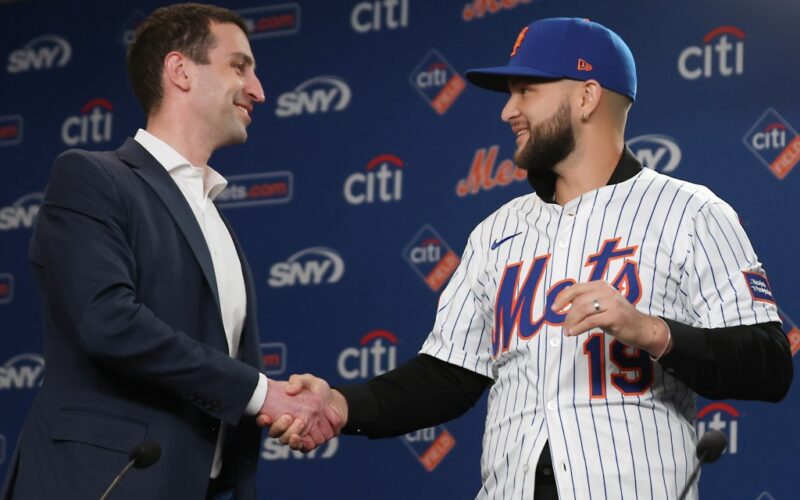
The new gang’s all here and now it begins for David Stearns’ Mets overhaul. After jettisoning Brandon Nimmo, Pete Alonso and Jeff McNeil in his self-declared determination to change the clubhouse, there were a lot Met folks — fans and media alike — wondering if there was truly a method to Stearns’ madness, especially since the team’s two most pressing needs — a top of the rotation starting pitcher and a center fielder — had not been addressed.
But then came the trades for Freddy Peralta and Luis Robert Jr. and those two holes were suddenly addressed followed by the eyebrow-raising three-year, $126 million signing of Bo Bichette to play third base and — voila — Stearns finally had a team to his own liking. But is it better than last year’s disappointing 83-79 team that didn’t make the playoffs?
It would be nice if we knew how impaired Francisco Lindor will be from the hamate surgery that’ll cost him most of spring training, but the deciding factor about the division might just be what happened — or more precisely didn’t happen — with the other teams in the National League East. But looking first at the Stearns Met makeover, the one sure upgrade was the acquisition of Peralta to join with Nolan McLean giving the Mets two dominant starters at the top of the rotation, something they haven’t had in a while. From there, questions abound with all the newcomers.
Robert conceivably can be an upgrade, especially defensively, in center field, but only if he stays healthy and plays more than 140 games — which he’s only done once and that was three years ago. Marcus Semien, the return from Texas for Nimmo, figures to also be a significant defensive improvement at second base over McNeil. But at 35, his offensive production has declined significantly the last two years, and with three years and $72 million remaining on his contract it’s not unreasonable to think Stearns may have stuck himself with an albatross.
There’s no getting around the departure of Alonso’s 38 homers, 126 RBI and league-leading 41 doubles puts a serious crimp on the Mets lineup, but maybe not as much as it would seem if Jorge Polanco (26 homers in Seattle last year), and Bichette (.311, 18 HR, 94 RBI) — both of whom will be playing out of position at first and third respectively — have repeat seasons. A likewise huge loss was Edwin Diaz and Stearns’ three-year, $51 million signing of Devin Williams to replace him looks like an expensive gamble until he can prove he can close on the big stage in New York.
With all these questions about Stearns’ additions, it may well be the most important developments to watch for the Mets this year will be whether Brett Baty can emerge as a 25-homer power bat somewhere and Carson Benge can break through as the everyday right fielder. Meanwhile, for what it’s worth, the rest of the division teams all had setbacks this winter that could make a difference in how it all plays out.
The Braves made some nice moves, signing NL saves leader Robert Suarez as a co-closer with Raisel Iglesius, and trading for Astros handyman Mauricio Dubon, but their most important offseason addition, signing oft-injured Korean shortstop Ha-Seong Kim for $20 million, was quickly nullified when he tore a tendon in his right middle finger in winter ball and will be lost for at least the first two months of the season. In addition, right after pitchers and catchers reported, No. 2 starter Spencer Schwellenbach was shut down with forearm soreness and will likely miss the first month of the season.
The Phillies start the season without their ace Zack Wheeler, recovering from thoracic outlet syndrome surgery and not due back until late April or May, and they’re still smarting from losing out to the Mets on Bichette. They also let Harrison Bader, a terrific late season center field pickup last year, and reliable No. 4 starter Ranger Suarez leave via free agency. On the plus side, scouts all say No. 3 prospect Justin Crawford is more than ready to assume the everyday center field duties and they will have closer Jhoan Duran for a full year. But even if Crawford has his breakthrough, the Phillies are still an old team with questionable starting pitching depth at least until Wheeler proves otherwise.
IT’S A MADD, MADD WORLD
If you were wondering why there were no long-term contracts doled out by the owners to position players this winter — Pete Alonso’s five-year deal with the Orioles being the notable exception — the owners recently had three reminders of their stupidity. A few weeks before spring training the Angels announced a restructuring of one of the worst contracts in history — the seven-year/$245 million deal they gave Anthony Rendon in 2020. Rendon has battled injuries throughout the contract, playing in just 257 games in five seasons and hitting just .218 with no homers in 57 games in his last season, 2024. After undergoing hip surgery, Rendon missed all of 2025 and is owed $38 million for this year when he also will not play. But that money has now been deferred giving the Angels some financial flexibility. Meanwhile, the Blue Jays, who were the winners of last year’s dumbest contract — five-year/$92.5 million for DH Anthony Santander off one good year and who missed four months in ‘25 with a left shoulder injury, hitting just .175 with six homers in 54 games — were informed the first day of spring training that Santander will now undergo surgery on the shoulder and miss most of ’26 as well. And lastly we have the sad saga of Kris Bryant and the Rockies that began prior to the 2022 season when Rockies owner Dick Monfort allowed himself to be played by Bryant’s agent Scott Boras, giving Bryant a seven-year/$182 million contract when there were no other clubs bidding for him. The 34-year-old Bryant has been plagued by assorted injuries and has played just 48 games the last two seasons — and last week was placed on the 60-day injured list by what they’re calling a lumbar degenerative disc disease in his back.