



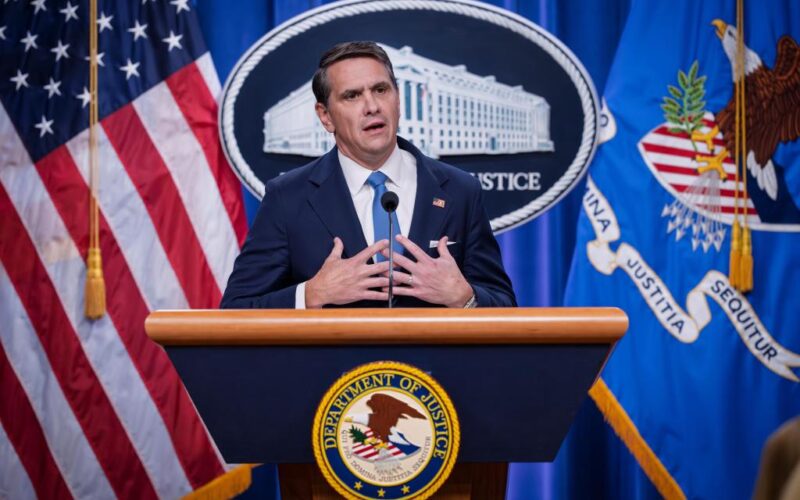
In announcing the latest release of the Jeffrey Epstein files, Deputy Attorney General Todd Blanche, proclaimed, “we did not protect President Trump.” Not true. Blanche still acts as Trump’s criminal defense lawyer. He did so last summer, by dangling a presidential pardon, to entice Ghislaine Maxwell, Epstein’s convicted co-conspirator, to provide a statement exonerating Trump from Epstein’s crimes.
Now, at least one set of the documents in the files shows that Blanche was trying to protect Trump from what could be Epstein’s final words about Trump.
The first batch of files in December revealed a letter from Epstein to Larry Nassar addressed to him in a prison where Nassar had been serving time for crimes relating to child sex abuse.
Because Nassar was transferred to another prison, the Postal Service returned the letter to the jail in Manhattan where Epstein had died while awaiting trial.
As to Trump, Epstein wrote “Our president also shares our love of young, nubile girls. When a young beauty walked by he loved to ‘grab snatch,’ whereas we ended up snatching grub in the mess halls of the system. Life is unfair.”
On Dec. 23, Blanche asserted on X, that “the so-called Epstein Nassar letter is clearly FAKE – wrong handwriting, wrong return address, and postmarked three days after Epstein died.” That tweet followed DOJ’s earlier posting that the letter was postmarked “out of Northern Virginia” and the “return address” was not the correct name of the New York jail.
Along with the Epstein/Nassar letter, DOJ also released a formal request to the FBI lab to perform a handwriting analysis to determine whether Epstein wrote the letter. The results of the analysis were not released.
Epstein wrote, “As you know by now, I have taken the ‘short route’ home. Good luck!” The implication that Epstein was going to kill himself made this letter highly material to the FBI’s investigation into Epstein’s death — whether it was murder or suicide.
The release provided a September 2020 handwriting report, concluding that the “analysis could not be conducted” because of insufficient known samples of Epstein’s handwriting “for meaningful” comparison to the Nassar letter.
The FBI’s conclusion does not mean Epstein did not write the letter. The files do not reflect any effort to find adequate comparisons. The other reasons Blanche gave on Dec. 23 for dismissing the letter as “fake” don’t hold up.
The postmark “out of Northern Virginia, when he was jailed in New York,” is consistent with Epstein having given the Nassar letter to his lawyers for mailing. For two consecutive days before he died, Epstein met with his lawyers, one of whom worked in Northern Virginia. Nothing in the Epstein files reflects the FBI ever questioning Epstein’s lawyers about this letter.
This also explains why Epstein did not include on the envelope “his inmate number,” which is consistent with Epstein not wanting prison officials, who sometimes read inmate’s mail, to learn of his intended suicide.
Finally, that the return address inaccurately stated the jail’s name as “Manhattan Correctional” rather than the “Metropolitan Correctional” is meaningless, since the Postal Service did return the letter to the correct jail.
Blanche’s efforts to debunk Epstein/Nassar letter serves to protect Trump and raises fundamental questions — the propriety of the massive redactions beyond what is necessary to protect the victims, the withholding of several million documents, and whether the public is receiving the full disclosure it deserves under the Epstein Files Transparency Act.
Akerman was formerly an assistant special Watergate prosecutor and an assistant U.S. attorney for the Southern District of New York.