




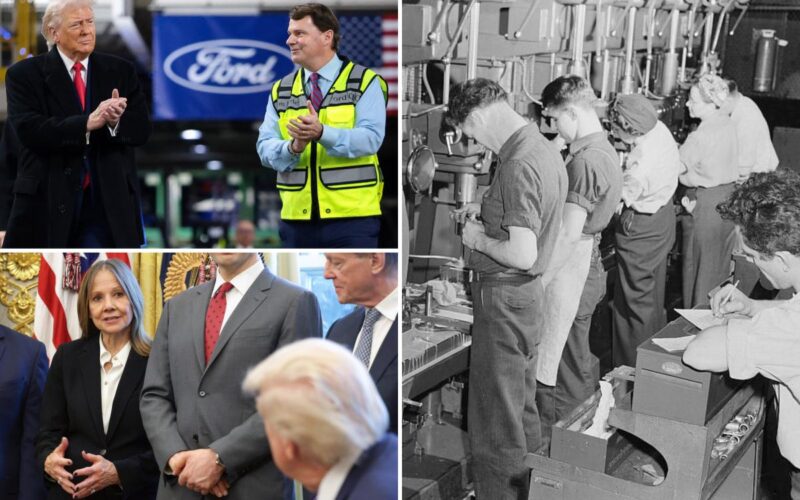
The Trump administration has quietly approached US industrial giants including Ford and General Motors about potentially boosting weapons production, according to a report.
Senior Pentagon officials have held talks with Ford CEO Jim Farley and GM boss Mary Barra about whether the automakers could help the military replenish its weapons stockpiles, The Wall Street Journal reported on Thursday.
The discussions are part of a broader push by the administration to put military manufacturing on what War Secretary Pete Hegseth has described as a “wartime footing,” according to the report.
The outreach echoes World War II-era efforts when Detroit automakers halted car production to churn out bombers, trucks and aircraft as part of the US’ “Arsenal of Democracy,” the Journal noted.
Today, however, only GM maintains a dedicated defense arm, while Ford’s involvement is largely limited to adapting its commercial vehicles for military and government use.
Administration officials believe Ford and GM could leverage their workforce and manufacturing capacity to support increased munitions output amid rising global demand tied to conflicts including Ukraine and Iran, the article stated.
Defense officials held what the Journal described as “preliminary and wide-ranging” discussions with auto executives focused on whether the companies could pivot to defense work.
The talks reportedly began before the outbreak of the Iran war and come as the Pentagon looks to expand production of key systems such as missiles and counter-drone technology.
Executives from GE Aerospace and Oshkosh Defense have also been included in the discussions.
“The Department of War is committed to rapidly expanding the defense industrial base by leveraging all available commercial solutions and technologies to ensure our warfighters maintain a decisive advantage,” a Pentagon official told The Post.
“The Department is aggressively pursuing and integrating the best of American innovation, wherever it resides, to deliver production at scale and drive resiliency across supply chains.”
The Post has sought comment from GM and GE Aerospace. Ford declined to comment.
“Oshkosh brings the full strength of a global enterprise, combining scale, financial stability, and advanced, flexible manufacturing, to efficiently ramp production while delivering consistent quality and reliability for both commercial and military customers,” a spokesperson for the company told The Post.
“We are committed to regularly evaluating how our available capacity can meet the Department of War’s evolving needs, and we are proud to support national defense and the service members who rely on our capabilities and technologies.”
GE Aerospace primarily supplies the behind-the-scenes systems that power and operate military hardware, rather than complete weapons.
The Ohio-based company manufactures engines, avionics and electrical systems used in fighter jets, helicopters, ships and other defense platforms, forming a critical layer of infrastructure across the US military’s fleet.
Oshkosh Defense, a unit of Oshkosh Corporation, builds the kinds of vehicles US troops drive into combat — from light armored trucks to heavy-duty transport systems — but the company’s broader business is largely focused on civilian equipment.
The Wisconsin-based manufacturer produces everything from fire trucks and airport rescue vehicles to construction lifts and garbage trucks across its portfolio of brands.
GM operates GM Defense, which builds platforms like the Infantry Squad Vehicle for the US Army and is developing next-generation tactical and fuel-cell-powered military vehicles.
Ford, by contrast, does not have a standalone defense division, with its trucks and SUVs typically modified by third parties for specialized roles rather than produced as purpose-built military systems.