




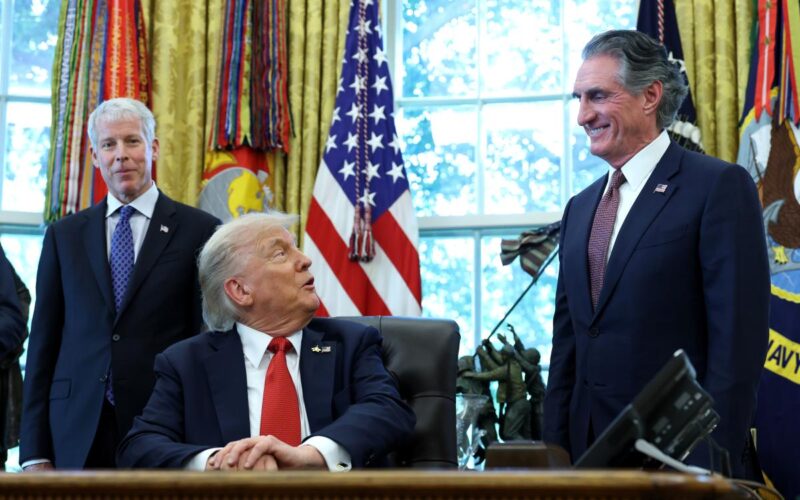
WASHINGTON — President Trump and a bipartisan group of governors joined forces Friday to pressure electricity giant PJM to halt soaring residential power costs by forcing new artificial intelligence data centers to generate their own supply.
Energy Secretary Chris Wright, Interior Secretary Doug Burgum and Govs. Wes Moore (D-Md.), Josh Shapiro (D-Pa.) and Mike DeWine (R-Ohio) inked the pact at the White House after voter frustration became a major issue in Mid-Atlantic elections last year.
Although the agreement will not necessarily have an immediate impact on prices, federal and state regulators have significant powers to pressure the country’s largest power grid operator, whose PJM acronym initially stood for Pennsylvania-New Jersey-Maryland.
The pact calls on PJM, whose capacity price increased about 22% over the past year, to invest $15 billion in new power plants to increase supply and to “require data centers to pay for the new generation built on their behalf – whether they show up and use the power or not.”
The agreement also urges the provider to “protect ratepayers by capping the amount existing power plants can charge in the PJM capacity market,” according to the Energy Department.
Burgum said the plan “will ensure we usher in the age of artificial intelligence with new power plants funded by the technology companies, not taxpayers, securing the steel of Pennsylvania, the manufacturing of Ohio and the ships of Virginia.”
Wright blamed the Biden administration’s “forceful closures of coal and natural gas plants without reliable replacements” and said that “perhaps no region in America is more at risk than in PJM.”
The Energy Department said: “During the Biden administration, PJM forced nearly 17 gigawatts of reliable baseload power generation offline. For the first time in history, PJM’s capacity auction failed to secure enough generation resources to meet basic reliability requirements. If not fixed, it will lead to further rising prices and blackouts.”
An Energy Department report found that data centers consumed about 4.4% of total U.S. electricity in 2023, and that rate is expected to jump to 6.7-12% of total U.S. electricity by 2028.
Trump has previously described his efforts to allow data centers to generate their own electricity, but the new agreement seeks to make that a requirement.
PJM released a statement saying it was “reviewing the principles set forth by the White House and governors.”
“The PJM Board’s decision, resulting from a multi-month stakeholder process on integrating large load additions, will be released later today,” the statement said.
“The Board has been deliberating on this issue since the end of that stakeholder process. We will work with our stakeholders to assess how the White House directive aligns with the Board’s decision.”
Trump, who did not attend the White House meeting, has unfurled a number of significant new policies aimed at addressing voters’ affordability concerns ahead of the November midterm elections, which will dictate whether he faces congressional obstruction and investigations for his final two years in office.
In the past month, Trump has pressured credit card companies to cap interest rates at 10%, announced he plans to ban large investors from buying residential housing and directed a $200 billion federal purchase of mortgages to drive down borrowing rates.
Moore and Shapiro are believed to be likely 2028 Democratic presidential contenders and their participation in the electricity initiative demonstrates its political salience.
Shapiro said that his actions already had saved PJM customers $18 billion, citing his role negotiating a prior price cap, and that “we’re going to keep fighting to lower costs.”
Moore said: “The cost of energy is just too high and it is one of Marylanders top concerns. Together, we are making strides towards more affordable energy for our state.”
PJM currently supplies power to about 67 million people in 13 states as far west as Illinois. States in its service area include Delaware, DC, Virginia and West Virginia and parts of Indiana, Kentucky and North Carolina.