



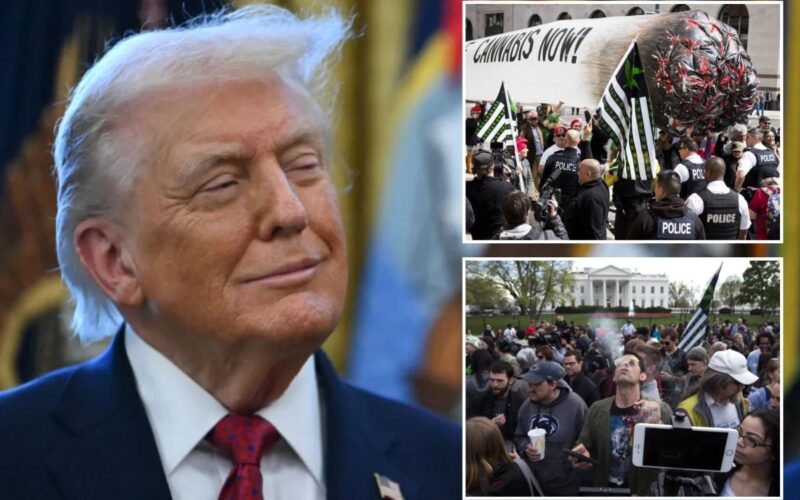
WASHINGTON — President Trump on Thursday is expected to deliver the biggest federal policy win yet for marijuana reform advocates — ending 55 years of pot’s categorization as a “Schedule I” drug alongside heroin and LSD — but the change stops short of full legalization.
The landmark action will move pot from “Schedule I,” the most restrictive Controlled Substance Act designation for drugs with a high potential for abuse and no accepted medical value, to Schedule III alongside ketamine.
Marijuana technically will remain illegal to use under federal law, but nearly all prosecutions of small-scale possession are made under local law, and 24 states, three territories and Washington, DC, allow recreational use, in addition to 16 other states that allow medical justifications.
Trump, 79, has tolerated state-legal marijuana sales throughout his two terms of office, despite federal prohibition, allowing a multibillion-dollar industry to flourish in the aftermath of Colorado and Washington state’s pioneering legalization ballot measures in 2012 during the Obama administration.
The president voted last year for a failed initiative to legalize pot under state law in Florida — meaning he is the first sitting president of the modern era to support recreational legalization, inspiring optimism among marijuana reformers that he will take further action.
Tax breaks and more research
There are a handful of practical effects of the rescheduling order, including allowing state-legal pot businesses to gain access to tax deductions and easing scientific research into the medicinal benefits of “cannabinoid” compounds.
A section of federal tax law known as “280E” bars companies involved in “trafficking” Schedule I or II substances from deducting business expenses.
A Wall Street Journal analysis found the change could save businesses billions of dollars, allowing them to lower prices for consumers or reinvest their profits.
Trump is expected to focus heavily on the medicinal impact of rescheduling.
The primarily high-inducing compound in marijuana, THC (tetrahydrocannabinol), is part of a broader bouquet of chemicals that have shown an array of uses, including to treat chronic pain.
CBD or cannabidiol is widely used to treat epilepsy. THCV or tetrahydrocannabivarin is reputed to assist weight loss and CBN or cannabinol is said to promote sleep.
The Schedule I designation has required researchers to gain a special license from the Drug Enforcement Administration, which required the weed to be locked away and sourced from a federally authorized farm.
Between 1968 and 2021, a single provider — the University of Mississippi — had a monopoly on growing marijuana for research, drawing researcher complaints about quality and delays in growing requested strains rich in certain compounds. There are now seven sources.
The rescheduling also opens the doors to doctors in the future prescribing marijuana — replacing a jerry-rigged system of physicians “recommending” it in states that allow medical use — though additional Food and Drug Administration action would be needed.
Trump’s order doesn’t resolve many key issues, including industry requests for banking protections for state-legal recreational pot companies, which are frequently de-banked by risk-averse financial institutions fearful of regulators punishing alleged drug dealing.
“This is certainly the biggest move that we’ve seen in terms of federal policy when it comes to cannabis since it was originally placed on Schedule I,” said Morgan Fox, political director of the National Organization for the Reform of Marijuana Laws (NORML).
“But in terms of making an impact on actual cannabis consumers and criminal justice, we clearly need to go a lot farther.”
Trump keeps campaign pledge after Dems disappoint reformers
Trump, who doesn’t drink alcohol and frequently discourages drug use, has for many years been open to marijuana reform — including expressing interest in then-Colorado Sen. Cory Gardner’s bipartisan push to federalize pot policy during his first term.
Last September, Trump endorsed recreational marijuana legalization, saying in a statement: “As I have previously stated, I believe it is time to end needless arrests and incarcerations of adults for small amounts of marijuana for personal use. As a Floridian, I will be voting YES on Amendment 3 this November.”
In that statement, Trump said, “As President, we will continue to focus on research to unlock the medical uses of marijuana to a Schedule 3 drug, and work with Congress to pass common sense laws, including safe banking for state authorized companies.”
Although Trump is the first sitting president to support marijuana legalization, cannabis reform has been a relatively low priority as he focused the first year of his second term on imposing tariffs, attempting to mediate foreign conflicts and ratifying promised tax cuts on tips, overtime and Social Security benefits.
And there is no evidence that Trump will heed activist calls for a complete “descheduling” of marijuana to effectively legalize it nationally.
Fox of NORML said that Trump should go further than his Thursday order, and that he’s hopeful that the president’s latest action will rally more Republicans to support reforms, particularly after Congress this year acted to restrict the use of industrial hemp-derived THC.
“Conservative policymakers are going to see that this is not just good policy, but good politics,” Fox said — after 22 GOP senators signed a letter pleading with Trump not to reschedule, arguing, “We cannot reindustrialize America if we encourage marijuana use.”
The longtime cannabis reform organizer said that Trump should instruct the Justice Department to issue new guidance protecting state-legal cultivation of marijuana — which occasionally ensnares home growers in federal prosecutions — and take executive-branch or legislative action to give banks more confidence in working with the regulated industry.
He urged Trump to also take steps to free marijuana inmates and expunge records. At the end of Trump’s first term, he released from prison seven people with life sentences for dealing marijuana, some of them locked up under three-strikes legislation authored by Joe Biden while he was a Delaware senator.
Trump is following through on rescheduling after decades of dashed hopes for reformers.
Although President Bill Clinton admitted to smoking marijuana — but not inhaling — he kept intact the federal prohibition, as did former President Barack Obama, despite being a self-identified member of a pot-smoking “choom gang” in his youth.
President Biden took steps to reschedule marijuana, but didn’t follow through before leaving office in January. He mass-pardoned people convicted federally of simple possession, of whom none were behind bars, but failed to fulfill his campaign pledge to release “everyone” in prison for pot, most of whom are there for dealing.