


By ISABEL DEBRE and VICTOR CAIVANO
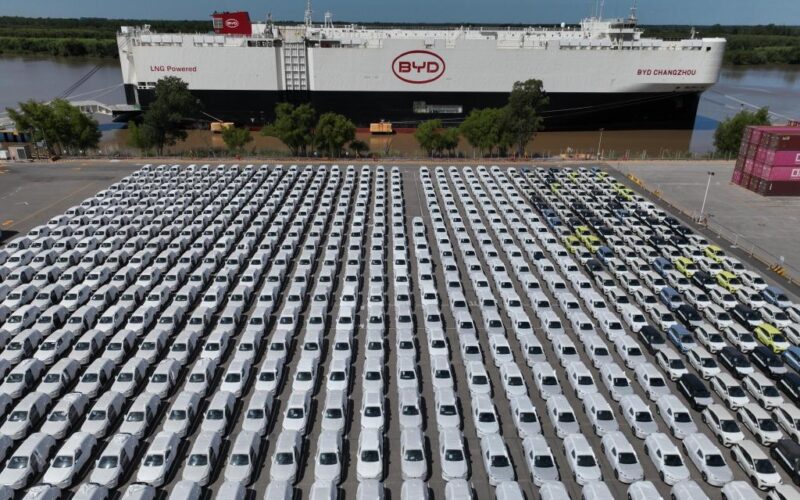
ZÁRATE, Argentina (AP) — The vast field of over 5,800 electric and hybrid vehicles gleamed on the cargo deck of the BYD Changzhou, an Chinese container vessel unloading Wednesday at a river port in eastern Argentina.
In other places, such a scene would not be noteworthy. Chinese automaker BYD has sped up its exports and undercut rivals the world over, alarming Washington, upsetting Western and Japanese auto giants, and unnerving local industries across Southeast Asia, Africa and Latin America.
But the sight of so many new Chinese EVs gliding onto a muddy river bank in Buenos Aires province was unprecedented for Argentina.
“This milestone reflects a long-term vision in Argentina — to invest, to steadily expand our dealer network across the entire national territory,” said Stephen Deng, the country manager for BYD in Argentina.
The giant BYD logo gracing the ship’s hull and each car window sent shockwaves through this crisis-stricken economy run for decades by the left-wing populist movement of Peronism that protected local industry with stiff tariffs and import restrictions.
“For decades people in Argentina had this vision that everything here must be manufactured here,” said Claudio Damiano, a professor in the Institute of Transportation at Argentina’s National University of San Martin. “The boat has a symbolic value as the first step for BYD. Everyone’s wondering how far it will go.”
The image of duty-free Chinese cars discharging in Argentina also sent a message to Brussels, where on Wednesday European Union lawmakers voted to delay ratification of a landmark free trade deal with the Mercosur group of South American countries, including Argentina, which promises to tear down trade barriers for European EV imports.
“The Europeans, there’s just no possibility of competing with the Chinese,” Damiano said.
Chinese cars show Argentina’s open economy
Under Peronists who disdained global trade as a destructive force, Argentina became one of the region’s most closed economies.
Sky-high taxes on imports and a chronically depreciating currency long constrained consumer choice, compelling well-heeled Argentines to smuggle iPhones and Zara hauls into the country when returning from vacations abroad.
For the last two years, radical libertarian President Javier Milei has done the exact opposite of his closest ally, U.S. President Donald Trump.
He has flung open Argentina’s doors to imports, slashed trade barriers, unwound customs red tape and shored up the local currency to make foreign goods more affordable.
Last year Argentina logged a record 30% increase in imports compared to the year before — much of it in the form of $3 milk frothers and $10 dresses piling up on Argentines’ doorsteps from Asian online retailers such as Temu and Shein.
Now Chinese automakers — once choked by 35% levies on imports — are seizing on a new measure to allow 50,000 electric and hybrid cars into the country this year tariff-free. The first shipment arrived Monday at Zárate Port after a 23-day voyage from Singapore.
-
Pablo Naya, the owner of Sero Electric, poses next to one of the company’s electric microcars at its factory in Castelar, Argentina, Wednesday, Jan. 21, 2026. (AP Photo/Victor R. Caivano)


1 of 4
Pablo Naya, the owner of Sero Electric, poses next to one of the company’s electric microcars at its factory in Castelar, Argentina, Wednesday, Jan. 21, 2026. (AP Photo/Victor R. Caivano)
Telling business and political leaders Wednesday at the World Economic Forum in Davos that that his drastic deregulation measures “allow us to have a more dynamically efficient economy,” Milei declared: “This is MAGA, ‘Make Argentina Great Again.
Trump and Milei: friends despite differences
Milei and Trump share a contempt for perceived “wokeness,” an impatience with multilateral institutions like the United Nations, a denial of climate change, a passion for supporting Israel and a zeal for dismantling the administrative state.
The ideological bond has paid dividends for Milei: Argentina is a rare place in the region where Trump has wielded the might of the U.S. to help an ally rather than coerce with military threats, as he has in Colombia and Mexico. Last year he offered Milei a $20 billion credit swap last year to boost his chances in a crucial midterm election.
Yet at Davos the leaders’ stark differences were on stark display. Milei delivered his anti-interventionist, libertarian definition of MAGA right after Trump laid out his vision for making America great: demanding control of Greenland and threatening allies with tariffs and other consequences if they don’t fall in line.
China has perhaps benefited most from Milei’s free-market drive. Chinese imports to Argentina surged over 57% last year compared to the year before — compared to a 9.6% spike in shipments from the U.S. Chinese investment has poured into Argentina’s energy and mining sectors.
China ‘has won the race’ in Argentina
BYD and similar Chinese brands have taken the streets of Latin America by storm, from Mexico City to Rio de Janeiro — inviting controversy and backlash.
Now they’re best positioned to reap the rewards of Milei’s zero-tariff quota for EVs, which applies only to cars under $16,000.
“Chinese manufacturers have the technology and the ability to meet the price limits set by the government,” said Andrés Civetta, an economist specializing in the auto sector at the Argentine consulting firm Abeceb. “China has won the race.”
Some major Western car manufacturers in Argentina have raised concerns. Opposition lawmakers warn of unfair competition.
But Argentina is still far behind its neighbors in developing its EV industry, said Pablo Naya, the creator of Sero Electric, Argentina’s only domestic electric car manufacturer.
The country’s aging power grid is nowhere near ready for a wave of electric cars to strain it en masse, he said. And if something goes wrong with a Chinese EV on the road, there are currently no dealers’ service centers able to undertake internal repairs.
“Honestly, we’re not worried,” he said.
But if or when Argentine infrastructure and consumer aspirations eventually catch up to China, it will be a different story.
“Then that would get complicated for us,” he said from the Sero Electric factory in the Buenos Aires suburb of Castelar. “We’d have a problem.”