



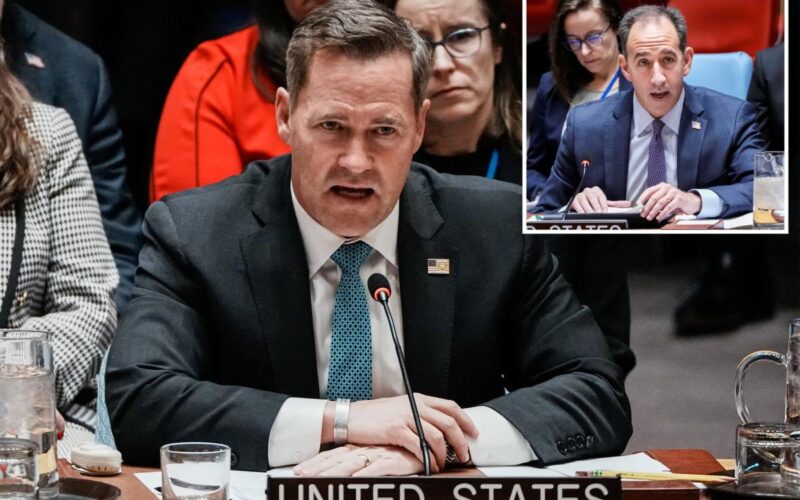
WASHINGTON — US ambassadors have taken a chainsaw to the United Nations budget as part of President Trump’s mandate to have the world organization “get back to basics.”
US Ambassador to the UN Mike Waltz and Management and Reform Ambassador Jeffrey Bartos told The Post they helped reduce the entire UN budget by $570 million — and America’s portion of that payment to the international governing body by around $126 million.
“The UN has agreed to the first real budget cuts – actual real cuts for the first time in modern history, pretty much since the founding of the organization,” Waltz recently told The Post. “They’ve never seen anything like it.
“It makes this organization smaller, less duplicative, more efficient, and cuts the fat,” said Waltz, a former Trump national security adviser and ex-Republican congressman.
Bartos noted that the effort “all ties back to the president’s vision and his charge to all of us to get the reform, get the UN back to basics and to get it fit for purpose.”
Waltz and Bartos talked to The Post about their success in getting nations to cut the 2026 UN budget by roughly 15.2% from the previous year, while defending the relevance of the international body.
The fresh cuts comprised a $110 million decrease in funding for the UN Secretariat that handles the international organization’s day-to-day operations, a $160 million dip in funding for field missions and a $300 million haircut across the board to the previously bloated budget.
The US ambassadors boasted that the cost-cutting was on top of the elimination of 2,900 bureaucratic posts at the UN.
Since the US pays about 22% of the UN’s annual budget, the total reduction in taxpayer savings amounts to around $126 million.
Bartos, the US ambassador for management and reform, rattled off other “shocking” costs that had accumulated since the UN was founded in 1945 — including the billions of dollars spent on conferences, as well as for workers’ compensation and pension plans for former employees.
“The UN spent $340 million in 2024 on conferences and meetings, which is a shocking number,” Bartos said. “The UN compensation system — so the entire system-wide compensation — is about $16 billion out of an overall global budget … of $64 billion.”
“Of that $16 billion, $2.1 billion dollars goes … to the pension plan for its employees,” he said. “It’s a traditional defined benefit plan which, you know, was all over the world in 1950, [but it’s] very hard to find one today outside of the UN.”
The ambassadors said they are now looking to modernize that pension system and reform the compensation plans.
Bartos said the guiding principle is: “What’s common sense, and what’s not common sense?
“The compensation system for the UN fails the common-sense test,” he said.
But Waltz and Bartos pushed back on calls for the US to exit the world’s governing body, emphasizing the importance that the New York City-headquartered organization holds as the center of diplomatic activity.
“There needs to be one place in the world where everyone can talk. The president is a president of peace, puts diplomacy first,” Waltz said. “We want that one place in the world to be in the United States, not in Brussels or Beijing.”
Still, the US ambassador to the UN said that “burden-sharing is a key part” of Trump’s “America First” policies.
“There are a number of conflicts or humanitarian crises or what have you. We don’t want to deal with that all ourselves. And we want the UN to step in when we need them to,” Waltz said.
“Case in point, Haiti: The Biden administration spent a billion dollars trying to deal with the gangs in Haiti. We’ve handed a portion of that over to the UN,” he said. “It will cut that cost … dramatically.
“Or Gaza, where we’re gonna have an international stabilization force,” Waltz said. “We have to deal with the situation. … God knows we don’t want US troops there.
“It’s an organization that we need to pare down the size, focus it back on stopping wars, preventing wars — and not climate and gender and all of this other nonsense and helping share the burden,” Waltz said.
Bartos said the UN “has potential, but it’s not living up to its potential, and the president charged us to do this, and the team executed the president’s vision.”