



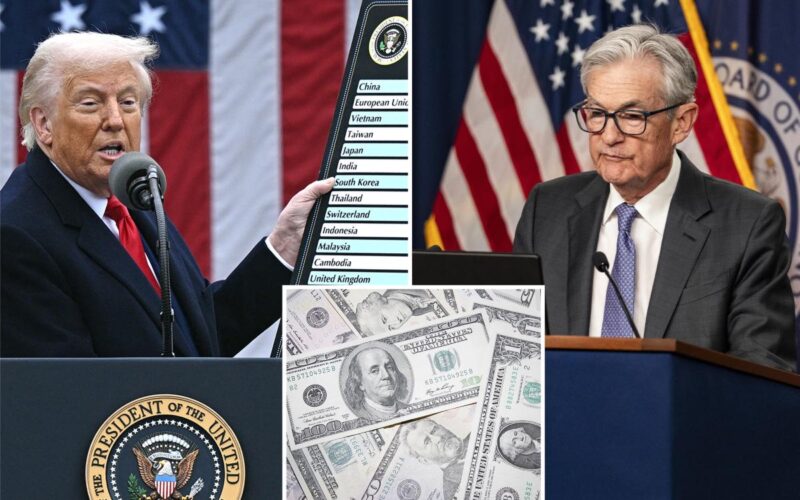
The US dollar ended the year with its worst performance since 2017 as Federal Reserve turmoil, trade shocks and economic uncertainty hammered the greenback.
The dollar finished the year down about 8% compared to a basket of foreign currencies, according the Bloomberg Dollar Spot Index.
That was sharpest annual retreat for US currency in eight years.
Some measures show losses closer to 9% to 10% after a historic first-half slide that erased a decade’s worth of gains from the dollar’s long bull run.
The dollar selloff accelerated after President Trump’s April “Liberation Day” tariffs rattled global markets and raised fears of lasting damage to US growth.
The currency never fully recovered as its decline coincided with stubbornly high inflation that limited the Fed’s flexibility — even as growth slowed.
Core inflation hovered near 3%, while tariffs added fresh price pressure and pushed consumer inflation expectations sharply higher through the summer.
Foreign investors also began pulling back.
China cut its holdings of US Treasuries to the lowest level since 2008, while global asset managers increased hedges against dollar weakness — a move that effectively reduced demand for the currency.
Investors now warn the pain may not be over, with the Fed expected to cut rates further in 2026 and Trump openly pushing for a more dovish central bank chief.
“The biggest factor for the dollar in first quarter will be the Fed,” Yusuke Miyairi, a foreign-exchange strategist at Nomura, told Bloomberg News.
“And it’s not just the meetings in January and March, but who will be the Fed Chair after Jerome Powell ends his term.”
Kevin Hassett, director of the National Economic Council in the White House, is considered the frontrunner to succeed Powell in May.
While he’s widely viewed as being in accord with the president’s economic worldview, he has insisted Trump would “have no weight” in the Federal Reserve’s decisions if he becomes chair.
At least two US rate cuts are already priced in for next year, undercutting the dollar’s yield advantage just as Treasury yields slid from above 4.5% early in the year to near 4.1% by December.
The damage was most dramatic in the first half of 2025, when the dollar suffered its steepest six-month decline in more than half a century. A brief July bounce faded quickly as worries about growth, politics and trade returned.
Trump’s April 2 tariff blitz proved a turning point.
The president invoked emergency powers to impose a 10% baseline tariff on nearly all imports, with higher “reciprocal” duties aimed at countries running trade surpluses with the US.
Global markets plunged. The S&P 500 sank more than 13% in less than a week, while the dollar tumbled as investors rushed for safety.
Although the White House paused the harshest tariffs days later, the baseline levy stayed in place — and so did the uncertainty. Economists warned the policy would raise prices, hit demand and invite retaliation.
Those fears lingered throughout the year, weighing on the currency even as stocks recovered.
By late summer, the focus shifted squarely to the Federal Reserve.
After holding rates steady for months, policymakers began cutting as signs of labor-market weakness mounted.
The Fed delivered a quarter-point cut in September and another in December, responding to rising unemployment and slowing payroll growth — a sharp reversal from the aggressive tightening that propped up the dollar in prior years.
Traders quickly positioned for more. Futures markets now anticipate additional cuts in 2026, with expectations ranging from one to four reductions.
The Post has sought comment from the White House and the Fed.