



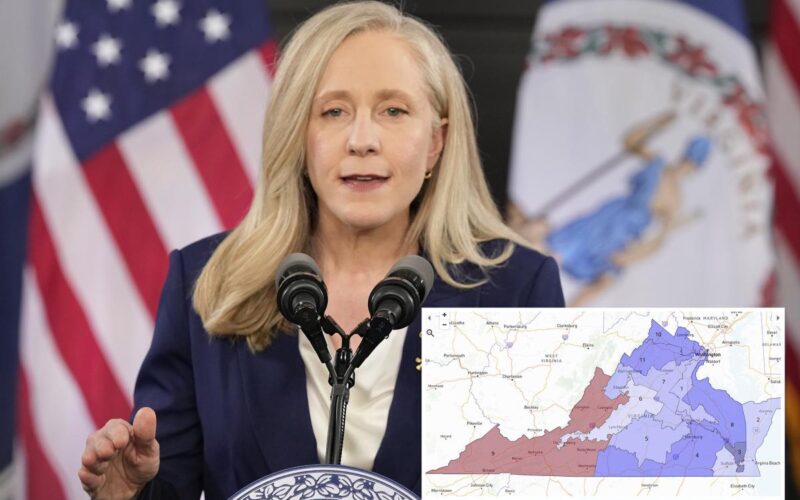
WASHINGTON — Virginians will decide one of the most aggressive gerrymandering proposals in the country on Tuesday that Democrats hope will help them net four seats in the midterm elections.
The referendum is expected to take a 6 to 5 Democrat to Republican breakdown in Congress and shift it to a 10 to 1 split for the Virginia delegation.
In other words, Democrats would be very likely, but not guaranteed to control 91% of Virginia’s congressional seats in a state where former Vice President Kamala Harris won with just under 52% of the popular vote in 2024.
“Today we have what is assessed as the fairest map in America,” former Virginia Gov. Glenn Youngkin (R) warned on Fox News. “And she [Abigail Spanberger] wants to override it and turn it into the most gerrymandered map in America — it’s wrong.”
“This is going to be close. Listen, it’s an uphill battle because they poured $70 million into this — that’s more than they spent on the governor’s race — to try to fool, deceive, and trick Virginians.”
The proposed map essentially siphons off the suburbs near DC and Richmond to stack districts with more Democrat-leaning voters than Republican-leaning ones.
Democrats have framed Tuesday’s vote as a means of restoring “fairness” and fighting back against gerrymandering from President Trump and his allies.
They brought in bigwigs such as former President Barack Obama to blanket the airwaves in support of the referendum, claiming it’s merely a temporary measure.
The state had amended its constitution in 2020 to form the Virginia Redistricting Commission, which is an independent panel to draw its congressional maps during the decennial redistricting process.
The referendum would impose the expected 10-to-1 split maps until the 2030 redistricting cycle, when it will allow apportionment to revert to the traditional system.
Virginia Gov. Abigail Spanberger (D), who infamously said during her 2025 gubernatorial campaign that “I have no plans to redistrict Virginia,” argued that it’s a necessary repsonse to red states for their redistricting efforts.
Spanberger reportedly had some early reservations about taking the maximalist approach, but has since become the largest proponent of the plan.
Trump had pushed GOP-controlled states to engage in rare mid-decade redistricting as a means of helping Republicans in the midterm elections in what is expected to be a blue wave year.
The crown jewel of those efforts was Texas’ redistricting, but California has since greenlit a referendum to alter its congressional maps in a way that would offset GOP gains in the Lone Star State.
“I mean, California’s already responded to Texas,” Adam Kincaid, executive director of the National Republican Redistricting Trust (NRRT), told The Post about Democrats’ justification for heavy gerrymandering in Virginia. “Democrats are still framing this as a response to Texas.”
“If anything, Texas was a response to some of the more aggressive Democrat gerrymanders of the last couple of cycles,” he added. “It was a response to the Biden administration’s manipulation of the census, and it’s been a response to the mid-decade redistricting in New York that happened in 2024.”
Kincaid argued that the proposal in Virginia would be “more extreme than every other congressional map” in the country.
Kareem Crayton, vice president of the Brennan Center’s Washington office, countered that the Texas gerrymandering tops what was done in Virginia.
If the Texas redistricting stands, the map could shift from a 25-13 Republican to Democrat to a 30 to 8 split. In other words, Republicans could get 80% of the state’s congressional seats, which is more seats than Virginia has.
“It is fair to say that the pushback from different states has essentially looked as though they battled to a draw,” Crayton contended about the mid-decades redistricting arms race.
“While there probably is some dispute over who’s the winner, what is quite clear is that the people are the losers.”