


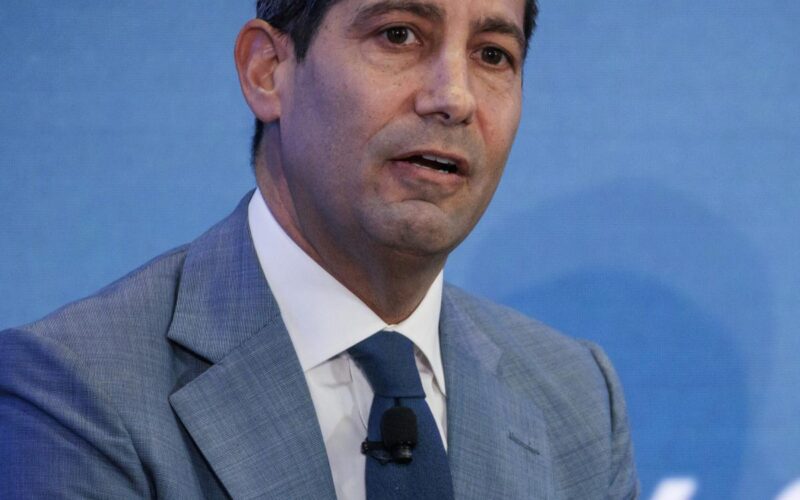
President Trump’s pick to succeed Jerome Powell as chair of the Federal Reserve is an Albany native with an Ivy League pedigree who married into the Estée Lauder fortune.
Kevin Warsh, 55, was among the candidates for the Fed chair job back in 2017, when Trump passed him over in favor of Powell — explaining that part of the problem was that Warsh looked too young for the job.
This time around, Trump — who has soured on Powell over the central bank’s reluctance to slash interest rates — has warmed to Warsh, a well-connected investment banker with ties to some of Wall Street’s most powerful players.
From Wall Street to Washington
After graduating from Stanford and then Harvard Law School, Warsh worked in the mergers and acquisitions group at Morgan Stanley for seven years, eventually becoming the unit’s vice president.
In 2002, he left Morgan Stanley to join the George W. Bush White House as a senior economic policy aide.
That same year, Warsh wed Jane Lauder, the daughter of billionaire Estée Lauder cosmetics heir Ronald Lauder, the Republican mega-donor and former US ambassador to Austria.
Lauder has had a decades-long relationship with Trump, as both studied together at Wharton Business School.
Inside the Fed as the system cracked
In 2006, Bush nominated Warsh to the position of Fed governor, making him, at age 35, one of the youngest in Fed history to be confirmed by the Senate.
During the 2008 financial crisis, Warsh, who had the ear of then-chair Ben Bernanke, used his Wall Street connections to help broker the sale of failing banks.
Fed watchers credited Warsh with acting as a liaison as he helped facilitate JPMorgan Chase’s acquisition of Bear Stearns.
The Lehman line
Warsh also advocated against a bailout of Lehman Brothers, the highly leveraged investment bank that was overexposed to real estate and mortgage-linked assets just as the housing market collapsed.
As panic mounted over Lehman’s fate in September 2008, Warsh privately argued that another bailout would reinforce the belief that Wall Street firms would always be protected, writing in an internal message, “I hope we don’t protect anything.”
His posture placed him on the side of officials who believed allowing Lehman to fail would restore market discipline — an outcome that proved catastrophic, as the bankruptcy triggered a global credit freeze and forced regulators to reverse course days later with the rescue of AIG.
Wall Street executives and senior Fed officials later praised Warsh for his steady hand during the turmoil, describing him as calm, direct and unflappable as markets unraveled.
Lloyd Blankfein, then the CEO of Goldman Sachs, said Warsh remained composed at “chaotic moments,” while former Fed vice chair Don Kohn credited him with knowing when bankers were delivering real information versus “arguing their book.”
Why Warsh walked away from the Fed
Warsh’s break with the Fed came after the crisis, when he emerged as a vocal critic of the central bank’s increasingly aggressive use of unconventional tools.
In 2010, he opposed the Fed’s second round of quantitative easing, known as QE2 — a $600 billion bond-buying program aimed at jump-starting growth — arguing that the emergency phase had passed and that continued stimulus risked distorting markets, fueling future inflation and blurring the line between monetary and fiscal policy.
He resigned from the Fed in March 2011, three years before his term was set to expire, a move widely interpreted as a protest against the program.
Warsh has also said the Fed’s expanding footprint in financial markets undermined its independence by drawing it deeper into politically sensitive decisions.
More recently, however, Warsh has signaled a shift in tone, aligning himself more closely with Trump’s push for lower interest rates.
While still stressing the importance of credibility and independence, he has argued that rates could be significantly lower if the Fed moved more aggressively to shrink its balance sheet.