



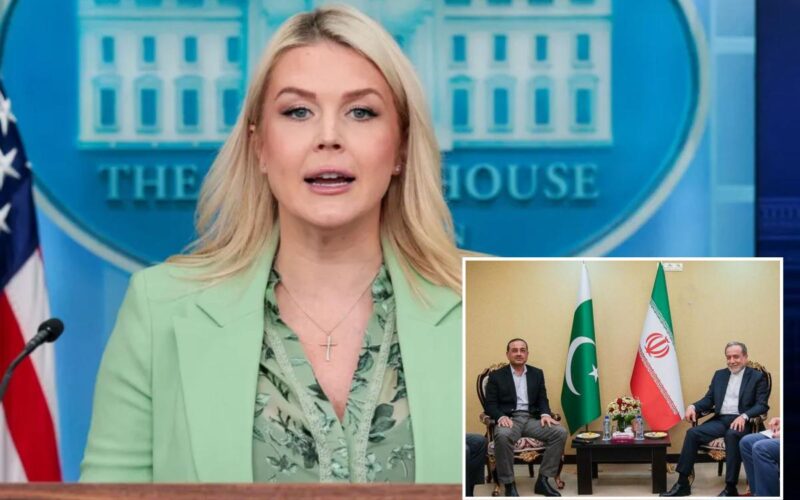
WASHINGTON — White House press secretary Karoline Leavitt claimed Wednesday that the Trump administration is optimistic about the prospect of reaching a deal to end its seven-week war with Iran.
“We feel good about the prospects of a deal,” she told reporters during her regular briefing. “It’s obviously in the best interest of Iran to meet the president’s demands.”
Leavitt also denied what she called “bad reporting” that the administration has sought a cease-fire extension as the two-week pause in fighting nears its expiration April 22.
“That is not true at this moment,” Leavitt told reporters. “We remain very much engaged in these negotiations, in these talks.”
Pakistani military officials traveled to Iran earlier Wednesday to try to nail down arrangements for additional talks in Islamabad as soon as this weekend.
“The Pakistanis have been incredible mediators throughout this process, and we really appreciate their friendship and their efforts to bring this deal to a close,” Leavitt further stressed. “So they are the only mediator in this negotiation.”
Initial talks in Pakistan’s capital, led by Vice President JD Vance on the US side, wrapped up after 21 hours last weekend without an agreement.
President Trump has made clear that the US has insisted Iran give up its nuclear program as part of a longer-term peace deal.
In all, the US has laid out six “red lines” that any agreement must include: Iran ending all of its enrichment of uranium, dismantling its nuclear facilities, retrieving any highly enriched uranium buried underground, participating in a broader peace framework with regional powers, cutting off funding for terrorist proxies like Hamas and Hezbollah, and fully reopening the Strait of Hormuz.

On Sunday, due to frustrations with Iran reportedly charging tolls on vessels passing through the Strait of Hormuz, through which more than a fifth of the world’s seaborne oil flows annually, Trump announced a blockade effective at 10 a.m. ET Monday.
“Effective immediately, the United States Navy, the Finest in the World, will begin the process of BLOCKADING any and all Ships trying to enter, or leave, the Strait of Hormuz,” Trump declared on Truth Social.
Leavitt clarified Wednesday that the blockade is specific to “all Iranian ports on the Arabian Gulf and the Gulf of Oman” and that vessels from “non-Iranian ports” are allowed through.
“We are supporting the freedom of navigation, just not with respect to any tanker or vessel that would benefit the economy of Iran, as these negotiations continue,” she stressed.
According to US Central Command, the blockade had been “fully implemented” as of Tuesday night, with no vessels making it past US forces and nine ships obeying orders to turn around and return to Iranian ports or coastal areas as of 11 a.m. ET Wednesday.