




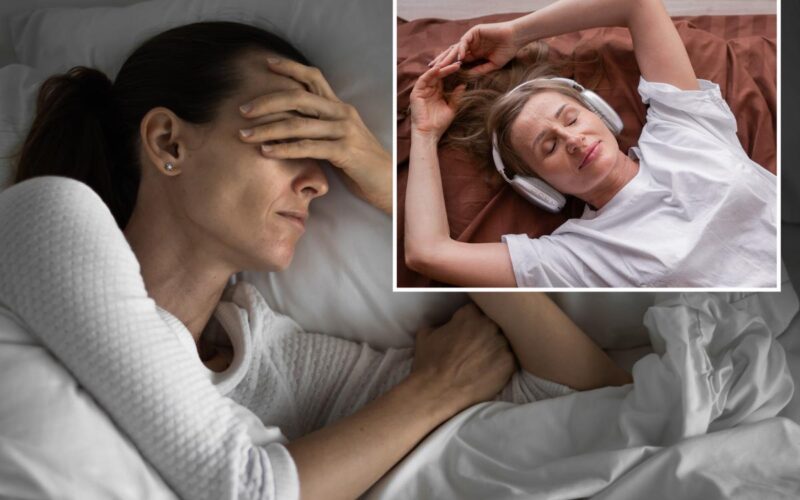
Getting to sleep often takes longer than a beat.
With 1 in 3 adults struggling to snooze, it’s no wonder many will try anything to get the recommended seven to nine hours or fall asleep fast.
Binaural beats could be the solution to nabbing a full night’s rest — and they don’t rely on counting sheep.
While the name implies a sound, it’s more of an auditory illusion when two acoustic signals of slightly different frequencies are played simultaneously in each ear.
What happens next is a completely different third sound, the result of your brain falling into synchrony with the difference.
For example, 300 Hertz (Hz) played in one ear and 310 Hz in the other creates a 10 Hz binaural beat.
It’s thought that this unique trick can help with meditation, relaxation, focus, stress relief and even sleep by altering the brain.
The two tones have to be at a frequency of less than 1,000 Hz, with the difference between each beat no more than 30 Hz.
Plus, each tone has to be listened to separately in each ear.

The idea is that when played for a period of time, the difference between beat frequencies can retrain brainwaves, promoting a state of focus or relaxation.
There are five main brainwaves classified by frequency and measured by the number of vibrations or waves per second that correspond to different states of mind:
- Delta (0.5 to 4 Hz) happens during deep sleep
- Theta (4 to 8 Hz) is associated with drowsiness, falling asleep or meditation
- Alpha (8 to 14 Hz) happens while awake but relaxed
- Beta (14 to 38 Hz) is linked to active thinking and problem-solving
- Gamma (38 to 80 Hz), the fastest waves that happen during intense focus
Some evidence that these psychoacoustic phenomena actually help sleep is fairly limited, but other research has shown promising results.
Early research suggested that it can help people fall asleep and relieve anxiety.
One study using binaural beats at a frequency of 3 Hz induced delta brainwaves, which lengthened stage three sleep, or deep sleep, necessary for feeling well-rested in the morning.
Meanwhile, another study found that tones ranging from 2 Hz to 8 Hz improved quality of sleep and helped participants wake up more easily and less groggy.
Better sleep is paramount to health — not logging enough hours can lead to a shorter life expectancy.
Poor sleep can also raise your risk of chronic health problems like heart disease, high blood pressure, diabetes and obesity.
There are numerous binaural beat soundtracks available online, as well as CDs and audio files that may be mixed with white noise for a relaxing environment.