



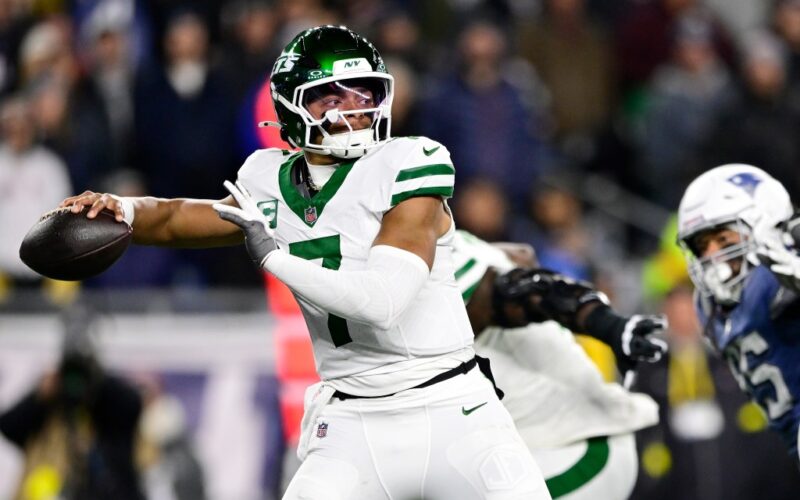
When the Jets dealt both Sauce Gardner and Quinnen Williams two weeks ago, it was on to 2026.
At 2-8, the Jets are certainly going to miss the playoffs for the 15th consecutive season.
After trading Gardner and Williams, the Jets now have a combined five first-round picks between the 2026 and 2027 NFL Drafts. However, the most critical position they need to find is their long-term solution at quarterback.
Gang Green was in a similar position before, with an abundance of draft capital after trading safety Jamal Adams. In 2021, the Jets had two first-round picks and selected quarterback Zach Wilson and offensive lineman Alijah Vera-Tucker. The following year, the Jets also drafted Gardner, wide receiver Garrett Wilson, and pass rusher Jermaine Johnson, all in Round 1.
Since the 2021 season, the Jets have a 25-53 record, which is the second-worst in the NFL during that span (Giants, 24-54-1). Vera-Tucker, Wilson, and Johnson have all become productive players, but whiffing on Wilson is the reason the Jets find themselves back at this exact position still without a franchise quarterback.
With coach Aaron Glenn and general manager Darren Mougey now in charge, the Jets will have to decide whether to draft a quarterback in 2026 or 2027. Additionally, they will likely need to find an alternative solution as a bridge quarterback, as Justin Fields has not been the answer and is in danger of being benched for the Jets’ Week 12 matchup against the Ravens.
Let’s examine all the possible quarterback options for the Jets.
Add different bridge quarterback and wait to draft quarterback in 2027
The Jets signed Fields to a two-year, $40 million contract last March, hoping he could be the next quarterback to perform well in a different zip code, similar to Baker Mayfield and Sam Darnold, but his tenure with the Jets has been mostly disastrous.
With Fields under center, the Jets are averaging 139.9 passing yards per game, which is dead last in the league. That would be the lowest in the NFL since the 2022 Bears averaged 130.5 yards per game when Fields was also the quarterback in Chicago.
It is not sustainable in today’s NFL to throw for less than 150 yards per game and expect to win games. This is why Glenn could be mulling a quarterback change, which would signal the end of the Fields era.
If the Jets release Fields, many would think they would be in line to select one in the 2026 NFL Draft. However, the Jets are currently fifth in the draft order, according to Tankathon. If many of the quarterbacks decide to return to school, they could wait until 2027 to select one when they will have three first-round picks, including the Colts and Cowboys picks.
Assuming that is the case, the Jets could decide to add an available bridge quarterback option for 2026 while also putting talent around that player. A quarterback who could be available next offseason is Arizona’s Kyler Murray, who is owed $42.5 million next year, with most of the amount already guaranteed.
A cheaper bridge quarterback option would be 49ers quarterback Mac Jones. After Brock Purdy suffered a right big toe injury, Jones started eight games for San Francisco, and he passed for 2,151 yards, 13 touchdowns, and six interceptions.
Unlike Fields, Jones isn’t afraid to throw the ball down the field and would be a good fit for the Jets run-heavy offense. But he is under contract with the 49ers for the 2026 season. So the Jets would have to swing a trade to acquire Jones, something the 49ers could be hesitant to do with the lack of quality backups around the league.
If the Jets wait until 2027 to draft a quarterback, Ohio State’s Julian Sayin is projected to be among the first players selected. Sayin’s game is similar to Bengals quarterback Joe Burrow, who can also make short, intermediate, and downfield throws at a high level. Sayin has become this year’s Heisman favorite after passing for 2,675 yards, 25 touchdowns, and four interceptions while completing 80.1% of his passes for the Buckeyes.
Texas quarterback Arch Manning also could be an option for the Jets in 2027 if they wait to draft a signal-caller.
Drafting quarterback in 2026 and keeping Justin Fields
Indiana’s Fernando Mendoza, Oregon’s Dante Moore, Alabama’s Ty Simpson, and South Carolina’s LaNorris Sellers — all have eligibility beyond the 2026 season. But that doesn’t mean they will also decide to return to school.
Mendoza fits the Jets’ offense the best with his precision passing and ability to throw into tight windows to get the ball to his receivers. At 6-5, 225 pounds, Mendoza also has prototypical size and good enough athleticism to evade defenders inside the pocket.
The Jets brass, including Mougey and senior football advisor Rick Spielman, attended the Nov. 8 game between Indiana and Penn State to watch Mendoza in person. Mendoza passed for 218 yards with one touchdown and one interception against Penn State, but it was his fourth-quarter game-winning touchdown pass to Kaelon Black that gave the Hoosiers the 27-24 victory.
If the Jets do indeed draft Mendoza, they will need a veteran quarterback on the roster to ease the transition since current backup Tyrod Taylor will be a free agent after this season. That’s why keeping Fields could be a possibility.
The Jets are already on the hook for $10 million of Fields’ $20 million base salary for 2026, which is why they could remain on the roster.
Final prediction
Having multiple options for both 2026 and 2027 is excellent for the Jets, as it will provide them with considerable flexibility. Depending on their draft order and the outcome of free agency, the Jets may wait until 2027 or decide to draft Mendoza or Simpson, both of whom would fit well in their offense.
Waiting to select a quarterback could be a smart move for the Jets, as 2027 may provide them with various options. However, if you fall in love with a quarterback and have a chance to draft them in 2026, the Jets should do it.
No one knows what could happen in 2027 and the Jets need to give their fans hope after missing the playoffs for the last decade and a half. They will have a projected $72 million of salary cap space to spend, according to Over the Cap.
Drafting Mendoza and attempting to swing a trade with the 49ers for Jones appears to be the best path to success. Having Jones would mean Mendoza could sit and watch as he acclimates to the speed of the NFL. It would also give Jones a chance to start and eventually get a larger payday with another team after 2026.
In addition to spending to improve their roster, the Jets have enough draft picks over the next two years to find several quality starters, utilizing their early draft picks to upgrade their roster. They have to hope they can finally find their long-term solution at quarterback, since it is the most critical position in sports.