

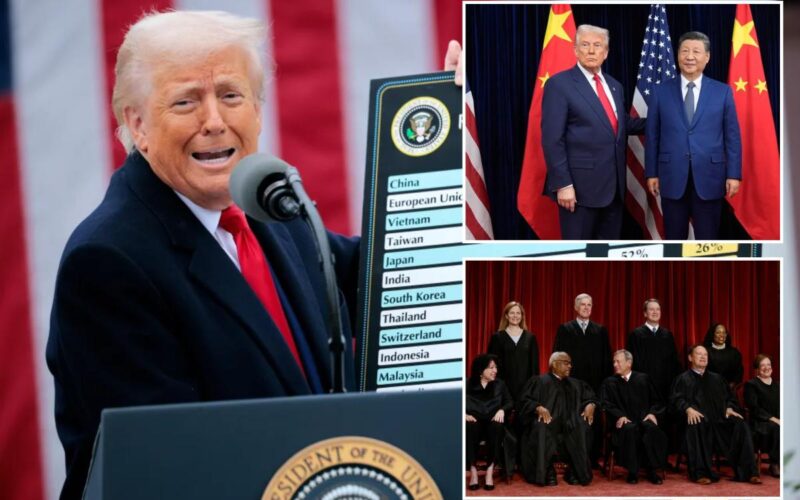
WASHINGTON — President Trump’s global trade agenda ran into a wall Friday as the Supreme Court struck down his “reciprocal” trade and anti-fentanyl tariffs.
The 6-3 ruling by the court puts at risk an estimated $175 billion already collected over the past year and jeopardizes the fate of Trump’s trade pacts with major partners, many of which have not been ratified.
The court found that Trump exceeded his authority using the International Emergency Economic Powers Act (IEEPA) to declare “national emergencies” related to trade imbalances and drug smuggling.
Trump’s fentanyl tariffs targeted China, Canada and Mexico for doing too little to stop the flow of illicit fentanyl, which had killed 330,000 Americans over the preceding five years, and his “reciprocal” tariffs announced last April sought to equalize long-standing trade imbalances.
The fentanyl tariffs elicited vows of increased anti-smuggling cooperation from the three countries and his reciprocal tariffs resulted in the brokering of massive trade deals with nearly all of America’s largest trade partners, which vowed to break down trade barriers to US imports.
Trump officials have for months said they would seek to resurrect tariffs under different legal authorities if the Supreme Court ruled against them, but the defeat creates significant uncertainty about what comes next.
When can consumers see tariff refunds?
Likely never.
Consumers have paid higher prices since last year after US businesses hiked prices in anticipation of higher tariff rates, including a new 10% baseline on most countries adopted last April and higher country-specific rates rolled out in August.
Businesses that paid the higher tariff rates, however, are expected to seek refunds.
“[T]he Court’s decision is likely to generate other serious practical consequences in the near term. One issue will be refunds,” dissenting Justice Brett Kavanaugh wrote.
“Refunds of billions of dollars would have significant consequences for the U.S. Treasury. The Court says
nothing today about whether, and if so how, the Government should go about returning the billions of
dollars that it has collected from importers. But that process is likely to be a “mess,” as was acknowledged at oral argument.”
Kavanaugh added: “A second issue is the decision’s effect on the current trade deals. Because IEEPA tariffs have helped facilitate trade deals worth trillions of dollars—including with foreign nations from China to the United Kingdom to Japan, the Court’s decision could generate uncertainty regarding various trade agreements. That process, too, could be difficult.”
Are any Trump tariffs unaffected by the ruling?
The court case, brought by an educational toy company, only directly asked the justices to analyze the “reciprocal” and fentanyl tariffs.
Other Trump tariffs applied under IEEPA could be at-risk as a result of subsequent proceedings, including the 50% tariff Trump applied to Indian goods last year over the country’s import of Russian oil and the 50% tariff slapped on Brazil over online censorship and the prosecution of ex-president Jair Bolsonaro.
Many of Trump’s major tariffs aren’t impacted, however.
Trump’s 25% tariffs on most foreign-made vehicles was adopted under a different legal authority and remains in effect.
The car tariffs give Trump leverage to keep intact major pending trade deals due to the fact that he agreed to lower the vehicle tariff for Japan, South Korea, the UK and the European Union under new trade deals.
Other tariffs remaining in effect include Trump’s 50% tariff on steel, aluminum and cooper.
What happens to Trump spending that was built on tariff revenues?
Trump has boasted repeatedly about his ability to redirect tariff revenue flowing into the country — and suggested he’s putting it to good use.
In December, Trump announced plans to distribute $12 billion to farmers impacted by his trade war. That plan is now cast into uncertainty.
He also claimed that $1,776 Christmas bonuses for military members would be taken from tariff revenue, though later reporting indicated it was instead taken from military funding.