



By DEEPA BHARATH
Holi, widely known as the Hindu festival of colors, is a joyful annual celebration at the advent of spring with cultural and religious significance.
Typically observed in March in India, Nepal, other South Asian countries and across the diaspora, the festival celebrates love and signifies a time of rebirth and rejuvenation — a time to embrace the positive and let go of negative energy.
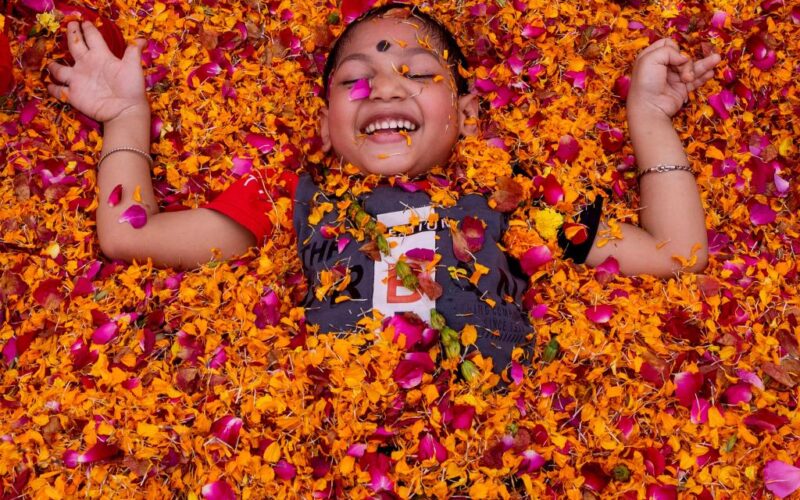
For one of Holi’s most well-known traditions, celebrants clad in all white, come out to the street and throw colored powders at each other, leaving behind a kaleidoscope of pigments and joy. Festivities with music, dancing and food ensue.
Holi is celebrated at the end of winter and the beginning of spring, on the last full moon day of the Hindu luni-solar calendar month of Falgun. The date of the festival varies depending on the lunar cycle. Typically, it falls in March, and will be celebrated this year on March 4.
-
Third Gender members of Kinnar Akhara play with colored powder during celebrations marking Holi, the Hindu festival of colors, in Prayagraj, in the northern Indian state of Uttar Pradesh, India, Sunday, March 1, 2026. (AP Photo/Rajesh Kumar Singh)


1 of 4
Third Gender members of Kinnar Akhara play with colored powder during celebrations marking Holi, the Hindu festival of colors, in Prayagraj, in the northern Indian state of Uttar Pradesh, India, Sunday, March 1, 2026. (AP Photo/Rajesh Kumar Singh)
Holi has its origins in Hindu mythology and lore
In many parts of India, people light large bonfires the night before the festival to signify the destruction of evil and victory of good. Different mythological tales point to the reason behind this observance.
In one story, the king, Hiranyakashipu, ordered everyone in his kingdom to worship him and was irked when his own son Prahlad, a devotee of Lord Vishnu, disobeyed his command. So, he ordered his sister Holika who was immune from fire to take the child, Prahlad, into a bonfire while holding him in her lap. However, when the pyre was lit, the boy’s devotion to Lord Vishnu protected him and left him unscathed while Holika, despite her immunity, burned to death.
In another southern India tradition, the event is known as Kama Dahanam to commemorate Lord Shiva burning Kamadeva, the god of love, with his third eye. It symbolizes the destruction of lust and other earthly attachments for a higher spiritual purpose, preceding the joy of colors.
Some also consider Holi a reference to Lord Krishna and his love for his beloved, Radha, and his cosmic play with his consorts and devotees called “gopikas,” who are also revered for their unconditional love and devotion to Krishna.
How is the festival of colors celebrated?
On the day of Holi, entire streets and towns are filled with people who throw colored powder in the air. Some fling balloons filled with colored water from rooftops and others use squirt guns. For one day, it’s all fair game. Cries of “Holi hai!” which means “It’s Holi!” can be heard on the streets. Holi has also been romanticized and popularized over the decades in Bollywood films.
The colors seen during Holi symbolize different things. Blue represents the color of Lord Krishna’s skin while green symbolizes spring and rebirth. Red symbolizes marriage or fertility while both red and yellow — commonly used in ritual and ceremony — symbolize auspiciousness.
An array of special foods are part of the celebration, with the most popular food during Holi being “gujia,” a flaky, deep-fried sweet pastry stuffed with milk curd, nuts and dried fruits. Holi parties also feature “thandai,” a cold drink prepared with a mix of almonds, fennel seeds, rose petals, poppy seeds, saffron, milk and sugar.
Holi is celebrated in the diaspora with worship and social gatherings
In North America and in any country with a Hindu population, people of Indian descent celebrate Holi with Bollywood parties and parades, as well as a host of public and private gatherings. Several U.S. temples will observe Holika Dahan this year on Feb. 2 or Feb. 3 to coincide with the full moon day and a total lunar eclipse, which is rare.
It is also common for Hindu temples and community centers in the U.S to organize cultural programs, friendly cricket matches and other festivities around the holiday.
Associated Press religion coverage receives support through the AP’s collaboration with The Conversation US, with funding from Lilly Endowment Inc. The AP is solely responsible for this content.