


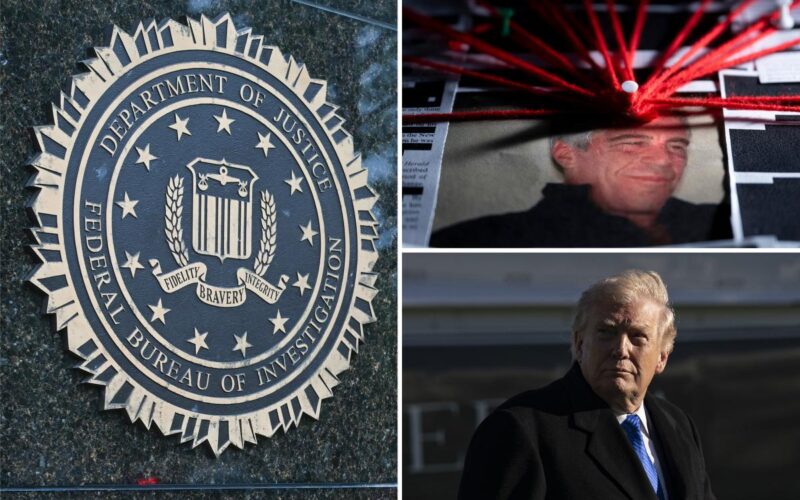
Members of Congress have accused the White House of covering up allegations contained in “missing” FBI files by a woman who said she was sexually abused by Jeffrey Epstein and Donald Trump while she was a teenager living in South Carolina during the 1980s.
The 37 pages, which aren’t public but have been reviewed by The Post, include sickening claims that Epstein began abusing the woman during a visit to Hilton Head Island when the accuser was just 13 and forced her to perform oral sex on Trump.
Sen. Sheldon Whitehouse (D-RI) claimed Monday in a video statement that the DOJ was “holding back” investigative materials that will reveal more of “what really went on” — and wrote a letter demanding the preservation of all documents.
But the allegations, first memorialized in an FBI agent’s handwritten notes in the summer of 2019, are already contained in other publicly available memos and there’s no evidence that the woman — whose identity is known to The Post — ever met Epstein or Trump.
There are also no public records or accounts showing the financier spent summers in the 1980s on Hilton Head.
Further, a friend of the woman who acknowledged spending time with her there could not corroborate a key claim that the two attended a Rick James concert with Epstein — and declined to answer other questions.
Additionally, the female accuser voluntarily quit discussing the alleged sexual abuse with the bureau after seeking to join a civil lawsuit against Epstein’s estate.
The woman wasn’t compensated as part of a fund set up by the executors of Epstein’s estate that benefited more than 100 victims. It’s unclear whether she received a separate settlement.
Despite having access to the claims in memos that FBI agents typed up after each interview, known in bureau parlance as “302 forms,” lawmakers like Rep. Robert Garcia (D-Calif.) still claim the DOJ “illegally withheld” information about “heinous crimes” committed by Trump.
“We are witnessing a White House cover-up of serious allegations against the president by a survivor,” said Garcia, the top Democrat on the House Oversight Committee, in a statement to NPR, which first reported last month on the “missing Epstein files.”
Committee members have also cited the “missing” documents to argue that Trump should be forced to testify before Congress — and to force a bipartisan vote subpoenaing Attorney General Pam Bondi for testimony. (Bondi is scheduled to sit for a deposition April 14.)
The White House has called the woman’s accusations “baseless” and “backed by zero evidence.”
The Epstein Files Transparency Act, signed by Trump in November 2025, requires the Justice Department to make all of its documents related to Jeffrey Epstein public. DOJ reps have emphasized that any pages withheld from the public have been “duplicates, privileged, or part of an ongoing federal investigation.”
Every page made public is tagged with a so-called “EFTA” number, but even after the release of the additional 302s, 37 pages appeared to be missing from the sequence of documents about the woman’s claims, as NPR first reported.
The 37 pages of documents consist of three separate sets of handwritten notes that are 18, 15, and four pages long.
One of the two FBI agents who prepared the 302 reports didn’t respond to requests for comment. The other could not be reached.
What the 37 pages of handwritten notes say
The notes cover the first three interviews with the accuser at meetings in Washington State between July 24 and August 20, 2019. The woman got in touch with the FBI shortly after Epstein’s arrest on federal sex-trafficking charges July 6 of that year.
Though largely matching 302 forms already made public by the Justice Department, the handwritten notes contain two additional details about the accuser’s life — a brief school trip to Washington, DC, and a road trip she took with a friend to New Jersey.
Notes from the FBI’s fourth interview with the woman, which was conducted on October 16, 2019, and appeared to be significantly shorter than the other meetings, are not part of the 37 pages — but are available in the 302 files recounting the meeting.
In that final meeting, the woman showed up without a lawyer and said she was in the process of obtaining a new attorney to represent her in a civil lawsuit against the Epstein estate. She declined to continue discussing her allegations against Trump and expressed doubt that the FBI would take any action about her claims, in part, because the statute of limitations would have run out, according to the FBI’s typed notes.
“[Redacted] again asked what the point would be of providing the information at this point in her life when there was a strong possibility nothing could be done about it,” the FBI 302 of the fourth meeting stated.
The FBI files on the Epstein accuser
According to the 302 reports, the woman told FBI agents that Epstein repeatedly abused her over the course of several years as he summered in a rental house at the well-known vacation destination.
There are no other records in the DOJ’s Epstein files of the notorious financier visiting Hilton Head in the 1980s — about a decade before the earliest known claims of sexual abuse were brought against him.
The woman also claimed she bumped into Epstein at a Rick James concert in Savannah, Ga., in about 1985 while she was with a friend and her friend’s mother.
She told the FBI that Epstein gave her alcohol and “isolated” her from her friend and the mother. The accuser claimed to have spent the night in jail after police found her walking around intoxicated and said she had been picked up the following morning by family members.
Asked whether she spent time with the accuser in Hilton Head, the friend could not recall the incident, saying: “I have no idea what you are talking about. I have never been to a Rick James concert.”
Teasing out the Trump allegations
The female accuser also told the FBI that, on one occasion, Epstein drove or flew her to New York or New Jersey, where she met Trump “in a very tall building with huge rooms.” Trump forced her to perform oral sex and she bit his penis, she alleged in one of her interviews.
When pressed to provide more details about her interactions with Trump in the Aug. 20, 2019, interview, she mentioned received threatening phone calls from strangers but was unsure if Trump had any involvement in them.
The woman’s claims resemble allegations brought by “Jane Doe 4” against Epstein’s estate in a lawsuit that same year.
In a June 2021 court filing, Arick Fudali, an attorney at The Bloom Firm who represented the accuser, said the woman’s claim was rejected by the Epstein Victims’ Compensation Program.
That program was established with funds from Epstein’s $630 million estate and paid $125 million to 136 different women who accused Epstein of sexual misconduct.
The estate has additionally settled claims from dozens of women outside of the program, attorneys for the executors have said.
It isn’t clear from court documents whether the woman — one of eight who initially accused Epstein in December 2019 — received any money from the estate. She withdrew her claims in December 2021 and did not respond to multiple requests for comment.
Richard Kahn, one of the co-executors of Epstein’s estate, gave differing answers during a deposition before the House Oversight Committee earlier this month about whether she received a settlement from the estate, according to Democrats on the committee.
Daniel Ruzumna, an attorney for Kahn, told committee staff members after the March 11 deposition that he could not confirm whether the estate ever reached a settlement with the woman.
Fudali and Ruzumna declined to comment. Garcia, Whitehouse, and reps for Democrats and Republicans on the Oversight Committee didn’t respond to requests for comment.