



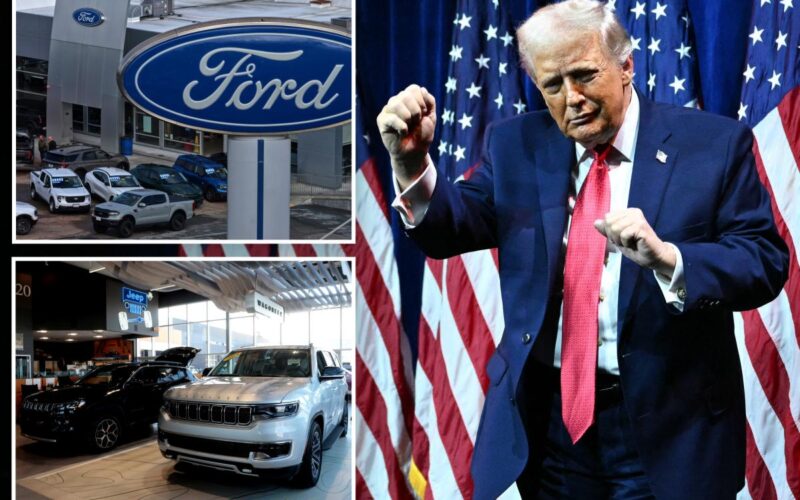
Sales of new vehicles in the US jumped about 2% in 2025, according to a new analysis – despite panicked warnings that President Trump’s tariffs would pummel the auto industry.
The White House boasted that Trump’s policies were to thank for the uptick, but many automakers said they haven’t fully passed along tariff costs to consumers yet – and analysts are warning that sales could slump once those price hikes hit this year.
“Most vehicle sales metrics in 2025 were slightly stronger than many forecast – including us,” Jeremy Robb, interim chief economist at Cox Automotive, said in a Tuesday statement.
About 16.2 million new vehicles sold in the US in 2025, up 2.2% from the previous year, according to Cox Automotive, fueled by demand for gas-powered trucks, SUVs and hybrids.
However, Cox Automotive expects US auto sales to decline 2.4% this year as tariffs begin to take a toll. Edmunds, an online car review and vehicle pricing site, said it expects steady or lower sales in 2026.
“While most vehicle sales figures in 2025 exceeded expectations, the outlook for 2026 suggests a slowdown across many important metrics,” Cox stated.
Steep price tags
Last month, the average new-vehicle retail transaction price was estimated to reach $47,104 – up 1.5% or $715 from December 2024, according to JD Power, an auto data analytics firm.
Kelley Blue Book placed the average cost of a new ride at $49,740 in December, slightly down from a jaw-dropping $50,080 in October.
The steep price tags have led to some canceled sales and mounting delinquencies on payments while consumers face ongoing economic uncertainty.
Still, General Motors, Lexus and Toyota reported annual US sales increases of 5.5%, 7% and 8%, respectively.
Hyundai reported a record year of US retail sales, Honda Motor saw its best year since 2021 and Ford notched its highest annual sales since 2019.
Stellantis, which owns brands including Ram and Dodge said sales fell 3.3%. But its Jeep brand reported its first US annual sales gain since 2018.
Trump touts tariff triumph
Coming in the wake of doom-and-gloom predictions about the impact of Trump’s tariffs, the White House sounded a triumphant note on Tuesday.
“These so-called ‘experts’ could not have been more wrong,” it said in a statement. “Automakers are thriving.”
“This success validates President Trump’s all-out push to Make Driving Great Again.”
It cited several Trump policies targeting the auto industry, such as tax deductions on auto loan interest payments, looser fuel economy standards, the end of a $7,500 EV tax credit and billions spent on US manufacturing from automakers seeking to avoid tariffs.
Automakers scrapped major plans for electric vehicle production in the US after Trump announced he would end the $7,500 federal tax credit for EVs, which expired in September. Analysts attribute a spike in EV sales earlier this year to the policy change, with consumers snatching them up before the tax credit ended.
General Motors said last summer it would use some plants originally slated for EV manufacturing to ramp up production of gas models. It was hit with a $1.6 billion charge due to the change in plans and said it expected more charges in the future.
Stellantis and Ford also killed their costly EV programs on a dime. The latter said it would take a $19.5 billion hit after scrapping a fully-electric version of its F-150 Lightning pickup, as well as a new electric truck and van.
“We had to come up with a better plan,” Ford CEO Jim Farley told Reuters earlier this year.
Sales face headwinds in 2026
Some automakers are also preparing to pass along tariff costs to consumers.
Toyota Motor North America has so far absorbed added tariff costs, but executives have said they can’t hold out much longer – and they’re expecting higher prices to dig into sales next year.
About 23% of its vehicles are imported from Japan, which is currently facing a 15% tariff, while imports from Mexico and Canada – which have a 25% tariff – account for roughly 28% of its sales.
When it comes to shifting more production to the US, the company is “capped out,” Andrew Gilleland, senior vice president of automotive operations was quoted as saying by Automotive News.
“The manufacturing people are going gray trying to figure out how to tweak it a little bit to get an extra 1 or 2%, but we’re close to max,” he said.
“Prices can’t stay the same with a 15% tariff. It’s just impossible for any brand to absorb that, there’s not enough margin in the car,” said Dave Christ, head of Toyota’s US division.